
I really really figured that if I just knuckled down I would be able to overcome the thin width of the the nut on my new 360.
But after trying for about three weeks, I am beginning to worry that it may actually present an insurmountable problem. I have large fingers though they are not fat just large, I figured I would be able to adapt. Maybe I haven't spent enough time or figured out how to adapt.
Right now I am getting a lot of inadvertent muting of adjacent strings and top-of-fingernail-buzzing and etc.
I like this guitar but I think it will need a bunch of modding to fit my liking: Accent & Toasters mostly - but I am starting to think that I might have to resell it it before I put money into it -money which is hard for me to come by.
Anyone have a solution or ways I might figure out how to work with it?
Anyone have the same situation and sell their Rick?
Has anyone ever modded a 360 by adding a 600 -series neck?
Are there ANY 360 models with bigger nut-widths?
I must admit it: neck size issues
Moderators: rickenbrother, ajish4
Re: I must admit it: neck size issues
Sorry to hear of your troubles. Keep at it, it will come. 3 weeks isn't all that long, it took longer than 3 weeks to learn how to play the guitar in the first place, right? Have a touch of patience. One day you'll pick up your 360 and it will feel all comfy and you'll wonder what all the fuss was about.
Jangle, Chime & Twang.

Re: I must admit it: neck size issues
The 660 is going to be it for a wider neck. The 660 is also a 'thru body' neck type.
---------------------------------------------------------------
Music is too important to be left to professionals.
Music is too important to be left to professionals.
-
beatlefreak

- Senior Member
- Posts: 6160
- Joined: Wed Jun 14, 2006 5:45 am
- Contact:
Re: I must admit it: neck size issues
There is a discontinued model, the 380L and 380L-PZ (PZ meaning with a piezo pickup) which has a walnut 360-type body and a wide (650-width?) neck. An ambitious member converted one to a (relatively) wide-neck 12-string:
viewtopic.php?f=1&t=392360&start=0
Another member has (or at least certainly had) 3 wide-neck 12-strings with 360-type bodies.
Note that the 360RCA looks like a 380L (similar walnut body but a different bridge/tailpiece) but seems to have a standard-width neck (same as a 360).
viewtopic.php?f=1&t=392360&start=0
Another member has (or at least certainly had) 3 wide-neck 12-strings with 360-type bodies.
Note that the 360RCA looks like a 380L (similar walnut body but a different bridge/tailpiece) but seems to have a standard-width neck (same as a 360).

Re: I must admit it: neck size issues
"Have a touch of patience. One day you'll pick up your 360 and it will feel all comfy and you'll wonder what all the fuss was about."
I certainly haven't found this to be true with my 360/12, 370/12, 250, 360, or even my 330/12 and I don't think folks who haven't had to deal with the big finger problem have any idea just how frustrating it is. No matter how long you practice, there is a limit to just how carefully you can place your fingers in that narrow space and your fingertips aren't going to get any narrower. As a result, your playing will suffer. At one point, I even remember trying to wrap my fingertips with tape to make them skinnier in order to try to play an unmuffled simple D chord on my first twelve (didn't work and was very uncomfortable). I eventually sold off the 360/6 (which was a lovely guitar) and my 250 (which would blow the doors off of the Tele I replaced it with) for precisely this reason. The Rickenbacker twelve has been my dream guitar since the 1960s and I actually got to the point where I was ready to unload mine and start looking at a Gretch Country Classic Twelve or others.
I ended up sending my 370/12 out to Dr. Arnquist and having him refret it with frets all the way out, over the binding to the edge of the neck and then space the pairs out as far as possible. That was expensive, but it changed the game from "frustrating" to "challenging" and I instantly got a hell of a lot better on the twelve. My 330/12 pretty much hangs on the wall as a spare and gets very little use. This will be the case until it eventually gets shipped out to someone for a similar mod, or a new neck (which I have talked to Paul about and he says it's do-able, but even more expensive).
I won't get into the mode of telling Rickenbacker what they should or should not be doing. They know their market, I dont - but there are some folks with big fingers who have, and will continue to have, serious problems playing some of the instruments in the line. You may be able to practice enough to find ways of dealing with some of it, but you can't just practice it away and expect that one day everything will be hunky-dory. It's simply not going to happen for some of us, so other measures may be required on any Rick you plan to keep. I'm 6'4" tall and wear size 13 shoes, so I'm fairly used to readymade stuff not being available in sizes that fit me. This is just one more case of the same sort of thing, but there are some options that can help if the guitar is going to be a keeper. If not, you may want to sell it and move on - maybe try a 660.
I certainly haven't found this to be true with my 360/12, 370/12, 250, 360, or even my 330/12 and I don't think folks who haven't had to deal with the big finger problem have any idea just how frustrating it is. No matter how long you practice, there is a limit to just how carefully you can place your fingers in that narrow space and your fingertips aren't going to get any narrower. As a result, your playing will suffer. At one point, I even remember trying to wrap my fingertips with tape to make them skinnier in order to try to play an unmuffled simple D chord on my first twelve (didn't work and was very uncomfortable). I eventually sold off the 360/6 (which was a lovely guitar) and my 250 (which would blow the doors off of the Tele I replaced it with) for precisely this reason. The Rickenbacker twelve has been my dream guitar since the 1960s and I actually got to the point where I was ready to unload mine and start looking at a Gretch Country Classic Twelve or others.
I ended up sending my 370/12 out to Dr. Arnquist and having him refret it with frets all the way out, over the binding to the edge of the neck and then space the pairs out as far as possible. That was expensive, but it changed the game from "frustrating" to "challenging" and I instantly got a hell of a lot better on the twelve. My 330/12 pretty much hangs on the wall as a spare and gets very little use. This will be the case until it eventually gets shipped out to someone for a similar mod, or a new neck (which I have talked to Paul about and he says it's do-able, but even more expensive).
I won't get into the mode of telling Rickenbacker what they should or should not be doing. They know their market, I dont - but there are some folks with big fingers who have, and will continue to have, serious problems playing some of the instruments in the line. You may be able to practice enough to find ways of dealing with some of it, but you can't just practice it away and expect that one day everything will be hunky-dory. It's simply not going to happen for some of us, so other measures may be required on any Rick you plan to keep. I'm 6'4" tall and wear size 13 shoes, so I'm fairly used to readymade stuff not being available in sizes that fit me. This is just one more case of the same sort of thing, but there are some options that can help if the guitar is going to be a keeper. If not, you may want to sell it and move on - maybe try a 660.
- Attachments
-
-
Re: I must admit it: neck size issues
Is this unplugged, or is it audible through the amp?pfflam wrote:Right now I am getting a lot of inadvertent muting of adjacent strings and top-of-fingernail-buzzing and etc.
By the way, this debate comes up every year or so. It's a moot point really, since RIC seems to have no trouble selling their guitars as they are currently produced, I doubt they are too keen on changing the specs.
Jangle, Chime & Twang.
Re: I must admit it: neck size issues
I have the same problem and have yet to find a solution for it. I've had 3 Rickenbacker 12-strings models, including the 660/12, as well as a few other electric and acoustic models. The closest I came to getting a nice clean sound was with a Guild acoustic, but now I've just given up on playing 12-string electric guitar.
Re: I must admit it: neck size issues
I have a 330/6. I am not the best player, and a wide nut helps me. I have a Seagull acoustic with a (comically huge) 1.82 width nut, and I can play any chord at any time on it with great ease. So I am very sensative to nut width. But the Ric 330 was my dream, so I picked one up.
I would say it took a full month to get comfortable with it. I just refused to let myself play my acoustic or Strat, and just play the Ric. You have to play every guitar different, and approach them differently. Now it is my #1 and I love playing it, and am used to the differences. The neck size is only part of it; the tiny frets and thick gloss neck take getting used to as well. You can't expect it to happen quickly.
I say give it some more time if you can. If you can't get used to it, don't beat yourself up over it: there are so many guitars out there, there has got to be one that feels perfect. Best of luck
I would say it took a full month to get comfortable with it. I just refused to let myself play my acoustic or Strat, and just play the Ric. You have to play every guitar different, and approach them differently. Now it is my #1 and I love playing it, and am used to the differences. The neck size is only part of it; the tiny frets and thick gloss neck take getting used to as well. You can't expect it to happen quickly.
I say give it some more time if you can. If you can't get used to it, don't beat yourself up over it: there are so many guitars out there, there has got to be one that feels perfect. Best of luck
Re: I must admit it: neck size issues
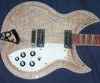
One thing I have found that helps me play my 381/12V69 is to finger the chords a bit differently. It was easier than trying for precision. Get the Roger McGuinn DVD "The 12-String Guitar of Roger McGuinn." He has a few tips. Hope it helps a little. I'm glad I'm blessed with skinny fingers!
Regards, Dave
Rickenbacker 381/12V69
Rickenbacker 360/12V64
Guild JF30-12
Gibson B-25
Gretsch Electrotone Bass
Rickenbacker 381/12V69
Rickenbacker 360/12V64
Guild JF30-12
Gibson B-25
Gretsch Electrotone Bass

Re: I must admit it: neck size issues
I will second Dave's suggestion as the Roger DVD tells how he overcame shortcomings he was having by adjusting chords, using finger picking and being a bit creative. He still says a Rickenbacker 12-string is hard to play and seems to want to let people know what he accomplished with the RIC-12 was no simple feat. But it works for him now. I still hit extra strings and mute notes, but I do that on wide necks too. I'm just a lousy guitar player. But those with skill can do this. My talented neighbor grabbed my old McGuinn sig model 12 and launched into Mr. Tamborine Man without missing a beat or a string. He usually plays a Martin 12 with a much wider neck and has large hands. I think if you mod a few things with your chords and just keep playing it a lot it will start to feel natural soon.
Best,
Manta
Best,
Manta
Re: I must admit it: neck size issues
Thanks forlks
I should mention: I am talking about a 6-string.
I can only imagine what a 12 is like.
I think Dano for 12.
BTW: size 14 boot might explain a few things.
I should mention: I am talking about a 6-string.
I can only imagine what a 12 is like.
I think Dano for 12.
BTW: size 14 boot might explain a few things.
Re: I must admit it: neck size issues
The chord fingering is actually pretty easy and works on most six-strings as well as it does on Rickenbacker twelves. Essentially, you are just covering any side-by-side fingerings with one fingertip, instead of two when it's possible. Em chord - one finger (first, second, or sometimes third, covering both the A and D strings), E - two fingers, adding the first finger on the G string. Am, first and second fingers with the second covering both the D and G strings. A chord - cover the three strings with just two fingers, usually the first covering the D and G strings and the second covering the B string. This allows you to lift the second finger for that hammer-on, as in "Feel A whole Lot Better". The tough ones are still the D, C and F chords, where you need to hit single strings without damping their neighbors. There really aren't any fingering tricks that fix those problems, from what I've been able to tell. Your fingertips either fit cleanly, given the nut width of that guitar, or you have a problem and may need to have something modified.
Covering two strings (or two pairs on a twelve) with one finger has some other advantages. It gives you one more free finger for playing around with hammers and runs as you're playing chords. With some practice and once you're used to it, it will probably become your standard procedure on almost any guitar. I play my Martin twelve, my various six-strings or even the Takamine twelves I owned (with 2" nut widths) using the same chord fingerings that I use on my Rickenbackers because it allows me to do more.
Also - A couple of my basses are usually set up with round-wound strings. I found that if I practice a lot on them, my callouses tend to get bigger and it makes it harder to play my guitars cleanly. I still leave the rounds on them, but do most of my practicing using other basses with flats and just use the rounds when I want that sound for a recording.
Covering two strings (or two pairs on a twelve) with one finger has some other advantages. It gives you one more free finger for playing around with hammers and runs as you're playing chords. With some practice and once you're used to it, it will probably become your standard procedure on almost any guitar. I play my Martin twelve, my various six-strings or even the Takamine twelves I owned (with 2" nut widths) using the same chord fingerings that I use on my Rickenbackers because it allows me to do more.
Also - A couple of my basses are usually set up with round-wound strings. I found that if I practice a lot on them, my callouses tend to get bigger and it makes it harder to play my guitars cleanly. I still leave the rounds on them, but do most of my practicing using other basses with flats and just use the rounds when I want that sound for a recording.
Re: I must admit it: neck size issues
That's all great advice. But to tell you the truth, I have a Tele with a pretty wide neck that I custom ordered and I have been using that technique even on that guitar: I always have used that technique (my fingers are pretty big, they're slender but my hands are big) . . . and yes its a great technique, and it is the only way I imagine I will be able to make this Rick work (something I am finding is coming along slowly)

Re: I must admit it: neck size issues
“I certainly haven't found this to be true with my 360/12, 370/12, 250, 360, or even my 330/12 and I don't think folks who haven't had to deal with the big finger problem have any idea just how frustrating it is. No matter how long you practice, there is a limit to just how carefully you can place your fingers in that narrow space and your fingertips aren't going to get any narrower”
I agree with Todd: in some ways it’s no matter of practice.
I’m about 6’4” too, my fingers are not too large but very long. This is the reason why I never got a 320 style, the guitar who start my love for Rickenbackers...
I always liked (and still do) be driven from the guitar I’m playing, be a rick, a strat, a tele or sg:
to me this is the best way to capture the character of the instrument.
But I play confortable with guitars who have wide and fat neck and I have to admit that few of my Rickenbackers give me some troubles.
I’m not in “frustrating fase”, more a “challenging” one to me. Among my Rickies there’s no two who have the same neck profile, ranging from very slim (the oldest –and troublest to play – from 60s) to the medium fat (’05 330 BB – the most playable).
I’ve been lucky enough to find a 330/12 with a medium fat neck: this helps me a little on my challenge with 12 strings, otherwise it should be a serious issue…
I agree with Todd: in some ways it’s no matter of practice.
I’m about 6’4” too, my fingers are not too large but very long. This is the reason why I never got a 320 style, the guitar who start my love for Rickenbackers...
I always liked (and still do) be driven from the guitar I’m playing, be a rick, a strat, a tele or sg:
to me this is the best way to capture the character of the instrument.
But I play confortable with guitars who have wide and fat neck and I have to admit that few of my Rickenbackers give me some troubles.
I’m not in “frustrating fase”, more a “challenging” one to me. Among my Rickies there’s no two who have the same neck profile, ranging from very slim (the oldest –and troublest to play – from 60s) to the medium fat (’05 330 BB – the most playable).
I’ve been lucky enough to find a 330/12 with a medium fat neck: this helps me a little on my challenge with 12 strings, otherwise it should be a serious issue…
'66 330/12 FG - '88 330/6 FG - '89 1997 FG - '05 330/6 BB