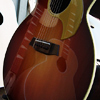
The damage was chalked-up to a battle scar until I noticed chips of paint in the case several months later; upon closer investigation it appears that the impact somehow weakened the bond between the poly and the wood, and the stuff was just flaking off. I figured I should try and get the ding repaired to stop further flaking.
After a month
 at a local "renowned" guitar shop (Colfax Guitar Shop) the deed is done ... and man, it's not pretty. The color match is fairly convincing (dude said he had two attempts) but the edge/wood-to-paint transition is quite a bit darker than the rest of the guitar. I realize CAR is probably one of the hardest finishes to color-match, so I didn't really raise a stink; it looks better than it did.
I'll post some photos tomorrow, but the question I had was this:
Does it matter that they fixed the ding (on a poly finish) with nitro? I told the guy it was poly, but he said they work with nitro because it was "better," and that it wasn't a big deal. Was I bamboozled? Will there be adverse affects over time?
Most things I've read say "don't bother touching-up poly dings," but these guys did it anyway.