
Negative neck pitch
Moderator: jingle_jangle
Negative neck pitch
I have owned several vintage Ricks over the years and I always notice a negative pitch in the neck in relation to the body. the strings are closer to the bridge pickup than the neck pickup. whats your take on this?
Im still looking for my guitar.
-
rickengrowl
- Veteran RRF member
- Posts: 328
- Joined: Sun Nov 04, 2001 4:51 pm
- Contact:
The bridge pickup *should* be set higher than the neck one, because there are less vibrations, thus less signal, over the bridge pickup.
All the best.
All the best.
Bass player for Next (FR)
I don't think that this is what he is refering to Jean .
Many older Ricks have a problem with the bodies of the 330, 360 six and 12 strings having negative neck sets .
This is caused by one or more things .
1- the bracing inside the body is such that it acts like a hinge at the apex oft these braces as they are NOT one piece the length of them .As this intersection is where the bridge pickup is , this void of wood acts as a pivot point to the tension of the strings.This causes the body to curl.
I have just straigthened out/flattened a vintage 4005 that had this problem (see John Williams website for photos of what I did )
2- the tailpiece area in thses hollow body guitars /basses does not have a gluing surface that touches the backs .This also contributes to this curling action.
3- the joint of some of the older guitars in the neck pocket is NOT a perfect fit.Meaning ....the walls of the pocket do not fit like a glove.Only the face and the back of the neck are actually glued .Because of this , the walls of the pocket do not act as a support structurally .This also contributes to this curling.
As the necks were not set at an angle to the body , but rather parallel to the face , this curling shows up over time.
Step to fix this were put into place sometime during the Brian Carman era at Rick (this is 1984 to 1994 or there about ) and the neck pocket was corrected and the bracing was changed .
The new guitars should not have these problems .They are fully aware of it and much has been done to correct this problem.
When the Carl Wilson guitar were issued ...it was one of my big concerns .Looking inside with Dental mirrors , I found guitars with similar type construction as the original guitar , but little things were changed to fix this .
This does NOT mean that ALL Ricks that are hollow , and made before 1984 are defective ....Rather this is something that needs to be known of these instruments .
Gibson guitars have a pitched headstock at two different angles and can snap at the end grain runout of this angle .That does not mean that ALL Gibson guitars are defective .Rather it is something to be aware of .
Fender headstocks over time also curl up ....I have seen some really strange Telecaster necks over the years ...especially old 1950's vintage .
Martin acoustic require neck resets after years of playing , as the tension of the strings pulls the neck into the body , arching the face and squishing the sides.Does this alarm everyone that has a Martin? NO!
If the guitar is to a point where the bridge is sitting on the plate under it , then steps need to be made to correct this .It is time consuming and costly .A major project .BUT ...fixable .
Curled Tele headstocks are NOT fixable , except for steaming them and eventually they return to the curled shape.
This is just something to be aware of .
Many older Ricks have a problem with the bodies of the 330, 360 six and 12 strings having negative neck sets .
This is caused by one or more things .
1- the bracing inside the body is such that it acts like a hinge at the apex oft these braces as they are NOT one piece the length of them .As this intersection is where the bridge pickup is , this void of wood acts as a pivot point to the tension of the strings.This causes the body to curl.
I have just straigthened out/flattened a vintage 4005 that had this problem (see John Williams website for photos of what I did )
2- the tailpiece area in thses hollow body guitars /basses does not have a gluing surface that touches the backs .This also contributes to this curling action.
3- the joint of some of the older guitars in the neck pocket is NOT a perfect fit.Meaning ....the walls of the pocket do not fit like a glove.Only the face and the back of the neck are actually glued .Because of this , the walls of the pocket do not act as a support structurally .This also contributes to this curling.
As the necks were not set at an angle to the body , but rather parallel to the face , this curling shows up over time.
Step to fix this were put into place sometime during the Brian Carman era at Rick (this is 1984 to 1994 or there about ) and the neck pocket was corrected and the bracing was changed .
The new guitars should not have these problems .They are fully aware of it and much has been done to correct this problem.
When the Carl Wilson guitar were issued ...it was one of my big concerns .Looking inside with Dental mirrors , I found guitars with similar type construction as the original guitar , but little things were changed to fix this .
This does NOT mean that ALL Ricks that are hollow , and made before 1984 are defective ....Rather this is something that needs to be known of these instruments .
Gibson guitars have a pitched headstock at two different angles and can snap at the end grain runout of this angle .That does not mean that ALL Gibson guitars are defective .Rather it is something to be aware of .
Fender headstocks over time also curl up ....I have seen some really strange Telecaster necks over the years ...especially old 1950's vintage .
Martin acoustic require neck resets after years of playing , as the tension of the strings pulls the neck into the body , arching the face and squishing the sides.Does this alarm everyone that has a Martin? NO!
If the guitar is to a point where the bridge is sitting on the plate under it , then steps need to be made to correct this .It is time consuming and costly .A major project .BUT ...fixable .
Curled Tele headstocks are NOT fixable , except for steaming them and eventually they return to the curled shape.
This is just something to be aware of .
So you too want yours "ALAPWOB"?!?!
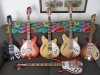
This symptom shows up as this - the bridge pickup is closer to the boday than the neck pickup and the strings are off the body farther at the neck pickup than th ebridge pickup .
The strings SHOULD run parallel to the face or the neck should be at a slight angle so that th ebridge pickup is higher off the face and the strings are farther from the face at the bridge pickup .
This is my own opinion and does not mean that this is the factories .I am only giving an observation from years of seeing Rick's in the field and the problems as they walk into a shop .
This is in NO way something that is a careless design by them , but rather a long term effect .
The strings SHOULD run parallel to the face or the neck should be at a slight angle so that th ebridge pickup is higher off the face and the strings are farther from the face at the bridge pickup .
This is my own opinion and does not mean that this is the factories .I am only giving an observation from years of seeing Rick's in the field and the problems as they walk into a shop .
This is in NO way something that is a careless design by them , but rather a long term effect .
So you too want yours "ALAPWOB"?!?!
 If there is anyone who thinks they have a guitar that shows these symptoms, it would be cool to see some pics posted, as a reference..Thank you!!