
Routing 12 String Slots Clear Through
Moderator: jingle_jangle

Routing 12 String Slots Clear Through
Mark: There has been a brief discussion of routing the 12 string slots clear through the headstock before. I am wondering what the contraindications may be of this procedure. While I am considering it for the purpose of making it easier to string, is it likely that the modification would make the headstock weaker? I would also be interested in hearing from those who have had this modification carried out. Your thoughts would be appreciated.
Life, as with music, often requires one to let go of the melody and listen to the rhythm
Please join the Official RickResource Forum Facebook Page https://www.facebook.com/groups/379271585440277
Please join the Official RickResource Forum Facebook Page https://www.facebook.com/groups/379271585440277
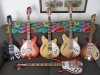
There are a few attempts to make th eRick 12 string headstock , more efficent .
Many of the older guitars have tuners that run into each other , and the casing of the Kluson tuners was filed away to allow clearance.
Some of the tuners are set so the two mounting screws of the side tuners leave little holding power as one of them is cut in half and is directed at the post of a tuner mounted on the back of the headstock .
As there was NO jig with drill guides for drilling the tuner holes EVER before 1984 , these hole patterns vary .
My point is this .........In an effort to make string easier , changing broken strings easier , and to deal with the layout of this brand of 12 string ......all kinds of modifications have been done in an effort to make these instruments work to their fullest potential.
I have personally plugged and redrilled many side tuner holes on Ricks and to ease the stringing /broken string problem , routed out the slots all the way through the headstock .
I have yet to be asked to fix a broken headstock from this modification.
As the public in the Seattle are and now via the internet , knows of my former relationship with Rickenbacker ...I get lots of these guitars for servicing.Most of the Seattle area repair personel would rather NOT deal with these instruments due to their quirks .....so I get the work .
This routing the headstock is a great modification ......however tuner layout is extremely important and some times this needs to be corrected ....otherwise the tuners are exposed in the slots. At that point the job looks sloppy and digging out broken strings is only slightly of any additonal benefit.
Yes I have seen one of Roger's guitar done this way .I have also done this FOR him on one occasion and have done it for several others due to HIS guitar .That was all in th e1970's however when this was done .I think the last one of these I did was in the early 1980's .
Many of the older guitars have tuners that run into each other , and the casing of the Kluson tuners was filed away to allow clearance.
Some of the tuners are set so the two mounting screws of the side tuners leave little holding power as one of them is cut in half and is directed at the post of a tuner mounted on the back of the headstock .
As there was NO jig with drill guides for drilling the tuner holes EVER before 1984 , these hole patterns vary .
My point is this .........In an effort to make string easier , changing broken strings easier , and to deal with the layout of this brand of 12 string ......all kinds of modifications have been done in an effort to make these instruments work to their fullest potential.
I have personally plugged and redrilled many side tuner holes on Ricks and to ease the stringing /broken string problem , routed out the slots all the way through the headstock .
I have yet to be asked to fix a broken headstock from this modification.
As the public in the Seattle are and now via the internet , knows of my former relationship with Rickenbacker ...I get lots of these guitars for servicing.Most of the Seattle area repair personel would rather NOT deal with these instruments due to their quirks .....so I get the work .
This routing the headstock is a great modification ......however tuner layout is extremely important and some times this needs to be corrected ....otherwise the tuners are exposed in the slots. At that point the job looks sloppy and digging out broken strings is only slightly of any additonal benefit.
Yes I have seen one of Roger's guitar done this way .I have also done this FOR him on one occasion and have done it for several others due to HIS guitar .That was all in th e1970's however when this was done .I think the last one of these I did was in the early 1980's .
So you too want yours "ALAPWOB"?!?!
One thing about doing this mod .... this is something that I have been thinking about since I last posted here.........
This is a great idea in that it allows you MORE access to the tuner post for removing stringts .
However , if you string using the 'OLD' factory method , you don't really need to do this .(see a prior posting by me on how to do this )
Another point is this ....The size of casing of the specific tuners is such that there are fairly close tolerances to make this all work .Little changes have been made over the years to 'improve' this .
The originals used USA made in chicago 'Kluson' tuners .The posts on these barely worked. The low E standard needed to be wound "UP" the shaft.The height of the bushing (these were two stepped ) caused there to be little room to wind the strings down.
The next change was to thin the headstock ...this resulted in the casings of the side tuners to hang over the edges.
The next change came from Kluson themselves , and the dimensions were changed on the bushings.
By 1978 Kluson was about to go out of business and by 1982 they were gone .John Kluson passed away in 1978 I believe.
By the early 1980's the Japanese company "GOTOH" was making tuners and they began making kluson knockoffs that were superior in quality to the original tuners.
These came in many types .
However ......In the Brian carman years at Rick , the company struck a deal with Schaller to use 'their tuners' .Schaller also made Kluson knockoffs , albeit different dimensions than the original kluson tuners .
Presently , rick is using "Gotoh" as their source for a Kluson tuner ....these are NOT direct copies of the USA made tuners ....they just look like the USA tuner.
The mechanics of them is superior in every way , and the post /shaft is longer .This allows for the dimensions of the headstock to be made so that there is no overhang of the casing from the side tuners .Cosmetically ...thias will finally be done "correctly" .Then the layout of the tuners can become uniformed and with older guitars needing replacement tuners , these will be ideal replacements .
This is something that when I worked there (at Rick/Electro String ) we wanted but found a stone wall .It was a case of frustration.
It has taken a long time to do this .... but at least it has been done .
Thank you John Hall for recognizing this problem and working it all out .
This will eliminate the need/desire to route out the slots hopefully .
This is a great idea in that it allows you MORE access to the tuner post for removing stringts .
However , if you string using the 'OLD' factory method , you don't really need to do this .(see a prior posting by me on how to do this )
Another point is this ....The size of casing of the specific tuners is such that there are fairly close tolerances to make this all work .Little changes have been made over the years to 'improve' this .
The originals used USA made in chicago 'Kluson' tuners .The posts on these barely worked. The low E standard needed to be wound "UP" the shaft.The height of the bushing (these were two stepped ) caused there to be little room to wind the strings down.
The next change was to thin the headstock ...this resulted in the casings of the side tuners to hang over the edges.
The next change came from Kluson themselves , and the dimensions were changed on the bushings.
By 1978 Kluson was about to go out of business and by 1982 they were gone .John Kluson passed away in 1978 I believe.
By the early 1980's the Japanese company "GOTOH" was making tuners and they began making kluson knockoffs that were superior in quality to the original tuners.
These came in many types .
However ......In the Brian carman years at Rick , the company struck a deal with Schaller to use 'their tuners' .Schaller also made Kluson knockoffs , albeit different dimensions than the original kluson tuners .
Presently , rick is using "Gotoh" as their source for a Kluson tuner ....these are NOT direct copies of the USA made tuners ....they just look like the USA tuner.
The mechanics of them is superior in every way , and the post /shaft is longer .This allows for the dimensions of the headstock to be made so that there is no overhang of the casing from the side tuners .Cosmetically ...thias will finally be done "correctly" .Then the layout of the tuners can become uniformed and with older guitars needing replacement tuners , these will be ideal replacements .
This is something that when I worked there (at Rick/Electro String ) we wanted but found a stone wall .It was a case of frustration.
It has taken a long time to do this .... but at least it has been done .
Thank you John Hall for recognizing this problem and working it all out .
This will eliminate the need/desire to route out the slots hopefully .
So you too want yours "ALAPWOB"?!?!

I never saw any of those in the factory and Bill Meyers ,Dick Burke ,Brian Carman and I had a long talk one day about 12 string headstocks and the layout of tuners, and the whole stringing issue and the slots were discussed at length .We also talked about the curvature of the side of the headstock and what happened when it was too severe.
If there were some that were done at the factory .....is was certainly early on .And I think that for possible structural reasons ... it was felt to leave the slots only part way through the headstock (as is the standard method) .
Unfortunately .....most of the people that came up with this , either have passed on or are not available for comment.
If there were some that were done at the factory .....is was certainly early on .And I think that for possible structural reasons ... it was felt to leave the slots only part way through the headstock (as is the standard method) .
Unfortunately .....most of the people that came up with this , either have passed on or are not available for comment.
So you too want yours "ALAPWOB"?!?!
Mark; I'll bet at least you, maybe others[?] have seen a stray 60s Rick 12 that the slotted trench wasn't routed as deep as it oughta be, and causes Real Big problems[more than usual for a Rick 12]
so you can hardly get the wound strings in there[or out, once they are in].I've only seen a couple of these, and what a nightmare!!!!
so you can hardly get the wound strings in there[or out, once they are in].I've only seen a couple of these, and what a nightmare!!!!