
Hi guys,
I am new to this board and hope to be able to find help with a long lasting problem.
I bought a 360/12v64 in London ten years ago.
Unfortunately, I have not played it as much as it deserves, as the neck tends to warp so the guitar becomes unplayable below the 5th fret. I have had many adjustments made to the neck, one went so far as to shave off a part of the lower neck to adjust it properly. It played wonderfully thereafter, but then again it starts to bend upwards so the strings raise again. This has now happened many times, and I am becoming desperate to have it adjusted once and for all.
I live in a country with real winters and summers, but my guitars are kept in a room with more or less constant temperature and humidity. And still the neck moves.
Can any of you tell me what needs to be done to this guitar? All advice will be highly appreciated.
Neck problems with a 12-string
Moderator: jingle_jangle

It may have to do with the way the string changes are performed. I disagree emphatically with the other guy here who said take off all the strings when you change them, and strongly suggest whenever possible you change no more than 2 strings at a time. The problem is that the massive change in tension on the neck can cause the rod to slip and lose it's adjustment as well as make the neck rubbery over time. Maybe you won't notice a problem immediately by changing strings this way but over time it damages the grain of the wood from alternately being under stress and then not.
Assuming your temperature and humidity REALLY is under control (humidity being more important, and should optimally hover around 35% in the air), the neck should stay where you set it, with only a minor tweak necessary each spring. Usually any heated area goes dry at times as few places in reality have systems which can put enough replacement moisture in the air.
If you can find anyone to borrow a wood humidity meter from, check it in the control cavity. If it's not between 6 and 7 %, you've found the problem.
Assuming your temperature and humidity REALLY is under control (humidity being more important, and should optimally hover around 35% in the air), the neck should stay where you set it, with only a minor tweak necessary each spring. Usually any heated area goes dry at times as few places in reality have systems which can put enough replacement moisture in the air.
If you can find anyone to borrow a wood humidity meter from, check it in the control cavity. If it's not between 6 and 7 %, you've found the problem.

Bjarne,
I'm not a luthier, just a player/collector, so please take my comments with a grain of salt.
I have a December 1993 370v64/12 FG (the "370" is not a typo!) that I play only once a month at the most (not that I don't like it, it's just that it might be the only one made, so I am reluctant to get it out and expose it to potential harm). I bought it used through an East Coast (USA) dealer, the brother of the original owner, about about five years ago, so it's been in the mild (temperature-wise, at least) Southern California climate for about that long. It still has its orignal strings on it. I have not needed to adjust the truss rods yet (probably will do a little tweak on them when I do change the strings), and there is no problem with the action anywhere on the neck.
So, if yours and mine are about the same age, why the problems with one and not the other? Although the climate may be a factor, my thinking is that, perhaps, the truss rods are mis-positioned inside the neck (I think that there was a thread addressing this issue, but I haven't checked the archive yet) and are not 'flexing' the neck the way it should be flexed. If it were a quality control problem at the time of manufacture, I would expect the problem to be more universal.
Let's hope we hear some feedback on this matter from the resident master luthiers!
I'm not a luthier, just a player/collector, so please take my comments with a grain of salt.
I have a December 1993 370v64/12 FG (the "370" is not a typo!) that I play only once a month at the most (not that I don't like it, it's just that it might be the only one made, so I am reluctant to get it out and expose it to potential harm). I bought it used through an East Coast (USA) dealer, the brother of the original owner, about about five years ago, so it's been in the mild (temperature-wise, at least) Southern California climate for about that long. It still has its orignal strings on it. I have not needed to adjust the truss rods yet (probably will do a little tweak on them when I do change the strings), and there is no problem with the action anywhere on the neck.
So, if yours and mine are about the same age, why the problems with one and not the other? Although the climate may be a factor, my thinking is that, perhaps, the truss rods are mis-positioned inside the neck (I think that there was a thread addressing this issue, but I haven't checked the archive yet) and are not 'flexing' the neck the way it should be flexed. If it were a quality control problem at the time of manufacture, I would expect the problem to be more universal.
Let's hope we hear some feedback on this matter from the resident master luthiers!
It is better, of course, to know useless things than to know nothing. - Seneca
-
rickplayer
- Veteran RRF member
- Posts: 88
- Joined: Wed May 30, 2001 7:14 am
-
bamse
Gary,
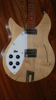
A 370v64 is exactly as you describe, three (reissue toaster) pickups, front/back binding, with the 21-fret v64 neck and trapeze tailpiece. Here is a not-so-good picture of the guitar:

It's the only picture I have of it on my computer at work (where I am currently); I do have some others on my home computer that I think might be better.
R.C.,
You are correct about the lefty 370v64 on eBay. That one was a 370/12v64 in Jetglo, and had a letter from Rickenbacker attesting that it was the only one made as such (it was made for a country/western artist whose name I cannot remember). When I e-mailed RIC service about mine (although every thing I checked on it pointed to it being all original, I wanted to confirm that it was indeed a factory issue), they confirmed it was a factory 370/12v64. Although they stated that they could not tell me how many were made, they did say that something like '... it's obvious that you have something very special...". I have not seen another righty as of yet.
I don't remember offhand when the JG lefty was made, but mine is from December 1993 (L6 date code).
I did bid on the JG lefty when it was offered but didn't meet the reserve.
A 370v64 is exactly as you describe, three (reissue toaster) pickups, front/back binding, with the 21-fret v64 neck and trapeze tailpiece. Here is a not-so-good picture of the guitar:
It's the only picture I have of it on my computer at work (where I am currently); I do have some others on my home computer that I think might be better.
R.C.,
You are correct about the lefty 370v64 on eBay. That one was a 370/12v64 in Jetglo, and had a letter from Rickenbacker attesting that it was the only one made as such (it was made for a country/western artist whose name I cannot remember). When I e-mailed RIC service about mine (although every thing I checked on it pointed to it being all original, I wanted to confirm that it was indeed a factory issue), they confirmed it was a factory 370/12v64. Although they stated that they could not tell me how many were made, they did say that something like '... it's obvious that you have something very special...". I have not seen another righty as of yet.
I don't remember offhand when the JG lefty was made, but mine is from December 1993 (L6 date code).
I did bid on the JG lefty when it was offered but didn't meet the reserve.
It is better, of course, to know useless things than to know nothing. - Seneca