
I recently inherited this gem (1966 vintage) and would like any suggestions from you as to where to begin. It has been in its case for 30 years and strung as a 6 string. I don't even have an amp to try it out yet...thinking about buying a Fender Frontman practice amp for $80.
Appearance wise it's not great...belt buckle marks on the back...real ugly. the neck and working parts look ok and it plays unbelievably well with the six strings.
I'll leave it up to you to advise me as to where to begin in getting it singing once again...TIA...JJ
Inherited 360/12 ...Need advice
Moderators: rickenbrother, ajish4

JJ: Welcome to the Rickenbacker Forum. I can't begin to tell you how thrilled most of us would be to inherit a 1966 Model 360/12. Please tell us more about it and if at all possible it would be nice to have a couple of photos.
There are a number of factors to consider when setting up an instrument. To begin, can you tell us what major city is near where you live. I am asking this as it wouldn't hurt to have someone experienced in Rickenbackers look this instrument over. We may be able to assist you in locating a luthier in your area. I would stay away from making any neck adjustments until you understand more about the truss rods in this instrument. Is it Fireglo finish? These instruments were built to last so it will jangle before you are through.
There are a number of factors to consider when setting up an instrument. To begin, can you tell us what major city is near where you live. I am asking this as it wouldn't hurt to have someone experienced in Rickenbackers look this instrument over. We may be able to assist you in locating a luthier in your area. I would stay away from making any neck adjustments until you understand more about the truss rods in this instrument. Is it Fireglo finish? These instruments were built to last so it will jangle before you are through.
Life, as with music, often requires one to let go of the melody and listen to the rhythm
Please join the Official RickResource Forum Facebook Page https://www.facebook.com/groups/379271585440277
Please join the Official RickResource Forum Facebook Page https://www.facebook.com/groups/379271585440277
-
jj123
I've been looking at the assembly drawings from the Ric website. I have some particular ??'s about differences I see:
1) The bridge is comprised of 6 individual saddles each having 2 slots for the strings. The drawings don't show this design. Instead they show 12 individual saddles. Why the difference?
2) My bridge assembly does not have springs on the intonation screws as shown in the schematic for a 6 string model. (the 12 string assembly is not an exploded view so I can't tell if springs are used). Do I need springs?
3) The intonation screws seem to be standard slotted, round head machine screws. Are these stock or is it possible that they were replaced? Should I order new screws?
4) The 4 channel bridge screws don't have springs as shown in the schematic. Instead, they each have a rubber grommet between the channel bridge and the screw head. This doesn't appear to be exerting any force to hold the bridge in tension. I think I need these springs...right?
5) There is no bridge cover.
So I called Rickenbacker customer service to get their advice on what I need. I was disappointed...they said they don't stock these parts and referred me to Mike Parks in NC (www.ricpage.com). Are there other sources of parts that anyone can recommend? I ordered the bridge cover (backordered) and the bridge screws. He was not able to answer my questions regarding the intonation screws and springs.
Anyway, those are my initial observations and would appreciate any answers to the above questions as well as other feedback you can offer...TIA...JJ
1) The bridge is comprised of 6 individual saddles each having 2 slots for the strings. The drawings don't show this design. Instead they show 12 individual saddles. Why the difference?
2) My bridge assembly does not have springs on the intonation screws as shown in the schematic for a 6 string model. (the 12 string assembly is not an exploded view so I can't tell if springs are used). Do I need springs?
3) The intonation screws seem to be standard slotted, round head machine screws. Are these stock or is it possible that they were replaced? Should I order new screws?
4) The 4 channel bridge screws don't have springs as shown in the schematic. Instead, they each have a rubber grommet between the channel bridge and the screw head. This doesn't appear to be exerting any force to hold the bridge in tension. I think I need these springs...right?
5) There is no bridge cover.
So I called Rickenbacker customer service to get their advice on what I need. I was disappointed...they said they don't stock these parts and referred me to Mike Parks in NC (www.ricpage.com). Are there other sources of parts that anyone can recommend? I ordered the bridge cover (backordered) and the bridge screws. He was not able to answer my questions regarding the intonation screws and springs.
Anyway, those are my initial observations and would appreciate any answers to the above questions as well as other feedback you can offer...TIA...JJ
-
jj123
Peter...Thanks for the welcome. This seems to be an overwhelming site. I'm glad I found it and look forward to becoming addicted to the Rickenbacker. I'll answer your questions:
1) I live in north central Indiana...between South Bend and Fort Wayne. I'd greatly appreciate your recommendation for a Ric luthier. Don't worry...I wouldn't even think about messing with a neck adjustment.
2) The color is Mapleglo. The finish on the front looks great but the back is badly worn from a belt buckle or something. The neck has some chips in the finish. Any thoughts on re-finishing the wood to get it back to a mint look?
The fretboard looks and feels good with the possible need for some fret dressing. The tuners are dull but I plan to get some Maas cream to shine them up. There is some delamination of chrome at the base of the "R" tail piece...probably needs to be replaced. Sorry I can't send a picture right now since I don't have a digital camera, but I'll get some taken in the near future.
3)I can't yet say how it sounds or if the toaster pickups even work yet.
4) The case was spray painted black and the band's name was stenciled. Should I re-paint to the original silver?
Thanks again and I look forward to learning a lot more at your site...JJ
1) I live in north central Indiana...between South Bend and Fort Wayne. I'd greatly appreciate your recommendation for a Ric luthier. Don't worry...I wouldn't even think about messing with a neck adjustment.
2) The color is Mapleglo. The finish on the front looks great but the back is badly worn from a belt buckle or something. The neck has some chips in the finish. Any thoughts on re-finishing the wood to get it back to a mint look?
The fretboard looks and feels good with the possible need for some fret dressing. The tuners are dull but I plan to get some Maas cream to shine them up. There is some delamination of chrome at the base of the "R" tail piece...probably needs to be replaced. Sorry I can't send a picture right now since I don't have a digital camera, but I'll get some taken in the near future.
3)I can't yet say how it sounds or if the toaster pickups even work yet.
4) The case was spray painted black and the band's name was stenciled. Should I re-paint to the original silver?
Thanks again and I look forward to learning a lot more at your site...JJ
A fine instrument deserves to be maintained correctly. There are some things an owner just needs to know and do. You are capable of making any simple adjustments to suit your taste.
Neck adjustments are fairly simple. The neck has settled in on your guitar, but you still need to know how to maintain correct neck relief. A piece of a .010" E1 string can be used as a feeler gauge. Capo the strings at the first fret, hold the E1 string down at the last fret, and see if the feeler gauge string will pass under the fretted string at about the 8th fret. The distance between the fretted string and the 8th fret is the relief. Loosen or tighten both truss rod nuts equally as needed, no more than one flat(1/6 turn of the nut), and then check again. Loosen to increase relief and tighten to reduce relief. Keep loosening or tightening until the correct neck relief is attained as measured by the feeler gauge. Every player needs to know how to keep the correct neck relief. I have had two basses with bowed necks from previous owners not routinely tightening down the truss rods as the neck shrank back as it dried out soon after being made. Try to keep everything in equilibrium as it ages. After a couple of years the neck should settle down. I adjusted my new 650D in late December, and I just had to adjust it again tonight by tightening both nuts exactly one flat. I will probably have to do it again within a couple of months as the neck continues to season and settle. Hopefully, your neck had settled in before your Rick was stored away. But you still need to know how to take care of any new guitar you might get later on, unless you want to run to a luthier every couple of months. Truss rod adjustment and action setup are not rocket science issues. Once you know what you are doing you do not even need the feeler gauge. You judge what to do by playing up and down the neck, and that is explained at http://www.frets.com I do believe.
You will need more or less neck relief depending on how you like your action. Generally speaking, more relief for higher action, less relief for lower action. There are several sites on the internet that teaches this, and it is important for a guitarist to at least maintain the setup that the luthier gives you, even if you don't want to go through all the intricacies of a complete setup. Intonation will change as string height changes due to increase or decrease of neck relief or bridge height changes. After you find your preferred setup, you should take the little bit of care necessary to maintain it. I just talked to a dealer several days ago that came into a Rick with a severely bowed neck. Probably from an owner that never touched that truss rod.
Once everything is set up correctly to your taste, nothing should move except the neck with the changes of the season, and even then only slightly. Keeping the neck in tune is a lot easier than dealing with a seriously bowed or warped neck later on.
The other thing to deal with would be fret wear at some future time. You'll probably want a luthier to handle that.
For $20 more you can get a much better amp than that Fender Frontman. The Kustom Tube 12 is something of a revelation at its $100 street price. Try to check one out, or read the reviews at Harmony Central.
Make sure the nuts and screws on your tuning keys are snugged down. A tuning key that is moving around will not hold a tune. Every new guitar I ever bought had the problem of loose tuning keys due to wood shrinkage after manufacture.
Hope that helps. Enjoy your new Rick!
Neck adjustments are fairly simple. The neck has settled in on your guitar, but you still need to know how to maintain correct neck relief. A piece of a .010" E1 string can be used as a feeler gauge. Capo the strings at the first fret, hold the E1 string down at the last fret, and see if the feeler gauge string will pass under the fretted string at about the 8th fret. The distance between the fretted string and the 8th fret is the relief. Loosen or tighten both truss rod nuts equally as needed, no more than one flat(1/6 turn of the nut), and then check again. Loosen to increase relief and tighten to reduce relief. Keep loosening or tightening until the correct neck relief is attained as measured by the feeler gauge. Every player needs to know how to keep the correct neck relief. I have had two basses with bowed necks from previous owners not routinely tightening down the truss rods as the neck shrank back as it dried out soon after being made. Try to keep everything in equilibrium as it ages. After a couple of years the neck should settle down. I adjusted my new 650D in late December, and I just had to adjust it again tonight by tightening both nuts exactly one flat. I will probably have to do it again within a couple of months as the neck continues to season and settle. Hopefully, your neck had settled in before your Rick was stored away. But you still need to know how to take care of any new guitar you might get later on, unless you want to run to a luthier every couple of months. Truss rod adjustment and action setup are not rocket science issues. Once you know what you are doing you do not even need the feeler gauge. You judge what to do by playing up and down the neck, and that is explained at http://www.frets.com I do believe.
You will need more or less neck relief depending on how you like your action. Generally speaking, more relief for higher action, less relief for lower action. There are several sites on the internet that teaches this, and it is important for a guitarist to at least maintain the setup that the luthier gives you, even if you don't want to go through all the intricacies of a complete setup. Intonation will change as string height changes due to increase or decrease of neck relief or bridge height changes. After you find your preferred setup, you should take the little bit of care necessary to maintain it. I just talked to a dealer several days ago that came into a Rick with a severely bowed neck. Probably from an owner that never touched that truss rod.
Once everything is set up correctly to your taste, nothing should move except the neck with the changes of the season, and even then only slightly. Keeping the neck in tune is a lot easier than dealing with a seriously bowed or warped neck later on.
The other thing to deal with would be fret wear at some future time. You'll probably want a luthier to handle that.
For $20 more you can get a much better amp than that Fender Frontman. The Kustom Tube 12 is something of a revelation at its $100 street price. Try to check one out, or read the reviews at Harmony Central.
Make sure the nuts and screws on your tuning keys are snugged down. A tuning key that is moving around will not hold a tune. Every new guitar I ever bought had the problem of loose tuning keys due to wood shrinkage after manufacture.
Hope that helps. Enjoy your new Rick!
JJ: Further to Philco's comments you can access most of your questions with regard to setup by using the Search function in the menu to the left of this text. The Archives of the Ask A Rickenbacker Luthier topic are detailed and most helpful in this regard.
One important point with regard to truss rod adjustment is to appreciate that for your 1966 model the rods are different than in current models. In tightening the rods it is desirable to physically move the neck to the desired direction by hand, then gently tightening the truss rods so that position is held. The newer rods do not need this same manual assistance. There have been many popped fretboards from adjustments made without this understanding. Again, the details of the neck adjustment can be found in the Luthier section.
One important point with regard to truss rod adjustment is to appreciate that for your 1966 model the rods are different than in current models. In tightening the rods it is desirable to physically move the neck to the desired direction by hand, then gently tightening the truss rods so that position is held. The newer rods do not need this same manual assistance. There have been many popped fretboards from adjustments made without this understanding. Again, the details of the neck adjustment can be found in the Luthier section.
Life, as with music, often requires one to let go of the melody and listen to the rhythm
Please join the Official RickResource Forum Facebook Page https://www.facebook.com/groups/379271585440277
Please join the Official RickResource Forum Facebook Page https://www.facebook.com/groups/379271585440277
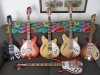
JJ, It sounds as though by what you describe that your 12-string still has all of its original bridge components, screws, grommets and all(minus the cover).
I guess it would depend on your preference for originality vs. new components.....if they function properly, then just use that stuff...my .02.
I guess it would depend on your preference for originality vs. new components.....if they function properly, then just use that stuff...my .02.
JJ - Also, FYI, the twelve saddle bridge is relatively new for RIC and wasn't even being made during the '60's. Depending on what your level of theory is relative to instruments and intonation, it may not be something you need to worry about. Clearly, most all of the characteristic Rickenbacker twelve-string recordings made during the '60's by favorite artists of the period were done with the six saddle bridges. Your guitar will just need to be set-up properly. I have two new RIC twelve strings that both came with six saddle bridges and I replaced both of them myself with new twelve saddle bridges.
-
jj123
Many thanks to the following for your comments and suggestions:
1) Philco...Your neck adjustment suggestions are most helpful. I think I'll have a luthier do the initial setup and thereafter take your advice on periodic tweaking. Thanks especially for your recommendation of Frets.com...fantastic site. Frank Ford has become one of my new heroes since my primary guitar is a 35 year old Martin D-35.
2) Peter...I've spent a lot of time at the Luthier archive just soaking up all this new information. Thanks for the tips on the procedure for adjusting the old-style truss rods.
3) Gary...I've decided to stay with the 6 saddle bridge for now and just get it back to its original assembly condition. If I ever decide to go to a 12 saddle bridge your comments will be considered.
So...my outstanding questions are as follows:
1) Do I need new intonation screws and springs?...remember, the current ones look like round head machine screws and have no springs.
2) Has anyone ever re-finished their Ric...if so please advise on how I should go about this? I would only consider if I could restore it to the original Mapleglo finish.
3) Finally...can anyone recommend a competent and experienced Ric luthier...I live near South Bend and Fort Wayne Indiana.
Thanks again...JJ
1) Philco...Your neck adjustment suggestions are most helpful. I think I'll have a luthier do the initial setup and thereafter take your advice on periodic tweaking. Thanks especially for your recommendation of Frets.com...fantastic site. Frank Ford has become one of my new heroes since my primary guitar is a 35 year old Martin D-35.
2) Peter...I've spent a lot of time at the Luthier archive just soaking up all this new information. Thanks for the tips on the procedure for adjusting the old-style truss rods.
3) Gary...I've decided to stay with the 6 saddle bridge for now and just get it back to its original assembly condition. If I ever decide to go to a 12 saddle bridge your comments will be considered.
So...my outstanding questions are as follows:
1) Do I need new intonation screws and springs?...remember, the current ones look like round head machine screws and have no springs.
2) Has anyone ever re-finished their Ric...if so please advise on how I should go about this? I would only consider if I could restore it to the original Mapleglo finish.
3) Finally...can anyone recommend a competent and experienced Ric luthier...I live near South Bend and Fort Wayne Indiana.
Thanks again...JJ
JJ - email me with a mailing address and I'll send you one of the six saddle bridges I removed including the four height adjusting screws, the bridge channel with the installed/notched for string/octave saddles and adjusting screws with springs.
Put "RIC Forum" in the subject line or I'm likely to delete your mail as I won't recognize who its from.
G
[email protected]
Put "RIC Forum" in the subject line or I'm likely to delete your mail as I won't recognize who its from.
G
[email protected]