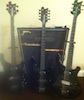
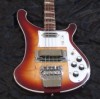
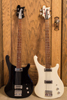
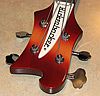
Another new body for my 2030. You've heard of the "dumpster" bass - this one is the "driveway" bass, built mostly outside in Wisconsin in February. I refined the shape a bit here and there from one I built last summer, tried installing binding for the first time (kind of fun, in a rather tedious way) and got it buffed and assembled today. It still has a couple finish issues to address, but they will wait for warmer weather. Plays great, sounds great, just like a 2030 should. It will also fit in the case a little better than my last body did. Not bad for a bass that used to have Mickey Mouse ears...
Hell will freeze-over, thaw and re-freeze (probably several times) before Dale and Paul have any competition from this end, but I'm enjoying the rank of "ambitious amateur" and the fact that at this level you're allowed to screw-up.
Ted, The varnish is KTM-9 waterbased from Luthier's Mercantile Supply - about 20 coats sprayed with a touch-up gun out in the garage. It's easy to work with, non-flamable and non-toxic, but it's starting to bug me. I'd like something that's harder, thicker (fewer coats) and maybe one that has some solvent in it to help melt the coats together a little better. On black, you see everything and this stuff has just a little bit of a uniform, just slightly blotchy/oily look to it that doesn't seem to buff out and turn perfectly clear. I've seen it on both bass bodies that I've built and once it warms up I'll probably blast it off and try something else.
On natural wood it probably wouldn't show (I've still got the little mandolin to buff out, so we'll see) but on Jetglo, the clear coats are either perfect, or they're not and there doesn't seem to be much middle-ground. Before buffing, I hand-sanded it with 800 grit, then 1000, 1500, 1800, and 2000 grit (wet), followed by 2400, 3200, 4000, 6000, 8000 and 12,000 grit Micro-Mesh, so I feel like I did my part and the stuff isn't on the surface - so I'm blaming the varnish.
I also don't have a buffer, so I stood there all afternoon with a diaper in my hand, rubbing with Finesse it, Scratch-X and then Zymol. It's flat, it's shiny, but it could be better. Luckily, this is just recreation for me, so if I have to do it again to get it right it's not a big deal. At nearly $50 per quart though, once it's shipped here, I'm not terribly happy with the stuff. Of course, it does say 70 degrees on the can, and I was spraying out in the garage at 40-45 degrees and then running with it into the house so that it would dry, but it's the same thing that happened on the other one and it was varnished in the summer so I don't think that temperature caused the problem.
Todd, I do hope you're coming to the Milwaukee Confluence the end of April. You MUST bring your "new" bass and any other Ricks. If you do, you'll be in great company.
Author: "The Rickenbacker Electric Bass - 50 Years As Rock's Bottom"