
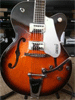
I found Brillianize today but I have an issue that has me worried. Gary Clauson has sent me some tung oil, and before I found the Brillianize, I tried it. It looks all blotchy! I tried to use a fine scratch pad,(I thought the idea was to clean off the tung oil with the pad?) which helped a little. I then tried the brillianize, and it is blotchy too. I think the surface needs to be cleaned with a solvent first. I wouldn't attempt without clearance, but I'm thinking maybe there is something I can do short of taking it into a shop. Like maybe naptha. Or sanding with a VERY light grade? I'm lost.....
Thanks in advance
Brillianize
Moderator: jingle_jangle
-
jingle_jangle
- RRF Moderator
- Posts: 22679
- Joined: Wed Dec 22, 2004 6:00 am
- Contact:
I use Brillianize on guitars with a conversion varnish finish, but not with an oil-type finish, as with an oil finish, the pores are still open and a bit of use can cause area wear (it's why we keep on oiling...).
Brillianize is 99% water, and you don't want this on any part of a guitar that has open grain. Brillianize is brilliant on hard, glossy surfaces (guards and CV finishes), though.
Try a fine Scotchbrite pad (cut it with scissors into a 2" X 2" pad to make it more manageable and allow you to focus your attention, Charlie...) and some mineral spirits. Scrub a bit, then wipe with clean cloth, and do this area by area until everything looks even again. Rub WITH the grain wherever possible. Now you can re-introduce the oil, bit by bit, working it into the wood with the Scotchbrite pad, again going with the grain.
Get some Johnson's paste floor wax, and dip your pad into this every so often, working this into the wood as well. Tung oil, wax, tung oil, wax. Wipe every so often with a clean cloth, going with the grain, etc. Spend two or three hours. If it were me, I'd take the guitar down to body only (remove guard, pickups, strings, tuners, etc, so you can do it right once and for all) but you can do it without this by masking off anything that the pads can scratch. When the wood has taken all it can take, rub over and over and buff with a clean dry cloth. Cotton, of course...
As I've mentioned, I've got nothing against tung oil (it's for purists and is perhaps too pure...) but my own preference is for Watco's Danish Oil finish, as it's easier to use and incorporates wax into its formula.
Go for it!
Brillianize is 99% water, and you don't want this on any part of a guitar that has open grain. Brillianize is brilliant on hard, glossy surfaces (guards and CV finishes), though.
Try a fine Scotchbrite pad (cut it with scissors into a 2" X 2" pad to make it more manageable and allow you to focus your attention, Charlie...) and some mineral spirits. Scrub a bit, then wipe with clean cloth, and do this area by area until everything looks even again. Rub WITH the grain wherever possible. Now you can re-introduce the oil, bit by bit, working it into the wood with the Scotchbrite pad, again going with the grain.
Get some Johnson's paste floor wax, and dip your pad into this every so often, working this into the wood as well. Tung oil, wax, tung oil, wax. Wipe every so often with a clean cloth, going with the grain, etc. Spend two or three hours. If it were me, I'd take the guitar down to body only (remove guard, pickups, strings, tuners, etc, so you can do it right once and for all) but you can do it without this by masking off anything that the pads can scratch. When the wood has taken all it can take, rub over and over and buff with a clean dry cloth. Cotton, of course...
As I've mentioned, I've got nothing against tung oil (it's for purists and is perhaps too pure...) but my own preference is for Watco's Danish Oil finish, as it's easier to use and incorporates wax into its formula.
Go for it!
“I say in speeches that a plausible mission of artists is to make people appreciate being alive at least a little bit. I am then asked if I know of any artists who pulled that off. I reply, 'The Beatles did.”
― Kurt Vonnegut
― Kurt Vonnegut

-
jingle_jangle
- RRF Moderator
- Posts: 22679
- Joined: Wed Dec 22, 2004 6:00 am
- Contact:
You wouldn't need the Johnson's for your wax job, but it's also compatible with Watco's.
(chuckle)
(chuckle)
“I say in speeches that a plausible mission of artists is to make people appreciate being alive at least a little bit. I am then asked if I know of any artists who pulled that off. I reply, 'The Beatles did.”
― Kurt Vonnegut
― Kurt Vonnegut

I used to use a lot of Watco on canoe trim. In time, you can build up a gorgeous gunstock-like finish, but it seemed to take multiple oilings over several weeks or months to really get something substantial and well sealed. I switched to Deks Olje #1 from the Flood Company. Theoretically, it's an old Norwegian formula for oiling boating wood, but that may be more advertising hype than truth. It's a very thin liquid and you apply it wet-on-wet with multiple coats in a single day almost as fast as you can apply them. Once it gets to the point that it won't absorb any more coats, you wipe off the excess and it will generally dry overnight leaving a well-sealed oil finish. My biggest complaint with Watco was that multi-coat applications often dry rather sticky and stay that way for a while. I've been using Deks #1 on my unvarnished fingerboards and really like the results. As far as I can tell, it's just about the fastest way possible to get a really nice matte oil finish. In a case where you would like to get the oiling done and the guitar oiled, dry, reassembled and ready to go in about a day, I think it would be ideal.
http://www.flood.com/flood/Products/Exterior/Marine/Deks+Olje+Product+Page.htm
http://www.flood.com/flood/Products/Exterior/Marine/Deks+Olje+Product+Page.htm
-
dale_fortune
- Intermediate Member
- Posts: 1241
- Joined: Sat Oct 30, 2004 6:00 am
-
jingle_jangle
- RRF Moderator
- Posts: 22679
- Joined: Wed Dec 22, 2004 6:00 am
- Contact:
Uff da, Dale. Do give us a report once you've tried the Dek's.
Going by your description, if you apply Watco's in multiple layers like this Norwegian stuff, you should get the same result. A stickiness after applying Watco's (or most any oil-only finish like tung oil or walnut oil) is due to not enough drying time, or with leaving it wet until the light aromatic components evaporate and only the heavier (stickier) ones remain.
The method for application I've described in my post above will work just fine and give a hard, deep wood finish that glows and protects. Note that I don't just "wipe off the excess and let it dry overnight"--I'm actively buffing and turning the clean cotton rag over to soak up any smidge of wet finish, bringing the wax to the surface at the same time.
Any stickiness remaining (there shouldn't be any) can be cured with an application of Johnson's Paste Floor Wax as I described.
Going by your description, if you apply Watco's in multiple layers like this Norwegian stuff, you should get the same result. A stickiness after applying Watco's (or most any oil-only finish like tung oil or walnut oil) is due to not enough drying time, or with leaving it wet until the light aromatic components evaporate and only the heavier (stickier) ones remain.
The method for application I've described in my post above will work just fine and give a hard, deep wood finish that glows and protects. Note that I don't just "wipe off the excess and let it dry overnight"--I'm actively buffing and turning the clean cotton rag over to soak up any smidge of wet finish, bringing the wax to the surface at the same time.
Any stickiness remaining (there shouldn't be any) can be cured with an application of Johnson's Paste Floor Wax as I described.
“I say in speeches that a plausible mission of artists is to make people appreciate being alive at least a little bit. I am then asked if I know of any artists who pulled that off. I reply, 'The Beatles did.”
― Kurt Vonnegut
― Kurt Vonnegut
-
jingle_jangle
- RRF Moderator
- Posts: 22679
- Joined: Wed Dec 22, 2004 6:00 am
- Contact:
Three years? I oil my own 380L every few months using the above method and it glows.
They can look dingy if not given a regular beauty treatment.
They can look dingy if not given a regular beauty treatment.
“I say in speeches that a plausible mission of artists is to make people appreciate being alive at least a little bit. I am then asked if I know of any artists who pulled that off. I reply, 'The Beatles did.”
― Kurt Vonnegut
― Kurt Vonnegut
I think the difference is in whether you want your "natural" finish to be mostly oil, or mostly wax. If you're applying an oil/wax mix and you can buff it with a cloth - you're not buffing the oil part of it. For guitars or furniture, I have no doubt that it works great. For boating woods, we don't tend to use much wax because it doesn't hold up very long. We want as much oil as we can get and we want it to soak in as deeply as possible. Watco is about three times thicker than Deks and most likely has a much lower percentage of evaporating solvents. If I'm working with an open grained wood, like ash for example, I can put six or eight coats of Deks #1 on in a day, if needed, and start using the piece the next day. By comparison, if I'm using Watco, it's one or two coats per day (any more and it will probably be gummy the next day) and the following day it will likely look like it needs more oil, especially on end-grain. So I suspect that if you use Watco and you want your finish done this week (or maybe this month) Paul's oil/wax/buff method is the way to go.
I don't share Paul's passion for buffing. I pretty much use up my annual allotment of buffing motivation with Scratch-X and Zymol. For oil finishing, I want to oil the living **** out of the wood, walk away and come back tomorrow to a dry, usable, beautiful finish that I can dunk in the lake, if desired.
This is a hunk of bubinga sanded to 100 grit with a random orbit sander. Fifteen minutes ago I wiped on one coat of Deks#1 with a paper towel and wiped off the excess. It's now dry to the touch, it's silky and already starting to get a bit of sheen to the surface, nothing comes off on your fingers and it already smells more like bubinga than oil. You could put strings on it and play it without gunk coming off on the strings. It's ready for the next coat of oil. For hard wood that's sanded smooth and lives indoors, around three coats is usually enough.
http://webpages.charter.net/tbradshaw/bub%20001.jpg
This is my 2030. It's been over 18 months since I oiled the fingerboard. It still looks pretty good, but it's about due for a refresher coat, so when I get energetic, I'll wipe it down with naptha to get any foreign yuck off the board, wipe a fresh coat of oil on, wait about ten minutes and wipe off the excess. I can then be playing it about as fast as I can get the strings back on.
http://webpages.charter.net/tbradshaw/fb%20002.jpg
Is this then a "better" natural finish than Watco/wax? On a boat absolutely! On a guitar or on your teak dining table, I couldn't tell you, but it is the fastest way I know of to build a lovely and durable oil finish. If you develop enough unusual interests or hobbies, you start to notice that there is often very little technology making the cross-platform transition. Most of the folks building natural-finished guitars have probably never even heard of Deks Olje. For some, it might be worth looking into.
Note that any rags used for applying any oil finish are a serious potential hazard for spontaneous combustion. If you want to avoid a true "fireglow" finish on all your guitars, be very careful with used rags and dispose of them safely.
I don't share Paul's passion for buffing. I pretty much use up my annual allotment of buffing motivation with Scratch-X and Zymol. For oil finishing, I want to oil the living **** out of the wood, walk away and come back tomorrow to a dry, usable, beautiful finish that I can dunk in the lake, if desired.
This is a hunk of bubinga sanded to 100 grit with a random orbit sander. Fifteen minutes ago I wiped on one coat of Deks#1 with a paper towel and wiped off the excess. It's now dry to the touch, it's silky and already starting to get a bit of sheen to the surface, nothing comes off on your fingers and it already smells more like bubinga than oil. You could put strings on it and play it without gunk coming off on the strings. It's ready for the next coat of oil. For hard wood that's sanded smooth and lives indoors, around three coats is usually enough.
http://webpages.charter.net/tbradshaw/bub%20001.jpg

This is my 2030. It's been over 18 months since I oiled the fingerboard. It still looks pretty good, but it's about due for a refresher coat, so when I get energetic, I'll wipe it down with naptha to get any foreign yuck off the board, wipe a fresh coat of oil on, wait about ten minutes and wipe off the excess. I can then be playing it about as fast as I can get the strings back on.
http://webpages.charter.net/tbradshaw/fb%20002.jpg

Is this then a "better" natural finish than Watco/wax? On a boat absolutely! On a guitar or on your teak dining table, I couldn't tell you, but it is the fastest way I know of to build a lovely and durable oil finish. If you develop enough unusual interests or hobbies, you start to notice that there is often very little technology making the cross-platform transition. Most of the folks building natural-finished guitars have probably never even heard of Deks Olje. For some, it might be worth looking into.
Note that any rags used for applying any oil finish are a serious potential hazard for spontaneous combustion. If you want to avoid a true "fireglow" finish on all your guitars, be very careful with used rags and dispose of them safely.
-
jingle_jangle
- RRF Moderator
- Posts: 22679
- Joined: Wed Dec 22, 2004 6:00 am
- Contact:
Thanks for that important safety tip, Todd!
I was so busy indulging my passion for buffing, I forgot the warning about spontaneous combustion...LOL
How do those guitars handle in the water, Todd?
I was so busy indulging my passion for buffing, I forgot the warning about spontaneous combustion...LOL
How do those guitars handle in the water, Todd?
“I say in speeches that a plausible mission of artists is to make people appreciate being alive at least a little bit. I am then asked if I know of any artists who pulled that off. I reply, 'The Beatles did.”
― Kurt Vonnegut
― Kurt Vonnegut
-
jingle_jangle
- RRF Moderator
- Posts: 22679
- Joined: Wed Dec 22, 2004 6:00 am
- Contact:
-
janglerocker
- Member
- Posts: 405
- Joined: Wed Dec 20, 2006 1:07 am