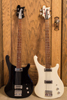
I will soon be taking delivery of a Rick bass with a very grungy-looking ebony fretboard. I believe the fretboard is unfinished. What should I use to clean it?
A couple people here have recommended lemon oil. Is this a good idea?
You could try some of that excellent wine you've been giving to your friendly West Coast luthier...<hic>...
But, seriously, first get an old toothbrush or two and a couple of clean popsicle sticks or sharpened small-diameter dowels. Now, if there's lotsa real crud collected around the frets, you can use the popsicle stick (cut the end square so the corner will dig into the crud) or sharpened dowel--bamboo barbecue skewers are what I keep in stock for this purpose. Just run the wooden tool along each side of each fret to dislodge the junk.
Spray some of that good ol' Dr. Stringfellow's Lem-Oil over the fretboard and using the toothbrush, scrub,scrub, scrub, along the frets, in the driection of the frets. Let it all sit for a couple of hours and wipe. If there's still crud there, go at it again. There's nothing wrong with using very fine (#000) steel wool to scrub with the Lem-Oil, either, This will also polish the ebony nicely.
In any event, conventional wisdon says stay away from electric guitars with steel wool, because of the pickup magnets. I simply put the body of the guitar or bass into a poly trashbag (I use drawstring Hefty bags), and tape around the neck to seal it. When you're all done with the cleanup operation, you can remove the bag, clean up the body and chrome, restring her, and you're set to stun!
My 4004C has an unfinished neck, or so it seems. I have cleaned it with the scotch pad and Watco's oil, but was wondering if I should (have) use(d) the lemon oil.
Guys, I'm assuming that what you refer to as "grunge" is, basically, finger dirt and sweat, hardened and caked into the open pores of the wood and into the areas around frets, etc.
Since this stuff is sweat-based (hence water-based), then it would seem that removing the thicker deposits as I describe above--with a sharpened tip of a softwood stick--is the most expeditious way of getting rid of the heavier deposits, and lighter films could be handled with a cloth dampened in Windex or soapy water solution.
Don't however, soak them. Water on unfinished woods causes damage:
Lem-Oil is a good preservative. Naphtha, being a petroleum solvent, might also remove part of the grunge, but not all.