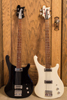
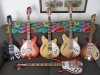
Here are a couple of photos of a Rickenbacker Vintage Model 370/12 (October 1968) along with a vintage Don Adamek. The photos were taken in July 1973 of Don and his first Rickenbacker guitar. Imagine having this as your first Rickenbacker. This Rickenbacker 370/12 was converted to Byrd wiring in 1970. I am hoping that Don will comment further on this instrument.
Life, as with music, often requires one to let go of the melody and listen to the rhythm
Don, great pictures. Love those BYRD models. Looks like you added those huge Groover tuners like Mcguinn's. I coverted my Carl Wilson into a BYRD model. I call the guitar, a CW BYRD. I'm not going to add those huge tuners. Thanks Peter for posting the pictures of Don.
Hey Peter. I would love to tell you about my BYRD conversion. I purchased the BYRD wiring from Tone Werks. The wiring is the Rickenbacker circuit. I use a outboard Treble Boost box, so I passed on the Mcguinn circuit. I also use a Keeley compressor, so I get some pretty cool Byrd sounds. The BYRD wiring took some time to get used too. The upper toggle switch is for pick-ups. So it's fun to play just the neck,mid,or bridge pick-up. Yes, you can't use multiple pick-ups together, but I would only use the bridge pick-up anyhow. The lower toggle switch is for tones. They are bypass, mid,and low. Most of the time I use the bypass. I always wanted a BYRD model since when I became a hudge Byrds fans. So I had a middle pick-up and the BYRD wiring added to my Carl Wilson.
Interesting story on the Dr.'s Rickenbacker here Peter. I can share this much about his guitar and how I thought I actually had it at one point:
Although Don's 370/12 was a 1968 model, he didn't actually purchase it until the Spring of 1970, as a 360/12. In November 1970 Don dropped off the guitar at RIC to have the 'Jim McGuinn wiring' added to it and the 3rd pickup as a converstion to a Byrd-wired Rickenbacker.(He still has the receipt for this somewhere...) It was like this for a couple of years after this, until he and John Hall customized it even further....Don can fill in these blanks...It was eventually sold to Paul Kantner of Jefferson Starship. Where is it today?? Good question..
Fast forward to the present where there was a discussion about Byrd Ricks over on Voxtalks, and by the description I gave of my own 370/12, a couple of people thought I may have stumbled on to Don's old guitar:
The serial number on my guitar is 3 numbers away from Don's, and apparently the guitars even have very similar grain patterns. I am pretty sure they were made in the same batch, and cut from the same wood stock.
Paul;
The tuners on that guitar shown here are Still the original Klusons, but I did the "reverse mount",
i.e., turned the buttons facing Forward, just to try out the look and functionality of doing that.When I first saw the Byrds live in Feb., of '70, I was sitting front row dead on at Rogers' feet, and noticed right away that the tuners were mounted reversed, and that the buttons on the tuners were not round/oval like a Kluson, but more rectangular.At that time, the only "rectangular" buttoned tuner I'd seen were the ones CBS fender was using on all their guitars, so I assumed that was what they might be. Not till Terry's guitar came along with details, did I actually find out just what they were.About a year after this was taken[this shot was actually taken in March, '73] I changed the tuners to the Gibson/Kluson type, like you'd find on a 60s SG or 335.
Lefty;
I'd hesitate to call it a "collaboration" of John Hall and myself, but somewhere during the summer of '72, I'd decided that the limited tone choices of the Byrd wiring was driving me nuts.After all, I also owned a Rick O Sound box, that I bought at the time I had the guitar Byrd wired 2 years earlier.Mind you, I had the Byrd wiring installed in the guitar without even really knowing just How it worked!But Roger had it, so how could doing this be a bad thing, right?
Besides, when I picked up the guitar from Rick sales when it was finished, F.C., Hall told me Roger owned a ROS kit[didn't mention whether he actually Used it!!!???]so that added fuel to the fire to "be all the Roger-like I could be".Back to the rewire job.I wanted to convert back to stereo capabilities, but not have the 5 knob deal going, and also retain the outward appearance of the Byrd wiring.I bought some pots and switches from Rick sales, and started messing with a soldering iron, but the more I messed, the farther from functional everything got. So one day after work, I stopped in the sales office and found John available, and I told him what I wanted to try to do.I left the guitar with him for a day or so, and got it back, plugged it into a couple Rick amps in the old showroom with the ROS, and I was really digging whatever John had done.He told me at the time that whatever he'd done was unlike anything he'd tried before, or something to that effect, and he thought I'd like it, which I did. Unfortunately, I was not into being the nutcase gadgethead I am now, where I would open it up, and copy the schematic layout.All I recall for sure, was that there were 2 identical stock 360 type toggles in it, one of which handled the bridge and neck PU, and a tone and volume for the bridge and neck. No "mixer knob".dual mono/stereo jacks.And the 2nd toggle somehow routed the mid PU to either neck or bridge.Beyond that, I can't tell you anymore.One that got away; the first of many.Kantner dug it when I sold it to him in spring of '75 for $475,a sum No One else would have given you for a Rick back then.BTW, that guitar had the "extra wood" inside the soundhole that can be seen through the catseye on the 366-12 converter models, and I seem to recall the guitar was 1-3/8" thick.I'm kicking myself as I write this.....
Don, thanks for telling us about your 1968-70 Byrd. Great story!!! The rewiring that John did sounds pretty cool. I wonder if Paul Kantner still owns your old guitar. My second Rickenbacker was a beautiful 1967 mapleglo 360/12 that I wish I never got rid of. So I still kick myself ever time I think of that guitar to. Don, what other Rickenbackers do you have?
Paul;
I emailed Kantner back in '99 and asked him if he remembered me selling him the guitar and if he still had it. I got a breif, if not cryptic message back saying something like, "Sorry, I can't help you, Rickenbacker is riding the music", or some such thing. I got the impression maybe he thought I wanted to buy it back[well, actually, if he'd said That, maybe then...oh, never mind!!]
Peter, I think I'd be surprised if John remembers doing that wiring for me.It wasn't done formally, like dropping off the guitar at sales, and getting an official invoice/work order on it.He just said, if you leave it with me a day or so, I think I know what might do the thing you're asking for.That was pretty cool of him to do that.
You think you could have walked into Fender or Gibson and had the owners' son personally do your guitar like that? And at no charge, no less?
Paul;
as to the Q on "what other Ricks I own; better to ask; What other Ricks Have I owned[past tense
emphasized!]Only 2 currently, and both were "projects".One is a '67 360-12 I got back in '93, that was Mapleglo, and though structurally and electronically sound, the frets were shot and loose, binding loose, finish worn, peeling or cracking, pickguards broken, couple of bad tuners....I stripped and sanded it, refretted it, new nut, remade pickguards, added a mid PU, 12 saddle bridge,a cosmetic lookalike "Byrd conrol guard", and a new natural finish.Very nice now, though has the infamous "bad neckset" problem,which is not so much a neckset problem in the classic luthier sense, but rather a bowing of the whole back of the guitar.If this seems incredulous, take your old Rick if you have one, and lay a good straight edge down the center seam of the back and see if the thing "rocks" back and forth.I digress. The other Rick is a cobbled back together conglomeration I did just to see if it could be done.I ended up with a couple bare carcasses of 2 different Ricks, both with opposite structural issues; a late 50s Capri 330, with a split open body and many other not worth fixing issues, that had a straight, unbroken neck, but needed a whole new fingerboard.I carefully cut the neck out of the body, and made a new board for it from Paduak, and put 360 poured inlays in it[full width, of course]. The other guitar was about a '67 335 I'm guessing, 2 piece top, that had the neck broken off clean way up around the 10th fret or so.The body was worn but not broken or gouged, so I cut the neck off it, mortised out the old neck, and stuck the 50s Capri neck in it.I also put binding on it before I renecked it, with 381 style treatment; white, with checkerboard. Bound the soundhole, too.It has a clear finish on it, purposely "yellowed" to give it a "relic" look , 3 PUs, a Long trapeze tailpiece[think old 360F] and my own "Byrd look" guard.Oh, and top it off with some NOS pearl button Rick "Van Ghent tuners.Peter has a bunch of other pics I sent to him last year that I think he is going to start posting here and there, of the "other Ricks" I've had.Only a couple of them I would consider truly "collectible, but, hey, you don't have to be in to "vintage" to be a Forum member, right???
I'm afraid my memories if any of this are long gone with a zillion other things like it. But Paul's tech is down here all the time and I'll ask him about that guitar. Hopefully it's not been modified.