
Hi all...
I heard this might be the place to post for technical luthier-type queries...?
Hope so...
Anyway, I'm looking to restore my '67 366/12 (see this thread: viewtopic.php?f=22&t=395144 ), and I have a few binding questions:
Can someone give me the dimensions of the finished back-binding on a '67 360 or 366???
Total binding height and thickness?
Somebody destroyed the existing binding (I have replacement binding), and I need to re-do it...
They also wiped out the sound-hole binding.
What is the thickness of that sound-hole binding, and where did they usually locate the joint?
Anyone have a close-up pic of the joint?
Thanks in advance!
'67 366/12 Restoration Questions....
Moderator: jingle_jangle
-
jingle_jangle

- RRF Moderator
- Posts: 22679
- Joined: Wed Dec 22, 2004 6:00 am
- Contact:
Re: '67 366/12 Restoration Questions....
Total binding height should be about 9/32" (.280"), but can be slightly over or under this dimension. The outer edge should be only slightly "broken", not rounded off. About 1/32" radius is correct. Thickness is nominally 1/16" (.060").
The soundhole binding is 1/16" thick, by however thick the top wood is. The seam can be in roughly the center of either longer curved edge. Inner edge is most common.
I've restored a couple of these, and the binding back then was genuine cellulose nitrate (celluloid). To use the more commonly-available extruded ABS binding would be non-original.
To source genuine celluloid binding, try:
www.axinc.net
The soundhole binding is 1/16" thick, by however thick the top wood is. The seam can be in roughly the center of either longer curved edge. Inner edge is most common.
I've restored a couple of these, and the binding back then was genuine cellulose nitrate (celluloid). To use the more commonly-available extruded ABS binding would be non-original.
To source genuine celluloid binding, try:
www.axinc.net
Re: '67 366/12 Restoration Questions....
Thanks Paul...
I really appreciate that......
b.
I really appreciate that......
b.

Re: '67 366/12 Restoration Questions....
As always, PW to the rescue. Well done, mate.
Dear Abbey: I'm in a bind..........
Dear Abbey: I'm in a bind..........
"Never eat more than you can lift." - Mr. Moon
-
jingle_jangle
- RRF Moderator
- Posts: 22679
- Joined: Wed Dec 22, 2004 6:00 am
- Contact:
Re: '67 366/12 Restoration Questions....
Miralax will work...gently...for your bind, Aitch...
Glad to be of assistance...
Glad to be of assistance...

Re: '67 366/12 Restoration Questions....
jingle_jangle wrote: I've restored a couple of these, and the binding back then was genuine cellulose nitrate (celluloid). To use the more commonly-available extruded ABS binding would be non-original.
To source genuine celluloid binding, try:
http://www.axinc.net
Yep, Celluloid is the stuff.
From my experience, celluloid was WAY easier to work with too. It softens up nicely when you're using acetone as an adhesive (well...not really adhering, more like melting the plastic).
Downside is that shipping is quite expensive as celluloid is classified as "highly explosive, haz mat" for shipping purposes. Axinc is a great shop.

Re: '67 366/12 Restoration Questions....
Got some from Rickenbacker 20 or so years ago....collin wrote: Yep, Celluloid is the stuff.
See: http://i231.photobucket.com/albums/ee22 ... 050981.jpg

OK, here's the problem (or one of them) on this puppy...
It looks like someone drastically thinned the back down, taking the binding down to a mere 3/32" or so....

I'm thinking of building the back to it's former glory with a veneer of hard maple, then re-cutting the binding to the 9/32" that it wants to be...
See a pic of the existing binding here:
http://i231.photobucket.com/albums/ee22 ... 050970.jpg

So, I'm wondering--just to make sure--what is the thickness of a '67 body measured just to one-side-or-the-other of the tailpiece??
I'm getting around 7/8" on mine--see:
http://i231.photobucket.com/albums/ee22 ... 050970.jpg
One more pic: http://i231.photobucket.com/albums/ee22 ... 050976.jpg

Sure would be nice to find an old fingerboard!
OK, thanks...!
-
jingle_jangle
- RRF Moderator
- Posts: 22679
- Joined: Wed Dec 22, 2004 6:00 am
- Contact:
Re: '67 366/12 Restoration Questions....
Umm...yes... What you've got there is a vintage Rick with checkerboard purfling intact, but no white binding over it. This suggests that the guitar was thinned as well as having its circumference shaved about 1/16" all round.
You should have a stepped rabbet around the outside, with a layer of white celluloid over an inner layer of checkerboard purfling.
The white stuff you can get from Axiom. The checkerboard is pretty much unobtainable, although it's being sold on eBay for ripoff prices (over $1.00 per inch!) .
You should have a stepped rabbet around the outside, with a layer of white celluloid over an inner layer of checkerboard purfling.
The white stuff you can get from Axiom. The checkerboard is pretty much unobtainable, although it's being sold on eBay for ripoff prices (over $1.00 per inch!) .
Re: '67 366/12 Restoration Questions....
Got it...jingle_jangle wrote:You should have a stepped rabbet around the outside, with a layer of white celluloid over an inner layer of checkerboard purfling.
Can you direct me to any online sources (or a book I can buy) that would document this with some closeup pics??
I guess I need a Ricky version of the Blackguard Book...

I've searched the Register, but nothing that detailed is showing up...
Thanks!
Got some...!jingle_jangle wrote: The checkerboard is pretty much unobtainable, although it's being sold on eBay for ripoff prices (over $1.00 per inch!) .
Thanks to John Hall....
-
sloop_john_b

- Rick-a-holic
- Posts: 13843
- Joined: Tue Jan 25, 2005 6:00 am
Re: '67 366/12 Restoration Questions....
Great! I know several people who have bought some recently straight from the manufacturer in Germany as well.tonewoods wrote:Got some...!jingle_jangle wrote: The checkerboard is pretty much unobtainable, although it's being sold on eBay for ripoff prices (over $1.00 per inch!) .
Thanks to John Hall....
-
jingle_jangle
- RRF Moderator
- Posts: 22679
- Joined: Wed Dec 22, 2004 6:00 am
- Contact:
Re: '67 366/12 Restoration Questions....
The manufacturer, is shellex.de. I don't know their minimums policy.
-
jingle_jangle
- RRF Moderator
- Posts: 22679
- Joined: Wed Dec 22, 2004 6:00 am
- Contact:
Re: '67 366/12 Restoration Questions....
Bruce, here are a few closeup photos of what the binding process looks like. This was a 360F that I restored for Graham Griffiths a couple of years ago.
Here's the stepped rabbet running around the circumference, that I made reference to:

The so-called "checkerboard" purfling (from shellex.de) runs in the inner rabbet, which is typically cut about 3/16" X 1/16":

Over this goes the white celluloid binding from axinc.net, which is then scraped and sanded to be flush with both surfaces:

End result after painting looks like this:

Sometimes headstocks are bound with checkerboard, sans the white outer binding:
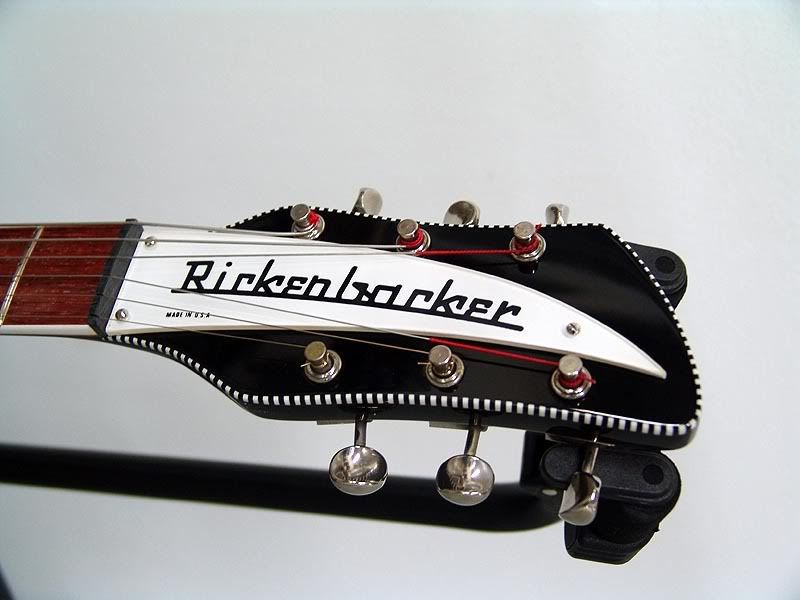
I hope this gives you a good idea of the correct "look"!
Here's the stepped rabbet running around the circumference, that I made reference to:
The so-called "checkerboard" purfling (from shellex.de) runs in the inner rabbet, which is typically cut about 3/16" X 1/16":
Over this goes the white celluloid binding from axinc.net, which is then scraped and sanded to be flush with both surfaces:
End result after painting looks like this:
Sometimes headstocks are bound with checkerboard, sans the white outer binding:
I hope this gives you a good idea of the correct "look"!
Re: '67 366/12 Restoration Questions....
Thank you!!!!!!!
This one is gonna be tough, as the guy actually removed wood from the side of the instrument....
Will keep ya'll posted as to how this proceeds...
Thanks again....
bruce
This one is gonna be tough, as the guy actually removed wood from the side of the instrument....
Will keep ya'll posted as to how this proceeds...
Thanks again....
bruce
Re: '67 366/12 Restoration Questions....
OK, if someone has one kicking around and handy, I'm looking for a measurement for the width at the widest point --measuring side-to-side--of the back of a late 60's 360 body....
I'm trying to figure out just how much wood this guy took off from around the rim....
Thanks in advance!!
I'm trying to figure out just how much wood this guy took off from around the rim....
Thanks in advance!!
-
jingle_jangle
- RRF Moderator
- Posts: 22679
- Joined: Wed Dec 22, 2004 6:00 am
- Contact:
Re: '67 366/12 Restoration Questions....
You don't have to look too far...it would appear (wood appear? ) that the edge had 1/16 taken off, to remove the thickness of the white binding down to the checkerboard purfling.
Tip: Remove the checkerboard and re-cut the rabbet for the checkerboard to 1/4"-9/32" wide X 1/16 deep with this type of router bit:
http://www.stewmac.com/shop/Tools/Speci ... r_Bit.html
Then use this bit in a Dremel to cut a new rabbet for the checkerboard, 3/16" wide X 1/16" deep:
http://www.stewmac.com/shop/Tools/Speci ... nding.html
This will give you the stepped rabbet. Checkerboard goes in the inside step, white celluloid in the outer.
You may have to re-radius (round over) the front to blend with the sides, if it hasn't been properly done already when the edge was buzzed off by the previous nut.
If not, just scrape/sand the binding to be flush with back and sides and Bob's yer mother's brother.
Oh, yeah, and then you'll have to refinish the guitar...
) that the edge had 1/16 taken off, to remove the thickness of the white binding down to the checkerboard purfling.Tip: Remove the checkerboard and re-cut the rabbet for the checkerboard to 1/4"-9/32" wide X 1/16 deep with this type of router bit:
http://www.stewmac.com/shop/Tools/Speci ... r_Bit.html
Then use this bit in a Dremel to cut a new rabbet for the checkerboard, 3/16" wide X 1/16" deep:
http://www.stewmac.com/shop/Tools/Speci ... nding.html
This will give you the stepped rabbet. Checkerboard goes in the inside step, white celluloid in the outer.
You may have to re-radius (round over) the front to blend with the sides, if it hasn't been properly done already when the edge was buzzed off by the previous nut.
If not, just scrape/sand the binding to be flush with back and sides and Bob's yer mother's brother.
Oh, yeah, and then you'll have to refinish the guitar...