
Follow the link to a pdf file where 11 different sets of electric strings has been tested for tension. Hope that the information will be useful.
Cheers,
Si.........
Link: http://www.scribd.com/doc/95267938/STRI ... NBACKER-12
Extract / Summary:
STRING TENSION AND VINTAGE 1960'S RICKENBACKER 12 STRING ELECTRIC GUITARS
1960's Vintage Rickenbacker 300 Series twelve string guitars with "set neck" construction are, over
time, known to experience changes in the neck to body angle. This can lead to valuable instruments
becoming difficult or impossible to play as the bridge runs out of downward adjustment to
compensate for the changing neck angle, and a very high string action becomes evident. The only
way to rectify the problem at this point, is to have the guitars neck to body connection re-set. The
problem is widely attributed to a combination of three factors, the design of the connection,
construction methods and string tension. This study was only to address the final factor, string
tension, as it is the only variable that can be controlled effectively without resorting to intrusive repair
to the instrument.
A second concern for owners of this type of guitar has been reported structural failures of the 'R'
type string tail piece used on many models made since the 1980's. The material composition used
to cast this item has apparently changed a number of times over the decades. Guitars with original
manufacturer supplied strings have been known to break the tailpiece, most probably due to string
tension on instruments made from approximately the late 1980's and through the 1990's.
Instruments from the 1960's and 70's have a different casting pattern and material makeup that is
more robust and typically have not been known to fail with any great regularity.
Debate surrounding the best type or maker of strings flourishes amongst enthusiasts even on the
single focus point of tension. The objective of this brief study is to present the results of a
comprehensive set of measurements of string tension for a number of popularly used sets of strings
on Rickenbacker 12 string guitars. In addition to these modern string sets, one new old stock set of
Rickenbacker Redbox strings was also tested.
The sets tested were selected based upon what gauges were deemed to be widely available and
commonly used today by 1960's period music enthusiasts. Sets and types that are commonly
debated on internet forums were targeted that fitted into this criteria.
Once preliminary testing had been completed, two specially ordered sets of very light 0.009" gauge
strings of equal gauges were added to the testing, one from Thomastik Infeld (TI) and one from Pyramid. A set of
these very light strings (TI's) was also sent to the owner of a 360/12c63 for playability testing.
As this undertaking was carried out entirely by a very small group of private enthusiasts, the number
of sets was limited on financial grounds. It is noted that other sets may be relatively commonly used
at present also. A total of eleven sets of strings were tested. A key objective was to present the
tension results to other enthusiasts in a completely impartial manner.
A testing rig was devised with importance placed around a robust design that would produce
consistently repeatable and accurate results. The Testing Rig scale length of the string placed in
tension was set at 628mm (24.75"), the scale length used on the 300 series full scale Rickenbacker
12 string instruments.
It can be seen that in practical terms there is very little difference in tension for the plain strings of
the same nominal gauge, regardless of manufacturer. However there are some notable differences
amongst the various types and makes of wound strings. The Octave strings for the A and E strings
have a relatively significant impact for all sets.
It may be argued that most of the gauges tested are too high in tension for valuable vintage
instruments. Clearly the extremely light gauged 0.008" to 0.032w" set of vintage Maxima strings
(Rickenbacker Redbox set) tested applies a significantly lower tension to an instrument.
Intonation of different gauge string sets is not addressed within this study, however there are many
articles available via the internet on the issues associated with varying string gauge pairs and twelve
string guitars.
A significant body of string data now exists that allows custom sets to be assembled and informed
decisions to be made by owners of valuable vintage instruments.
Simon Edwards and Karl Teten - May 2012
Tension Test Data for 12 String Sets
Moderators: rickenbrother, ajish4
-
37012player

- Junior Member
- Posts: 112
- Joined: Sat Sep 22, 2007 2:42 pm

Re: Tension Test Data for 12 String Sets
This is a very nice survey and fun to read. However, I note one major flaw and have two other minor corrections.
First, A440 (rather than 441) has been used as the official tuning standard for guitars and piano in the USA and Europe since the late 1920's. I don't know how much that will affect the tension measurements but you can most certainly hear the difference.
Second, the red box 484 was not produced by Maxima but rather V.C. Squier of Battle Creek, Michigan. At that time, the vast majority of string brands in the US were produced by them under private label contracts.
Third, Rickenbacker has never used Selmer brand strings (which were probably private label-made by someone else).
I'll also add that there are more and possibly more important reasons for the neck-body shift on these instruments but that's not what this survey is about.
First, A440 (rather than 441) has been used as the official tuning standard for guitars and piano in the USA and Europe since the late 1920's. I don't know how much that will affect the tension measurements but you can most certainly hear the difference.
Second, the red box 484 was not produced by Maxima but rather V.C. Squier of Battle Creek, Michigan. At that time, the vast majority of string brands in the US were produced by them under private label contracts.
Third, Rickenbacker has never used Selmer brand strings (which were probably private label-made by someone else).
I'll also add that there are more and possibly more important reasons for the neck-body shift on these instruments but that's not what this survey is about.
-
37012player
- Junior Member
- Posts: 112
- Joined: Sat Sep 22, 2007 2:42 pm
Re: Tension Test Data for 12 String Sets
John,
Thanks for the interest and comments. Corrections will be made to the document on your second two points.
Would you be able to shed some light on the age of the red box 484 set. The string pairs in this set were placed in clear plastic packets/bags the size of a typical paper string packet, and the gauges were hand written on the plastic with blue ball point pen.
Cheers,
Si......
Thanks for the interest and comments. Corrections will be made to the document on your second two points.
Would you be able to shed some light on the age of the red box 484 set. The string pairs in this set were placed in clear plastic packets/bags the size of a typical paper string packet, and the gauges were hand written on the plastic with blue ball point pen.
Cheers,
Si......
Re: Tension Test Data for 12 String Sets
I don't ever recall an era where the strings were in plastic bags. We had printed paper envelopes for this purpose, the string number as part of the print. The first common ones, used well into red box times, were yellow printed parchment with blue (and perhaps some other color) printing with the lightning logo. Then, coincident with the dozen pack boxes that I designed about 1970, the envelopes changed to white paper with red and black printing.
I guess there could have been a day when envelopes were out of stock but I've not seen it before.
FYI, earlier there were blue boxes with gold printing.
I guess there could have been a day when envelopes were out of stock but I've not seen it before.
FYI, earlier there were blue boxes with gold printing.
Re: Tension Test Data for 12 String Sets
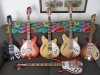
Not to veer off topic too much, but here is an intersting set that was with a '68 6006 Banjoline when it was on Ebay years ago, the paper was inside the box.....



Re: Tension Test Data for 12 String Sets
Bravo! Fascinating results. Thanks much for posting this. I've personally tried many of the sets you tested and your results coincide with my personal experience. I was quite horrified the first time I put the Pyramid 10-465 set on and saw a visible bow in the neck. I took them off almost immediately. People often refer to the TI flat 10-44 set as "low tension" but I have found them to have higher tension than the roundwound sets I tried - the various 95404 incarnations and the Curt Mangan strings. Your study seems to back that up too. The TI 10-44 set does sound great though and for whatever reason they play alot more easily than the Pyramid 10-465 set.
2010 360/12c63 FG
2002 360/12 MG (mod with 7.4K scatterwound toasters, push/pull switch for 0.0047uF bridge cap)
2002 360/12 MG (mod with 7.4K scatterwound toasters, push/pull switch for 0.0047uF bridge cap)
-
Hotzenplotz

- Intermediate Member
- Posts: 942
- Joined: Sun Sep 26, 2010 8:51 am
Re: Tension Test Data for 12 String Sets
For these datas I was asking in another thread with no results.
Now I got them! Many, many thanks!!!
That helps me to do some customizing - accompanied by useful knowledge.
Thinking about a swap to TI 11-flats now I can compare directly.
Now I got them! Many, many thanks!!!
That helps me to do some customizing - accompanied by useful knowledge.
Thinking about a swap to TI 11-flats now I can compare directly.
Re: Tension Test Data for 12 String Sets
I think it's more accurate to say the TI's are a "low stiffness" or "slinky" strings, as ultimately that's what you really feel. Stiffness and tension are two different things, although we tend to put a number on stiffness by quoting tension stats.stsang wrote: People often refer to the TI flat 10-44 set as "low tension" but I have found them to have higher tension than the roundwound sets I tried - the various 95404 incarnations and the Curt Mangan strings.
It's rather like using DC resistance to rate a pickup which is, of course, in reality a purely AC device in its function.

Re: Tension Test Data for 12 String Sets
Not only that, but tension is only a guide. As Mr. JH said, it has nothing to do with "feel." Moreover, due to the differences in core and wrap, this will say nothing about how a particular set will intonate when set up on a particular guitar. But that said, this points out items that we have all anecdotally discussed, and now have hard evidence, including that the Pyramid standard strings are not suitable for a Rick 12.
And to follow up on Mr. JH's comment about standard tuning is A=440 and not A=441: tension varies as the square of the pitch. So the actual tensions for A=400 compared to the data rendered in the publication using A=441 means that the "real" tension will be the stated numbers multiplied by 440^2 / 441^2 . In other words, the "real" tension is about 99 1/2 percent of the stated numbers for the higher pitch, which is roughly about a single pound less tension overall for each entire set.
And to follow up on Mr. JH's comment about standard tuning is A=440 and not A=441: tension varies as the square of the pitch. So the actual tensions for A=400 compared to the data rendered in the publication using A=441 means that the "real" tension will be the stated numbers multiplied by 440^2 / 441^2 . In other words, the "real" tension is about 99 1/2 percent of the stated numbers for the higher pitch, which is roughly about a single pound less tension overall for each entire set.
Re: Tension Test Data for 12 String Sets
That's very good to know. Intuitively I would have said it was a linear relationship.iiipopes wrote:And to follow up on Mr. JH's comment about standard tuning is A=440 and not A=441: tension varies as the square of the pitch. So the actual tensions for A=400 compared to the data rendered in the publication using A=441 means that the "real" tension will be the stated numbers multiplied by 440^2 / 441^2 . In other words, the "real" tension is about 99 1/2 percent of the stated numbers for the higher pitch, which is roughly about a single pound less tension overall for each entire set.
As an aside, we once recorded a tune in the studio where our base track was a sampled baroque orchestra. As we added some guitar and other modern sample tracks, we kept hearing some very strange dissonance at various points. Turned out the orchestra was tuned to 441 and naturally, everything else was at 440; it took quite awhile to figure that out.
Re: Tension Test Data for 12 String Sets
Thanks for the excellent work, and paper.
Just an editorial comment: I find it impossible to adequately resolve the different colors in the graph on the last page. For example, on my Macbook Pro, the colors for the bars labeled 18.0 and 19.2 appear identical. In addition, I may be slightly color blind, and I imagine there are others worse so off. I would be a great service to publish this such that color perception or differentiation were not necessary to discern the content.
Thanks,
jv
Just an editorial comment: I find it impossible to adequately resolve the different colors in the graph on the last page. For example, on my Macbook Pro, the colors for the bars labeled 18.0 and 19.2 appear identical. In addition, I may be slightly color blind, and I imagine there are others worse so off. I would be a great service to publish this such that color perception or differentiation were not necessary to discern the content.
Thanks,
jv
Re: Tension Test Data for 12 String Sets
Indeed. Thanks also for confirming my ears at gigs: I played a gig this weekend on the outdoor patio or veranda at a popular watering hole near a local lake. As the sun set, the temperature naturally dropped and the relative humidity naturally rose. By third set, it was apparent to me the guitars were going askew to the electronic keyboards and my bass (I kept an electronic tuner in front of me to keep tweaking as the evening progressed), and I started hearing the same kinds of dissonances.johnhall wrote:As an aside, we once recorded a tune in the studio where our base track was a sampled baroque orchestra. As we added some guitar and other modern sample tracks, we kept hearing some very strange dissonance at various points. Turned out the orchestra was tuned to 441 and naturally, everything else was at 440; it took quite awhile to figure that out.
-
Hotzenplotz
- Intermediate Member
- Posts: 942
- Joined: Sun Sep 26, 2010 8:51 am
Re: Tension Test Data for 12 String Sets
A bit off topic:
This 440/ 441 tuning annotations solved a problem when I had a rehearsal with strings at the weekend. Yes, it can sound very strange...
Back to topic:
The results of the different string measurements shows that e.g. Thomastik-Infeld is telling other datas (see their homepage!) for their strings. Different method?
This 440/ 441 tuning annotations solved a problem when I had a rehearsal with strings at the weekend. Yes, it can sound very strange...
Back to topic:
The results of the different string measurements shows that e.g. Thomastik-Infeld is telling other datas (see their homepage!) for their strings. Different method?
Re: Tension Test Data for 12 String Sets
The page I saw doesn't indicate a scale length. If they used a different one, which is actually quite likely, the numbers would indeed be different.Hotzenplotz wrote:The results of the different string measurements shows that e.g. Thomastik-Infeld is telling other datas (see their homepage!) for their strings. Different method?
-
Hotzenplotz
- Intermediate Member
- Posts: 942
- Joined: Sun Sep 26, 2010 8:51 am
Re: Tension Test Data for 12 String Sets

Yes of course...