
Tailpiece observations....
Moderators: rickenbrother, ajish4

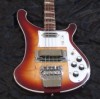

Hey all - for what's it's worth, I've had the leaning bridge dilemma on all my 4001 basses. To remedy this, I removed the height adj pins altogether and stacked small washers or coins (dimes or pennies) placed under the screw holes of the bridge. Not only does this solve the lean problem, but it helps the sustain a lot AND no drilling into the body or tailpiece is necessary. It really brings the whole stock Ricki tailpiece/bridge design up to it's full potential, which when achieved is really better than any replacement bridge I've tried, Bad-***, Hipshot, or otherwise.
I determine the number of washers or coins I use by how high I want the action to be. This remedy works great for me, especially on my '68 4001 that I particularly did not want to drill into.
I determine the number of washers or coins I use by how high I want the action to be. This remedy works great for me, especially on my '68 4001 that I particularly did not want to drill into.

Excellent tip Mark!!!!
I've stacked 3 5 pence pieces (I live in UK), which are about the same size as a dime under the bridge.
I used to have a dead spot on the D string 10 fret C. That has disappeared completely. A bit more sustain too.
Plus you can move the bridge back a fraction, which helps with any intonation problems.
Genius!!!!
I've stacked 3 5 pence pieces (I live in UK), which are about the same size as a dime under the bridge.
I used to have a dead spot on the D string 10 fret C. That has disappeared completely. A bit more sustain too.
Plus you can move the bridge back a fraction, which helps with any intonation problems.
Genius!!!!
What d'ya mean... the bass is TOO loud!
Gary...
The 6-32 set screws only come in the "cup" shape on the bottom... To fix this dilemma, simply drop a small tiny ball bearing into the hole for the set screw to ride on...
I cut a small flat piece of brass and dropped it into the hole...So I have the set screw ridding on this so it doesn't dig any further into the wood.. The holes are about 1/4" deep...
I don't really like drilling holes into my instruments..on the other hand if I have a 4001 that is useless to me because the E-string is completely weak...then at that point it makes sense to do...
P.S. I have a bunch of new 4001 truss rod nuts if anyone is interested..
Chris
The 6-32 set screws only come in the "cup" shape on the bottom... To fix this dilemma, simply drop a small tiny ball bearing into the hole for the set screw to ride on...
I cut a small flat piece of brass and dropped it into the hole...So I have the set screw ridding on this so it doesn't dig any further into the wood.. The holes are about 1/4" deep...
I don't really like drilling holes into my instruments..on the other hand if I have a 4001 that is useless to me because the E-string is completely weak...then at that point it makes sense to do...
P.S. I have a bunch of new 4001 truss rod nuts if anyone is interested..
Chris
Ted...
I take it your set screws are only sitting on the surface of the wood???
Is your bridge sitting upright 90 degrees or is it drooped to the rear????
ARe your set screws the original ones at 5/8 length????
The trick is to go down about 1/4" into the wood and use a longer set screw at 1"...
I ordered a box of 50 of these 6-32 set screws at 1"....
Chris
I take it your set screws are only sitting on the surface of the wood???
Is your bridge sitting upright 90 degrees or is it drooped to the rear????
ARe your set screws the original ones at 5/8 length????
The trick is to go down about 1/4" into the wood and use a longer set screw at 1"...
I ordered a box of 50 of these 6-32 set screws at 1"....
Chris
Great stuff Mark! I've been playing and the tone and sustain is definitely a lot better. A bit more punch too. Plus there is no modification needed. I like it!
It's probably because there is more of the bridge connecting with the tailpiece, due to the extra surface area provided by the coins.
Enough of the science.... Bloody brilliant!
It's probably because there is more of the bridge connecting with the tailpiece, due to the extra surface area provided by the coins.
Enough of the science.... Bloody brilliant!
What d'ya mean... the bass is TOO loud!
I think it is a legit topic Jeff. It interests me greatly. Many 4001s and some 4003s suffer from dead spots that no amount of truss tweaking will fix. The tailpiece is just as likely a target as any other that I can think of. I let a LOT of 4001s go over the years because of a distinct lack of bottom from the E string. At this point, I consider any effort to remedy the situation to be a public service. Perhaps this will turn out to be waste of time. Perhaps not but we won't know until we try. Constructive comments are welcome.