

I agree Peter and in my opinion Sir Paul's best work was done after he was given his Rickenbacker.
Thanks for the info Jerry, I hadn't really considered it might be worth something. Regarding the tone you heard out of the Hofner at the Ronnie Mack gig, maybe modern amplification really helps. I really should dust my 500/1 off and see how it sounds through a Trace.
I'm not totally down on Hofners by the way, but if I could have only one bass that wouldn't be the one. I would take one of my 4004 models, though I have to say my "classic" Ricks are great too so it wouldn't be an easy choice.
Hofner Violin Basses
Moderator: jingle_jangle
I was very fortunate to have had the opportunity to visit the Hofner factory in Haganeu a couple of May's ago. It was to say the least a experience that I will never forget.
To visit any guitar factory is in my opinion "is a treat", to visit the Hofner factory was awesome!
I've owned and played a Hofner 500/1 since 1966, so to visit this factory was a thrill of a lifetime.
The skill and craftsmenship that every employee in the factory has is unbelieveable. Most of the employees have worked there 40 plus years.
Hofner do incorporate some modern day technology in their day to day manufacturing, but over all very little. Almost all of the work is done by hand.
Outside the main wood shop is a large open storage area that is filled with various woods sitting on large skids. This wood is curred a minimum of 25 years out doors before it is brought inside to climatize in a special drying room for 6 months. Only then is it moved into the production area to make bodies and necks of guitars, basses, violins, cellos, etc.
Once the wood is cut into production pieces, it goes through various stages of shaping and cutting depending on what the piece is going to be used as. For instance, only seven 500/1 necks are cut on the shaping machine at one time. It takes almost one hour for the machine to shape the necks into their basic form. From there, they are hand sanded to perfection.
Most Hofner's have scalloped tops and backs. To see the staff cut and form these pieces is truly amazing. Each piece is cut and formed until the proper thickness of wood is arrived at.
Fronts, backs, sides and bindings are all assembled and glued together to form the body. They're bound by hand and left to sit and cure for a week or two on a special rack. Then they're sent to the finishing booths. Two to be exact. Every instrument goes through these. Once the finishing and drying process has been completed the instruments are moved into the final assembly area where the necks and hardware and special bindings are attached to the instrument.
There are 3 gentlemen who work on electric guitars and basses at this final assembly stage and 2 others that work on acoustic only guitars and that's it.
These are the guys that give each instrument "its personality" if you will. No instrument is exactly the same because each piece of the instrument for the most part has been created by hand.
While I was visiting Hofner I was not permitted to take any pictures while inside the wood shop itself, however I was allowed to take some of their showroom and outside. Perhaps if Peter will allow these photos to be posted here I would gladly send them to him.
I do have photos of the prototype Relic Verythin, Star 60 and Club 500/2 bass that were in the showroom on display while I was there.
They told me that each instrument is sold long before it goes into production (just like RIC).
and just like RIC, they can't keep up with the demand for their guitars and violins. There is no inventory of finished intruments kept on hand.
There was a time during the 70's 80's and early 90's when Hofner was still owned by Christen Benker, where the quality control suffered and many 2nd grade instruments were shipped and sold.
When B & H took over in the early 90's, the first thing they did was work on improving the quality control. It took a couple of years but they were very successful and the quality of todays Hofner's reflect those improvements.
Today I own a 500/1 Vintage 62 with a thin neck that is absoutely gorgeous. It's fun to play and always a conversation piece where ever I take it.
I don't use traditional flatwound strings on it but rather Hofner roundwounds. They eliminate alot of the traditional thump.
Cheers,
JC
To visit any guitar factory is in my opinion "is a treat", to visit the Hofner factory was awesome!
I've owned and played a Hofner 500/1 since 1966, so to visit this factory was a thrill of a lifetime.
The skill and craftsmenship that every employee in the factory has is unbelieveable. Most of the employees have worked there 40 plus years.
Hofner do incorporate some modern day technology in their day to day manufacturing, but over all very little. Almost all of the work is done by hand.
Outside the main wood shop is a large open storage area that is filled with various woods sitting on large skids. This wood is curred a minimum of 25 years out doors before it is brought inside to climatize in a special drying room for 6 months. Only then is it moved into the production area to make bodies and necks of guitars, basses, violins, cellos, etc.
Once the wood is cut into production pieces, it goes through various stages of shaping and cutting depending on what the piece is going to be used as. For instance, only seven 500/1 necks are cut on the shaping machine at one time. It takes almost one hour for the machine to shape the necks into their basic form. From there, they are hand sanded to perfection.
Most Hofner's have scalloped tops and backs. To see the staff cut and form these pieces is truly amazing. Each piece is cut and formed until the proper thickness of wood is arrived at.
Fronts, backs, sides and bindings are all assembled and glued together to form the body. They're bound by hand and left to sit and cure for a week or two on a special rack. Then they're sent to the finishing booths. Two to be exact. Every instrument goes through these. Once the finishing and drying process has been completed the instruments are moved into the final assembly area where the necks and hardware and special bindings are attached to the instrument.
There are 3 gentlemen who work on electric guitars and basses at this final assembly stage and 2 others that work on acoustic only guitars and that's it.
These are the guys that give each instrument "its personality" if you will. No instrument is exactly the same because each piece of the instrument for the most part has been created by hand.
While I was visiting Hofner I was not permitted to take any pictures while inside the wood shop itself, however I was allowed to take some of their showroom and outside. Perhaps if Peter will allow these photos to be posted here I would gladly send them to him.
I do have photos of the prototype Relic Verythin, Star 60 and Club 500/2 bass that were in the showroom on display while I was there.
They told me that each instrument is sold long before it goes into production (just like RIC).
and just like RIC, they can't keep up with the demand for their guitars and violins. There is no inventory of finished intruments kept on hand.
There was a time during the 70's 80's and early 90's when Hofner was still owned by Christen Benker, where the quality control suffered and many 2nd grade instruments were shipped and sold.
When B & H took over in the early 90's, the first thing they did was work on improving the quality control. It took a couple of years but they were very successful and the quality of todays Hofner's reflect those improvements.
Today I own a 500/1 Vintage 62 with a thin neck that is absoutely gorgeous. It's fun to play and always a conversation piece where ever I take it.
I don't use traditional flatwound strings on it but rather Hofner roundwounds. They eliminate alot of the traditional thump.
Cheers,
JC
I am happy to hear that things are well at Hofner. But if most of the employees have been there 40+ years, how is it that many 2nd grade instruments were sold before Boosey took over? Were these craftsmen forced to use poor materials or methods? Or were there other incompetent employees who were terminated?
Like many things, repetition can lead to boredom over time. Christen Benker who owned Hofner during this time didn't see that (or just didn't care). He was close to the end of his career at Hofner and knew he was going to sell the company. He didn't encourage or motivate his people to make every instrument the very best that they could. And he really didn't care, cause everything they made was presold anyway.
When Boosey & Hawkes took over they put a number of quality control incentives in place for each employee to achieve. It took awhile for everyone to get the message but the results as predicted were improved overall quality of every instrument made while also increasing productivity.
If you've held or played a new Hofner within the past 6 or so years you'll know what i'm talking about.
Every instrument produced now a days is perfect or it doesn't leave the building.
The B & H management at Hofner were very concerned about replacing their long time skilled employees when they decide to retire.
They started an apprentiship program when they bought the company and since then have been hiring on new employees that are being trained how to develop the many wood working skills that they need in order to build musical instruments and become master craftsmen.
When Boosey & Hawkes took over they put a number of quality control incentives in place for each employee to achieve. It took awhile for everyone to get the message but the results as predicted were improved overall quality of every instrument made while also increasing productivity.
If you've held or played a new Hofner within the past 6 or so years you'll know what i'm talking about.
Every instrument produced now a days is perfect or it doesn't leave the building.
The B & H management at Hofner were very concerned about replacing their long time skilled employees when they decide to retire.
They started an apprentiship program when they bought the company and since then have been hiring on new employees that are being trained how to develop the many wood working skills that they need in order to build musical instruments and become master craftsmen.

Jon: It would seem that Hofner has "uped its game." Many of my impressions of Hofner basses have been bassed on old Hofners that I have played. B & H must have realized that a manufacturer's reputation is based as much on the poor instruments that they make as the good ones. It seems to me that they also need an advertising campaign to go along with this improvement in quality of which you speak.
Life, as with music, often requires one to let go of the melody and listen to the rhythm
Please join the Official RickResource Forum Facebook Page https://www.facebook.com/groups/379271585440277
Please join the Official RickResource Forum Facebook Page https://www.facebook.com/groups/379271585440277
Peter, I've noticed over the past year or so that Boosey & Hawkes had been placing high quality print ads in many of the music industry publications. Not only were the ads promoting specific models but they were focusing on the quality of all new Hofner guitars and basses being made today.
Some of the mags i've seen them in are Vintage Guitar, Bass Player, Guitar Player to name a few.
Perhaps with The Music Group now taking full control of Hofner they will focus and improve their Hofner marketing efforts.
I must admit, that of the many Hofner's that i've owned over the past 40 years most of them left very good lasting impressions with me.
A quick story, last week while visiting a local vintage guitar store here in T.O. there was a Hofner 500/1 Beatle Bass in stock. Upon picking the bass up I noticed that it was beat, but original. The store claimed that it was a 64. I begged to differ because it had 65-66 features. Upon sitting down and playing the bass I must admit that it played very nice with great action and a great neck. Upon a closer look I noticed the bass was missing some of the body finish on the back and was suffering the worse case of finish lacquer checking that i've ever seen on any instrument. On top of that the neck had been reset. 15 years ago you couldn't get $100.00 for this bass. The price today was $3k.
This continues to amaze me when I see a 72 4001 in good condition selling for less than half the price.
This makes no sence.
Some of the mags i've seen them in are Vintage Guitar, Bass Player, Guitar Player to name a few.
Perhaps with The Music Group now taking full control of Hofner they will focus and improve their Hofner marketing efforts.
I must admit, that of the many Hofner's that i've owned over the past 40 years most of them left very good lasting impressions with me.
A quick story, last week while visiting a local vintage guitar store here in T.O. there was a Hofner 500/1 Beatle Bass in stock. Upon picking the bass up I noticed that it was beat, but original. The store claimed that it was a 64. I begged to differ because it had 65-66 features. Upon sitting down and playing the bass I must admit that it played very nice with great action and a great neck. Upon a closer look I noticed the bass was missing some of the body finish on the back and was suffering the worse case of finish lacquer checking that i've ever seen on any instrument. On top of that the neck had been reset. 15 years ago you couldn't get $100.00 for this bass. The price today was $3k.
This continues to amaze me when I see a 72 4001 in good condition selling for less than half the price.
This makes no sence.
Jon: Great story. Can you spell M c C A R T N E Y?
Life, as with music, often requires one to let go of the melody and listen to the rhythm
Please join the Official RickResource Forum Facebook Page https://www.facebook.com/groups/379271585440277
Please join the Official RickResource Forum Facebook Page https://www.facebook.com/groups/379271585440277
-
shamustwin
- Senior Member
- Posts: 5287
- Joined: Tue Apr 29, 2003 5:00 am
When I was at Hofner factory a few years ago, during one of the conversations that we had the name Klira came up. Apparently when Klira closed their doors, some of their crafts people came to work for Hofner.
Klira was another guitar company also located in the village of Bubenreuth. This is before Hofner moved 14 yrs ago down the road (3 miles) to the village of Haganeau.
Klira also used many of the same parts suppliers that Hofner used, and many of their guitar/bass designs were almost identical to one another.
I recently purchased the Klira "Twen Star" violin bass pictured below. It is body/neck wise identical to a Hofner 500/1. Klira used the same woods and building methods as Hofner to make their instruments. Other than the missing pickguard the bass is original and very solid for a 65 model. It feels and plays just like a Hofner 500/1 but has more of an "edge/bite" than the Hofner.


These are very cool basses. Klira used the same tailpiece and binding as the 500/1 on their Twen Star.
There have always been alot of Hofner copies out there, but this has to be the ultimate 500/1 copy when you think about it. Especially when you consider that they were made a few blocks away from the Hofner factory.
Unfortunately, Klira couldn't cash in on the popularity of the Hofner 500/1 because of poor marketing. Had these basses come to North America, i'm sure they would have given Hofner a good run for the money.
Klira was another guitar company also located in the village of Bubenreuth. This is before Hofner moved 14 yrs ago down the road (3 miles) to the village of Haganeau.
Klira also used many of the same parts suppliers that Hofner used, and many of their guitar/bass designs were almost identical to one another.
I recently purchased the Klira "Twen Star" violin bass pictured below. It is body/neck wise identical to a Hofner 500/1. Klira used the same woods and building methods as Hofner to make their instruments. Other than the missing pickguard the bass is original and very solid for a 65 model. It feels and plays just like a Hofner 500/1 but has more of an "edge/bite" than the Hofner.
These are very cool basses. Klira used the same tailpiece and binding as the 500/1 on their Twen Star.
There have always been alot of Hofner copies out there, but this has to be the ultimate 500/1 copy when you think about it. Especially when you consider that they were made a few blocks away from the Hofner factory.
Unfortunately, Klira couldn't cash in on the popularity of the Hofner 500/1 because of poor marketing. Had these basses come to North America, i'm sure they would have given Hofner a good run for the money.
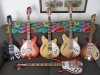
I also have a Klira Violin bass, which I believe to be earlier than the one above; it is quite cool, and I even play it out(upside down) from time to time. Mine doesn't have sound holes in the top, but it does have a fat two-piece bolt-on neck, a single piece back, no body binding. The finish is darker, almost like a Rickenbacker dark walnut finish. It sounds great. Mine has the same p/ups and controls as Jon's.
Jon, do you have a literature on the Kliras?
Jon, do you have a literature on the Kliras?
John, I've emailed you what Klira literature I have.
The neck on my bass is 3 piece. The body/neck joint uses a single bolt / set neck design. The back and front are definately 2 piece on mine.
I have jpeg photos of darker Twen Star's but never seen one in person. The color of mine is more like a butterscotch burst for lack of a better description. I have also seen the bass utilizing pickup covers that are chrome and white.
I think the fully bound "cats eyes" sound holes on the front of the bass are very cool looking.
This bass maybe just passing through my collection. I haven't decided for sure yet. But if I keep it, I think i'll have a pickguard made for it.
The neck on my bass is 3 piece. The body/neck joint uses a single bolt / set neck design. The back and front are definately 2 piece on mine.
I have jpeg photos of darker Twen Star's but never seen one in person. The color of mine is more like a butterscotch burst for lack of a better description. I have also seen the bass utilizing pickup covers that are chrome and white.
I think the fully bound "cats eyes" sound holes on the front of the bass are very cool looking.
This bass maybe just passing through my collection. I haven't decided for sure yet. But if I keep it, I think i'll have a pickguard made for it.

