The mono Helter Skelter was indeed released in the US in 1980.Scastles wrote:JakeK wrote:I hear there are some stereo mixes better than mono ("Helter Skelter"), I hear there are some mono better than stereo ("She's Leaving Home").
The primary reason you'll find the stereo mix better than the mono mix of "Helter Skelter' is because the stereo version is nearly a full minute longer than the mono. Ringo's blistering scream is also absent from the mono copy. The mono version was never released in the U.S.
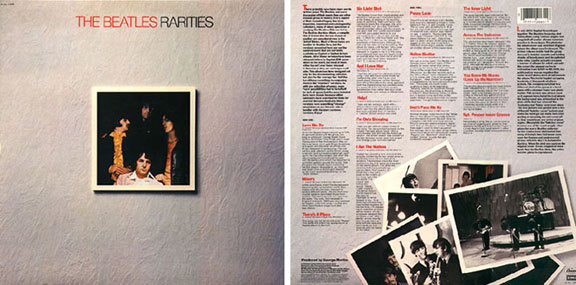
RARITIES (March 24, 1980 - Capitol SHAL 12060
http://www.rarebeatles.com/boxsets/rarius.jpg
Side One
Love Me Do - (Version 1) with Ringo on drums. At the time, the master of this take could not be located in EMI's vaults so Randall Davis had to settle for an excellent quality dub of the original single, supplied by Ron Furmanek.
Misery - the common recording, but this was the first time the song appeared in stereo on a Capitol album. It was previously available just as a single (Capitol Starline 6065).
There's A Place - same circumstances as Misery. Issued by Capitol as a single in October 1965 (Capitol Starline 6061).
Sie Liebt Dich - had only been issued in the United States in 1964 as a single on Swan Records (Swan 4182). This marked the first Capitol Records release, and the first stereo release in America. The liner notes on Rarities are incorrect. They say "EMI persuaded (the Beatles) to re-cut the vocal tracks 'I Want To Hold Your Hand' and 'She Loves You' - in German. . . ." The backing was recut for "Sie Liebt Dich" but not for "Komm, Gib Mir Deine Hand", for which the original backing was used. The reason most often given is that the original master for "She Loves You" had been destroyed/lost/wiped by this time (q.v. Lewisohn, Recording Sessions). Others have claimed recently that at least part of SLD comes from SLY, and that the manual tape synchonization which created SLY was such a mess to reproduce that SLD turned out terribly.
And I Love Her - contains Paul's double-tracked vocals and six bars of acoustic guitar in the fade-out. This may be a Capitol creation - the Rarities version sounds like it's the usual version with an extended ending.
Help - The mono single mix has different lead and backing vocals and lacks the tambourine present in the stereo mix.
I'm Only Sleeping - this is the true stereo version, which in America could only be found on the Capitol Record Club edition of "Yesterday" . . . And Today, and on all stereo tape formats of Y & T. It also appeared in true stereo on some commercial copies of the album pressed in Winchester, VA, after c. 1973. The liner notes on Rarities are in error. They claim only two versions of this track exist when, in fact, we have located five so far. They also state that the verses in this version were rearranged. The differences between the various takes are only in the amount of "backwards guitar" included and in the places where it was cued in. The structure of the song is identical in all recordings.
I Am The Walrus - this is a new, composite version created by Capitol engineers John Palladino and George Irwin. They took the British stereo version with the six-beat introduction and spliced in the four extra beats of music heard after the third verse in the mono recording.
Side Two
Penny Lane - another composite track by Palladino and Irwin.
This time, they took the true stereo version, which had never been released in the United States before (the version on the American stereo Magical Mystery Tour was "reprocessed"), and added the seven piccolo trumpet notes heard at the end of this song on the U.S. and Canadian promotional singles.
Helter Skelter - the mono mix.
Don't Pass Me By - the mono mix.
The Inner Light - the first time this song had ever been issued on an American album. This is the original mono mix.
Across The Universe - (Version 1); the first time this George Martin-produced version had ever been released in the United States.
You Know My Name (Look Up The Number) - the first time this mono track had ever been included on an album in America.
Sgt. Pepper Inner Groove - the first time these four seconds of Beatles sounds had ever been issued in the United States.