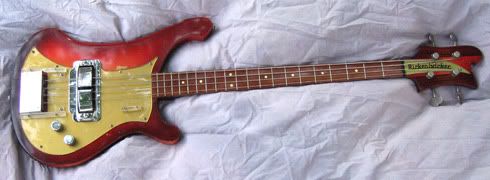
Some interesting comments and questions. Here are my thoughts.
cheyenne wrote:Nice Jake. How does it sound?
It's remarkably clear and responsive to differences in technique and attack. It seems to really excel on some of the more rhythmic lines I play -- you can really hear each individual note.
Spike- wrote:
The one in OP's link seems like an exagerrated version of the one you posted. The headstock is big, but it's also tall so it dosen't appear 'fat'. The horns do have a bit of an odd shape but they're more restrained and look like a classic Rick.
Actaully, i'm really liking that image. I should look at the gallery on the corporate site more often. That bass looks gorgeous.
For what it's worth, there is quite a bit of variation between the basses from this era, including body and headstock shape and pickguards. We worked with pictures of a whole bunch of different basses from this era. The shape of my bass looks quite a bit like some of them, and not as much like others. The headstock is the trickiest part, because I didn't want Larry to rebuild the whole headstock, and I think he did a great job of getting close to the shape with that constraint -- within the range of what these looked like, I think.
egosheep wrote:The only thing I saw that was off was the knobs and the plexi bridge holder. Usually the plexi pieces on the bass are much longer than the bridge cover itself. The knobs also seem to be the newer Ric chrome type. Those original 50's chrome knobs is a huge detail on a bass like this. I also don't like the way the pickguard swings up around each side of the pickup... seems like it should be a curved line reflecting the curve of the body.
The issue that this raises for me is this: What does it take to make a "kosher" fantasy Ric(as many of us would like to own)? When you're looking at this bass, needing a new body, new pickguard, new bridge and tailpiece, new pickup, knobs, new trc and heavy headstock modification, the only thing original is the neck and the serial. It seems terrible to destroy a perfectly good bass like this... if the only reason for it is to lend an air of legitimacy to a largely luthier-created dream instrument. It's your guitar and you can do what you want with it, but if the object is to avoid infringing copyrights, I'm not totally sure it's achieved this way. IE... if I were to handbuild a body in this 50's 4000 shape, I would be liable for a cease and desist, but if I have a project Rickenbacker ready to destroy, I would be in the clear?
Does this mean if I buy a valid serial # jack and or TRC, I can have a new body and neck built for it to sit on? Where is the line drawn?
Well, let me start with the "destroy a perfectly good bass like this" line. First, I want to state that there are plenty of 4003s basses out there, and I personally don't have any problem with anyone modifying a bass the way they see fit. People put in different pickups and refinish basses all the time. This went a bit further than that, but really how much further than replacing all of the hardware and the finish, and reshaping the wood? Not all that much further, I think. That said, this was far from a "perfectly good bass" when I got it -- as you can see in the "before" pics, it was stripped down to bare wood and sanded down in several spots. Since it'd been played without any finish, the wood was grimy and nasty in a few places in a way that you could never clean. Almost none of the original parts were on it, and the electronics had been resoldered so many times that the harness was barely salvageable. The tuners were all but frozen, and the bridge had been filed in an awkward attempt to adjust the action. So what's the appropriate way to restore this? If you cover the nasty wood with a solid finish, you still have the goofy amateur reshaping to look at. My point is, this bass needed a ton of work anyway, and there's nothing rare or remarkable about a 4003s, so why not make it into something a little more interesting? (Especially when the cost of restoration would have just bought a much nicer 4003s.) It has nothing to do with legitimacy or avoiding copyright infringement, and everything to do with taking a dog of a bass and making it into something cool.
Second, you talk about the only things "original" being the neck and the jackplate, and that's true, but not all that different from a lot of other restorations -- and it ignores the fact that as many parts as possible are authentic RIC parts. It took me two years to get the right parts, and most of them are even from the right era (most of the tuners, wiring harness, surround, magnetic shoes -- I had a pickup that didn't work out, too). The TRC is a legit gold plexi TRC that goes on RIC's own reissues. The other parts are as faithful a replica as I could find (good luck finding an original bridge for one of these). We've seen tons of basses converted to look like a pre-73 4001, RIHS pickups used to sell for huge money around here for the vintage look ... aside from the new wood (replacing damaged wood), how is this different except for being an homage to a different era?
aceonbass wrote:I think using the original neck and serial number keeps him in the clear, but I don't think building a whole new bass around a neck (or the other way around with body wings) make it a Rickenbacker. I feel that too much of the original instrument is gone. Looking carefully at it, almost everything about it is wrong. The pickguard, the plexi mute slides (which look like recycled finger pulls), the shape of the horns, the headstock shape, the truss rod cover. The tuners aren't right either. There are tuners out there that are exact without having to fab anything. I think it honestly comes off looking like a bad copy. It just doesn't look exact, and for what I'm sure it cost, it should be nearly indistinguishable.
I respectfully disagree with your assessment that "almost everything about it is wrong" given the wide variation of body, pickguard, and headstock shape from this era. I agree with you about the length of the plexi mute slides, and I'd love to find a better approximation (or real version) of the chrome knobs (mine are from a Laredo). I'd also be curious to find a source for the correct tuners. But for the sake of argument, if we'd built a whole new bass out of an existing Rickenbacker body, replacing no wood, using repro hardware, would it be a Rickenbacker? What if we had to replace one body wing due to fire damage, and swapped out all of the hardware? Another luthier I've worked with rebuilt a 4001 that had been in a flood, fell apart when the glue dissolved, and needed some of the wood replaced and all new (modern) hardware. Is that still a Rickenbacker? Like Heraclitus said, you cannot step twice into the same stream. But how much of the original instrument is "too much" to replace (and doesn't it matter what you replace it with)? I don't think that line is particularly clear.
There's some fantastic attention to detail here that isn't apparent in these pictures, including "deleting" the 19th fret marker, squaring off the neck heel (not perfect, but very good given the constraint of working with the original neck), the 3-ply nut, etc. We made a few concessions for parts that we couldn't find an original or good replica of, and I'm sure that you could have built a more accurate bass starting from scratch with unlimited resources, but that's not what this is. If I could have afforded that, I would have just saved up to buy an original. Instead I took a bass that I wanted to restore, and we turned it into this.