Page 2 of 3
Re: True or False: If you don't like vintage frets...
Posted: Mon Apr 11, 2011 12:48 pm
by jingle_jangle
Jeff, did Third Coast use nitro or conversion varnish?
Re: True or False: If you don't like vintage frets...
Posted: Mon Apr 11, 2011 6:47 pm
by wints
There is that old school of thought that many older 4001 basses had to have larger frets installed when the original's wore out, with the purpose to "improve neck stability"...
Maybe there is a grain of truth in there somewhere, but to me, they look cumbersome compared to the finesse of the originals, and, as mentioned here, unless done by a really skilled luthier really make a bass look poor on first (and second...) viewing, especially when the binding is involved.
Re: True or False: If you don't like vintage frets...
Posted: Mon Apr 11, 2011 7:03 pm
by paologregorio
When Larry Davis transformed "Big Red" I asked him to install the medium-tall frets over the binding to avoid some of the refret issues with Ricks; depending on era, some of the older style Ricks have frets that stop and the binding, and the binding has "nubs" that come up to meet the binding in near seamless fashion, but if one needs a refret, especially if one wants taller frets, it can be an issue. On 90s Ricks, the fret ends seem to be inserted directly into the binding, with the result that the binding may eventually crack in those spaces. I have Ricks with neck binding done both of the ways I have described.
Re: True or False: If you don't like vintage frets...
Posted: Mon Apr 11, 2011 7:10 pm
by jingle_jangle
They're never inserted right into the binding; their tangs are stepped so the fret overlaps the binding. The reason they look slotted into the binding is because the neck shrinks--along with the binding--and the fret tangs don't, so they poke through and crack the binding.
Looks like slots, but isn't.
Re: True or False: If you don't like vintage frets...
Posted: Tue Apr 12, 2011 1:24 pm
by rickaddict
jingle_jangle wrote:Jeff, did Third Coast use nitro or conversion varnish?
Well...they
didn't use nitro! Is that a good answer?!

It's been at least a year since I had it done, and I'm not a guy that knows much about finishes. When I discussed it with the shop manager, I asked if they would use conversion varnish. He told me that the stuff they use is basically the same thing...that there are two basic types of finish that they use; nitro which is air dried, and the other type which is chemically dried. I think he called it poly?
Anyhoo, it looks great. Looks just like a RIC job except that I had jumbo frets installed. I wish I had a photo handy to post.
True or False: If you don't like vintage frets...
Posted: Tue Apr 12, 2011 1:45 pm
by 8mileshigher
paologregorio wrote:When Larry Davis transformed "Big Red" I asked him to install the medium-tall frets over the binding to avoid some of the refret issues with Ricks; depending on era, some of the older style Ricks have frets that stop and the binding, and the binding has "nubs" that come up to meet the binding in near seamless fashion, but if one needs a refret, especially if one wants taller frets, it can be an issue. On 90s Ricks, the fret ends seem to be inserted directly into the binding, with the result that the binding may eventually crack in those spaces. I have Ricks with neck binding done both of the ways I have described.
Paulie --- if you don't mind re-posting, don't you have one or two close-up pics of the medium tall frets and where they meet the neck binding on Big Red or the Blue Boy ? It might be useful for the discussion to show the close-up pics of the neck-binding and new frets.

Thanks
Re: True or False: If you don't like vintage frets...
Posted: Tue Apr 12, 2011 2:29 pm
by jingle_jangle
rickaddict wrote:jingle_jangle wrote:Jeff, did Third Coast use nitro or conversion varnish?
Well...they
didn't use nitro! Is that a good answer?!
It's been at least a year since I had it done, and I'm not a guy that knows much about finishes. When I discussed it with the shop manager, I asked if they would use conversion varnish. He told me that the stuff they use is basically the same thing...that there are two basic types of finish that they use; nitro which is air dried, and the other type which is chemically dried. I think he called it poly?
Anyhoo, it looks great. Looks just like a RIC job except that I had jumbo frets installed. I wish I had a photo handy to post.
Yes, great answer. The ubiquitous "poly"--which in this case refers generically to "polyurethane". That's the right stuff!
So, Third Coast is added to my list of those who can do it right!
Re: True or False: If you don't like vintage frets...
Posted: Thu Jun 09, 2011 10:14 am
by vintagemusicgear
Drew816 wrote:...you won't like vintage Rickenbackers? In other words, if you can't play small frets than Rick's probably aren't for you?
I was talking to a buddy of mine who's a guitar broker and he said he loves Ricks but that the tiny original frets make it a challenge to play and if a vintage Rick is refret'ed it dings the value.
Admittedly I'm a big fret fan, 6100's for me. Now I don't expect I'm going to find jumbo's on a vintage Rick but if they are dominated by tiny frets it's something I have to consider pretty strongly.
How often do you see vintage Rick's that have been refret'ed with bigger frets? Value dinged or not, to me if the guitar has the original frets and it's unplayable than it's not something I'm going to be interested in as I want to play. Buying one as an investment I can understand but that's not my world...
Thoughts?
And I'm not trying to ding vintage Rick's, on the contrary I'm trying to learn because I really do WANT one but tiny frets and I do not get along.
Thanks!
Just like anything, you will get used to, and really like vintage frets. It just may take a little time. My guitar tech loves vintage frets, but used to be a big fret guy....
Re: True or False: If you don't like vintage frets...
Posted: Sun Jun 12, 2011 11:58 am
by Chris82
I prefer vintage frets. I tried playing a new Fender American Special Telecaster in a shop and the huge frets were definitely a deal breaker. Smaller frets feel and (to my ears) sound better.
Re: True or False: If you don't like vintage frets...
Posted: Wed Aug 03, 2011 12:17 pm
by benjamin672
I have spent some time thinking about this issue and I've come to agree with vintagemusicgear. I think it's something that you get used to over time and it's one of the distinguishing features of these guitars. That said, I would always choose a guitar I know I will spend time playing -- if I bought something and had it sitting in its case forever because I didn't want to deal with x issue when I played it, I would feel terrible. So I would give the smaller frets a chance but ultimately choose something you'll spend too much time playing
Re: True or False: If you don't like vintage frets...
Posted: Fri Aug 19, 2011 6:56 am
by soundmasterg
I play blues a lot and bend strings a lot, and for me the vintage frets are really hard to work with. Its not the width really but the lack of height that I have an issue with. I have a lot of guitars and I don't really use the Rics much out for blues because of the small fret issue. I do use the Rics for other music styles more, and eventually I will get them refretted with larger frets from somebody good. My 230 does have larger frets stock and that is much easier to play when bending than the 350V63 or 360/6.
Greg
Re: True or False: If you don't like vintage frets...
Posted: Fri Aug 19, 2011 10:47 am
by johnhall
jingle_jangle wrote:rickaddict wrote:jingle_jangle wrote:Jeff, did Third Coast use nitro or conversion varnish?
Well...they
didn't use nitro! Is that a good answer?!
It's been at least a year since I had it done, and I'm not a guy that knows much about finishes. When I discussed it with the shop manager, I asked if they would use conversion varnish. He told me that the stuff they use is basically the same thing...that there are two basic types of finish that they use; nitro which is air dried, and the other type which is chemically dried. I think he called it poly?
Anyhoo, it looks great. Looks just like a RIC job except that I had jumbo frets installed. I wish I had a photo handy to post.
Yes, great answer. The ubiquitous "poly"--which in this case refers generically to "polyurethane". That's the right stuff!
So, Third Coast is added to my list of those who can do it right!
You don't think this might mean polyester? "Chemically dried" meaning catalyst?
Re: True or False: If you don't like vintage frets...
Posted: Fri Aug 19, 2011 11:45 am
by paologregorio
jingle_jangle wrote:They're never inserted right into the binding; their tangs are stepped so the fret overlaps the binding. The reason they look slotted into the binding is because the neck shrinks--along with the binding--and the fret tangs don't, so they poke through and crack the binding.
Looks like slots, but isn't.
Ooh, I missed this when you posted it, Paul. Interesting. Thanks for clearing that up. I bought the 90s Ricks in question second hand, and within the last 5-6 years, so I never saw these guitars brand new.
My 11/84 built Azure Glo WB's neck binding and frets were done with "nubs," so the fret ends at the binding, which has a "nub" at each fret that comes up to meet the fret profile. This binding is still in pristine condition, but I'm going to need a refret sometime in the not-too distant future. I'll go with medium tall, but I won't be happy to lose the "nubs" or have to have the binding replaced completely if I want to keep them.
How are these "nubs" formed? Is the binding applied with the top edge rising above the fretboard, and then trimmed to fit with the frets, or is it a separate piece, applied just where the fret is? I've always wondered about that. It appears to be the former.
8mileshigher wrote:Paulie --- if you don't mind re-posting, don't you have one or two close-up pics of the medium tall frets and where they meet the neck binding on Big Red or the Blue Boy ? It might be useful for the discussion to show the close-up pics of the neck-binding and new frets.
Thanks
Here you go: All three variations of Rick Neck binding I have. Dale did "nubs" when he refretted the Blue Boy, but that guitar's on loan for a couple more days, so I can't photograph it. In the phot of the TUR WB's neck binding, one can see how the neck and binding have shrunk, and the ends of the frets are slightly visible through the opaqueness of the neck binding.
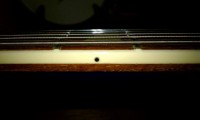
- Older Style neck edge binding, on my Azure Glo WB, built in November of 1984
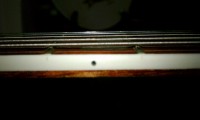
- 90s style application of binding to neck, on my TUR WB, built in January of 1997. The ends of the frets are slightly visible through the opaqueness of the neck binding.
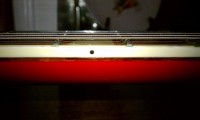
- Big Red's Binding; medium-tall frets over the top edge of the binding, as I requested. Note the crown/profile of the dressed frets; Larry did a great job of tapering them at the top and the frets are a joy to play and do not have a wide, or fat feel to them as some larger frets do when dressed differently.
Re: True or False: If you don't like vintage frets...
Posted: Fri Aug 19, 2011 11:58 am
by jingle_jangle
John--entirely possible they meant "polyester"...the term "poly" is vague and misused by guitar hobbyists.
Anyway, polyester, though not historically correct for this instrument, is still a good choice, and much more durable than nitrocellulose. I wonder if they UV-cure this stuff as the factory now does?
Re: True or False: If you don't like vintage frets...
Posted: Fri Aug 19, 2011 12:44 pm
by collin
vintagemusicgear wrote:
Just like anything, you will get used to, and really like vintage frets. It just may take a little time. My guitar tech loves vintage frets, but used to be a big fret guy....
I totally agree.
Any decent guitar player worth his salt can pretty much pick up ANY guitar, feel it out for a little while, and be able to get by and play with it.
I may agree that if you're playing some SRV blues, bigger frets are a bonus...but I can easily bend on a Ric too. Frets shouldn't be such a limiting factor (unlike short-scale guitars that are physically small for many players with larger hands).