
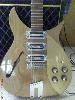
Thanks for that Larry. Hopefully we can crack this and clear up what may be the final unknown link in the '58 325's.
I wonder how many Rics from this brief period ended up with the same simplified combo wiring. We know of the 325 longbody's, but perhaps there were some other full scale capris (like the 384 above) with it too. We also know that the very first capris had full combo wiring eg: 2T100 - early 330 prototype, John Williams '58 365, Tony Blair's '58 330 (#2V103), Mark Vaquer's '58 335 (#2V134)and Tom Klein's '58 345 #3V121?)- all have full Combo wiring (not to mention that extra long crescent soundhole).
I'm also hoping to get some help from an owner of a 57/58 Combo450 or 950 with the same type of simplified combo controls, because these models enable the whole plate to be lifted and expose the complete wiring. It won't be easy to work out what's going on inside your 325, as it wouldn't be wise or easy to poke around with the insides too much. However, maybe you could loosen off the two neck pickup scews and lift it just enough to see if the extra coax happens to be connected anywhere there? Just another possibility I've considered.
The mystery inside original 2 control Capri's
Moderators: rickenbrother, ajish4
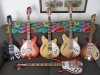

Another photo from Larry.

Life, as with music, often requires one to let go of the melody and listen to the rhythm
Please join the Official RickResource Forum Facebook Page https://www.facebook.com/groups/379271585440277
Please join the Official RickResource Forum Facebook Page https://www.facebook.com/groups/379271585440277
It could well qualify, seeing as the common proctice for Ric is to join the neck and middle pickups together in parallel. I don't think the circuit would differ between a 2 and 3 pickup model. I wonder about that rotary switch though. Is it a 3 position switch wired the same as a toggle, or does it have something different?
After checking the schematics on the Rickenbacker Corp website I found another indication that there could be a passive filter network involved. The attached pic is for early single pickup combo guitars.
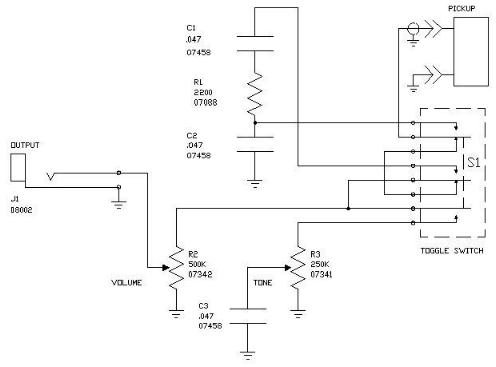
It includes 2 pots, a special 3 pole toggle switch, and a network consisting of 2 0.047uF caps and a 2K2 fixed resistor, most likely for tone shaping.
I'd love to see the equivalent schematic for two pickup combo's though. That could relate very much to the first 325's.
It includes 2 pots, a special 3 pole toggle switch, and a network consisting of 2 0.047uF caps and a 2K2 fixed resistor, most likely for tone shaping.
I'd love to see the equivalent schematic for two pickup combo's though. That could relate very much to the first 325's.
I've got a page up of some 50's wiring, including a '57 Combo 450 (2 pickups, 2 knobs, 1 switch)- unfortunately it's been meddled with a bit. There's some wiring that goes into a mystery area of fossilized masking tape- I really don't want to rip it apart, as it's hardened to near plastic strength over time & I fear damaging what's inside:
http://www.tblair.com/50s_caps.htm
http://www.tblair.com/50s_caps.htm
Excellent work Tony. There are some gems of info concealed in that wiring.
Your early 335 appears to have the same wiring as John Williams' early 365. At least there's some consistancy. It doesn't look the same as Combo850 wiring though.
The combo450 loom is very surprising. The ground from each pickup is daisychained on a seperate shielded cable back to the toggle switch, and remains independant of the main guitar ground. This may be about noise reduction, or it may be something entirely different. Needs more investigation.
The toggle switch has two shielded runs into the mystery sealed section, and one run to the volume and tone pot. I wonder is that toggle actually a pickup selector? Have you done a tap test?
Your early 335 appears to have the same wiring as John Williams' early 365. At least there's some consistancy. It doesn't look the same as Combo850 wiring though.
The combo450 loom is very surprising. The ground from each pickup is daisychained on a seperate shielded cable back to the toggle switch, and remains independant of the main guitar ground. This may be about noise reduction, or it may be something entirely different. Needs more investigation.
The toggle switch has two shielded runs into the mystery sealed section, and one run to the volume and tone pot. I wonder is that toggle actually a pickup selector? Have you done a tap test?
I've gained even more respect for the 450 after seeing Tony's pics. They went to whole lot of trouble to keep noise to a minimum in this guitar. The rear cover on each pickup, with just that small opening for each end of the coil are a good idea. They've even gone to the extent of having the external case of the pickups grounded to the cable shields, while the ground for the actual coil is run inside a seperately sheilded coax straight to the switch. This type of wiring was only possible on a guitar like the Combo450 where you could lay it all out on the pickguard like it is. It would not be possible to have such a complex circuit in a hollowbody guitar.
Very intuitive work by someone with a good handle on common-mode noise reduction here. Would it have been done by Paul Barth or was there someone else who specialised in electronics working at the Ric factory in about '57?
So Tony, have you noticed whether the 450 is fairly immune to hoise and hum?
Very intuitive work by someone with a good handle on common-mode noise reduction here. Would it have been done by Paul Barth or was there someone else who specialised in electronics working at the Ric factory in about '57?
So Tony, have you noticed whether the 450 is fairly immune to hoise and hum?
-
larrywassgren
- Veteran RRF member
- Posts: 401
- Joined: Wed Aug 16, 2000 8:34 pm
Well David, when you look at the low production numbers(28 325's in 1958 and 12 315's in 1959), how could anybody become efficient or an expert at wiring? If one guy did all the wiring on the '58 325's, he might be getting consistent by the last ten. Then, if he did all the wiring on the twelve 315's in 1959(which had four controls instead of two), he had to get beyond what he did in 1958 and figure out what he was looking for in 1959 with another two pots added! These numbers are so low and things were so new back then. Everybody, just think about it. I worked in a factory for 22 years and know what I'm talking about. It takes awhile to get good at these kinds of repetitive jobs. These numbers didn't give enough time to get consistent with anything. That's why it's so important to look at original models that haven't been tampered with. But, looking at those doesn't mean you're going to get what John had because his guitar was converted to four pots(along with two others) before they were sent to Germany. If we can find one of the other two(John's is totally rewired by Ron DeMarino who thought he was doing the right thing) then we'll have the answer(if those remain stock). Talk about looking for the needle in the haystack! But, let's keep posting here as this is all interesting and the more we turn up the better. Glen or Peter, I took the pick-ups off my guitar here for the first time since 1958. Can you post any of those photos you think might be relevant or interesting? Thanks.
Here's that photo of Larry's pickup lifted off the guitar.

And again we see completely shielded undersides on the old pickups, with just two small holes for each end of the coil to come thru.
The wiring does look a little messy on some of the pic's I've looked at. It could be factory, or some could be from servicing thru the years. Hard to be sure all these years later.
As Larry mentioned, none of these guitars were high production models. In '58 they appear to have gone thru no less than 3 versions of the wiring for the Capri's alone. It must have been confusing for production and service. Mr Hall, do any old diagrams or notes exist from back then which give some clue about the sealed section inside the '57/58 combo450's (and possibly the 325's)
And again we see completely shielded undersides on the old pickups, with just two small holes for each end of the coil to come thru.
The wiring does look a little messy on some of the pic's I've looked at. It could be factory, or some could be from servicing thru the years. Hard to be sure all these years later.
As Larry mentioned, none of these guitars were high production models. In '58 they appear to have gone thru no less than 3 versions of the wiring for the Capri's alone. It must have been confusing for production and service. Mr Hall, do any old diagrams or notes exist from back then which give some clue about the sealed section inside the '57/58 combo450's (and possibly the 325's)