

Body shape
Moderators: rickenbrother, ajish4

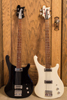
The song "Perpetual Change" by Yes nicely illustrates the evolution of RIC instruments. The 4001/4003 basses have gone through various profile changes through the past 50 years. My 3 RIC basses are different from one another. I've got some interesting measurements on my 3 Rick basses here:
-'98 4003 FG
Width at nut: 4.31cm
Width at last fret: 5.92cm
Width at body weist: 23.1cm
Weight: 9lb(s?).
-'86 4003 Shadow
Width at nut: 4.08cm
Width at last fret: 5.625cm
Width at body weist: 23.1cm
Weight: 9lb.
-'72 4001 MG FL
Width at nut: 4.31cm
Width at last fret: 5.79cm
Width at body weist: 22.1cm
Weight:8.9 lb.
If I'm not mistaken, the neck of the '72 is quarter-sawn maple while the other 2 are flat-sawn. Thickness of all 3 headstocks are the same: 21/32". Body thickness of the 3 are identical too:1 1/4".
The '98 and '72 have similar neck width. The '72 has a thin neck while the '98s is quiite fat and chunky.The '86 has a narrow neck. Its thickness is pretty much that of the 98's, but maybe just a little thinner.

The 72's body is the smallest among them but the difference in size is too small to notice. The 98's body contour is similar to the '72's but the '98 has more smooth and delicate body back contour that feels delicately sensual and sexy. The '86 has chunkier upper and lower horns and "squarier" body back contour which is the least comfortable among the three. On the other hand, she has the least head dive among them 3 and balances very well when I play standing up because of her narrower neck and chunckier body. (Sometimes I wonder why RIC still makes fat chunky 4003 necks since the modern truss rod system is quite strong and permits less mass of neck wood in the construction.) Unplugged, the '72 has the loudest and most even acoustic resonance through all frequency ranges while the '86 is bright and twangy and the '98 is strongest in the low-mids and less bright.
-'98 4003 FG
Width at nut: 4.31cm
Width at last fret: 5.92cm
Width at body weist: 23.1cm
Weight: 9lb(s?).
-'86 4003 Shadow
Width at nut: 4.08cm
Width at last fret: 5.625cm
Width at body weist: 23.1cm
Weight: 9lb.
-'72 4001 MG FL
Width at nut: 4.31cm
Width at last fret: 5.79cm
Width at body weist: 22.1cm
Weight:8.9 lb.
If I'm not mistaken, the neck of the '72 is quarter-sawn maple while the other 2 are flat-sawn. Thickness of all 3 headstocks are the same: 21/32". Body thickness of the 3 are identical too:1 1/4".
The '98 and '72 have similar neck width. The '72 has a thin neck while the '98s is quiite fat and chunky.The '86 has a narrow neck. Its thickness is pretty much that of the 98's, but maybe just a little thinner.
The 72's body is the smallest among them but the difference in size is too small to notice. The 98's body contour is similar to the '72's but the '98 has more smooth and delicate body back contour that feels delicately sensual and sexy. The '86 has chunkier upper and lower horns and "squarier" body back contour which is the least comfortable among the three. On the other hand, she has the least head dive among them 3 and balances very well when I play standing up because of her narrower neck and chunckier body. (Sometimes I wonder why RIC still makes fat chunky 4003 necks since the modern truss rod system is quite strong and permits less mass of neck wood in the construction.) Unplugged, the '72 has the loudest and most even acoustic resonance through all frequency ranges while the '86 is bright and twangy and the '98 is strongest in the low-mids and less bright.
The headstock shapes are all different too.

I call the '72's headstock the "Authorative";

The '86's the "Slim";

And the '98's the "Lovely Young Babe" type that has a "motion" to it.

The '98's headstock top looks the most reminisent of waves to my eyes.

The '72's truss rod cavity under the TRC is the shallowest while the 98's is the deepest and the most user-friendly when it comes to using the 1/4" socket driver to get at the nuts.
I'd love to "experience" a '60s Rick bass someday!
Also, I'd love to have a 4003 with the 86's neck and the '98's body but I'm quite sure there's never been such a 4003 ever made. I've seen and recorded a '94 4003 FG owned and played by a bassist friend of mine. That '94 has a neck like the 98's and a body like the '86's. I've also closely investigated a very heavily damaged, unplayable '79 4001 Azureglo that has neck and body profiles similar to my 86's.
Before CNC came along, it's no surprise that every RIC instruments was slightly different than another of the same model from the same batch as they were basically handcrafted. I seem to have read somewhere that RIC started using CNC in the late '80s/early '90s.
Maybe Mr. Hall can enlighten us on RIC's philosophy and history of constantly changing design details? I'd love to take a lesson here.
I call the '72's headstock the "Authorative";
The '86's the "Slim";
And the '98's the "Lovely Young Babe" type that has a "motion" to it.
The '98's headstock top looks the most reminisent of waves to my eyes.
The '72's truss rod cavity under the TRC is the shallowest while the 98's is the deepest and the most user-friendly when it comes to using the 1/4" socket driver to get at the nuts.
I'd love to "experience" a '60s Rick bass someday!
Also, I'd love to have a 4003 with the 86's neck and the '98's body but I'm quite sure there's never been such a 4003 ever made. I've seen and recorded a '94 4003 FG owned and played by a bassist friend of mine. That '94 has a neck like the 98's and a body like the '86's. I've also closely investigated a very heavily damaged, unplayable '79 4001 Azureglo that has neck and body profiles similar to my 86's.
Before CNC came along, it's no surprise that every RIC instruments was slightly different than another of the same model from the same batch as they were basically handcrafted. I seem to have read somewhere that RIC started using CNC in the late '80s/early '90s.
Maybe Mr. Hall can enlighten us on RIC's philosophy and history of constantly changing design details? I'd love to take a lesson here.

I'd also be very interested to see what Mr Hall says. Personally I prefer the vintage style headstock (I include the newer 4003 version), and the late 60s-72 headstock, preferably with walnut wings like mine. The "cresting" part of my 72 headstock is deeper than yours; the "notch" is some way underneath the machinehead if you look at the headstock as per the picture above. Hopefully I'll get to post some pictures eventually....
"Be kind, for everyone you meet is fighting a hard battle."

Thanks for all the responses, I'm learning so much from this thread, I'm bookmarking it for future reference.
I guess my 86 has all the less-desirable features - larger waist, fatter horms, smaller headstock - but if it means better balance, then it's worth it.
I would also like to see what Mr Hall says about this.
I guess my 86 has all the less-desirable features - larger waist, fatter horms, smaller headstock - but if it means better balance, then it's worth it.
I would also like to see what Mr Hall says about this.
"A Noble Instrument Must Be Nobly Regarded"
Ilan, your 86 would be more desirable to some; not everyone prefers the slimmer styles. With regards to balance though, my 72 has the old slimmer horns etc and balances far better than any other Rick I've ever played, which is surprising because its also the lightest Rick I've ever played.
"Be kind, for everyone you meet is fighting a hard battle."
Shaun - yep my 73 that i sold was light, balanced and slim - but i didnt like tone, and the old "flat" neck profile.
I played a white 75 that was about the same as my 4003 in terms or neck, body contours, weight etc. Of course - i thought that particular 4001 was great
I played a white 75 that was about the same as my 4003 in terms or neck, body contours, weight etc. Of course - i thought that particular 4001 was great
The email address shown is down, you can email me at [email protected]
-
atomic_punk

- Senior Member
- Posts: 5093
- Joined: Wed Sep 17, 2003 5:00 am
- Contact:
Ilan,
I like the late 70's early 80's (never played a late 80's) basses a lot. I have 78 and 79 4001's and an 81 4003 which at this point is my favorite bass to play. It has a very slim neck but is not flat like the earlier ones. it measures 2.1 cm at the 12th fret from back of neck to top of fretboard. My 78 measures 2.4 and the 79 measures 2.0. So right there you can see some significant differences in closely spaced years. My 78 is the thickest, my 79 is the thinnest and the 81 is very close to my 79. they all have the thicker cutaways and the headstocks are all very similiar. They are all great playing and sounding basses.
I'll have to measure the rest of the dimensions to compare with Pauls. My 72, 95 and 2000 are in the USA.
I like the late 70's early 80's (never played a late 80's) basses a lot. I have 78 and 79 4001's and an 81 4003 which at this point is my favorite bass to play. It has a very slim neck but is not flat like the earlier ones. it measures 2.1 cm at the 12th fret from back of neck to top of fretboard. My 78 measures 2.4 and the 79 measures 2.0. So right there you can see some significant differences in closely spaced years. My 78 is the thickest, my 79 is the thinnest and the 81 is very close to my 79. they all have the thicker cutaways and the headstocks are all very similiar. They are all great playing and sounding basses.
I'll have to measure the rest of the dimensions to compare with Pauls. My 72, 95 and 2000 are in the USA.
The 73 I once had was very lightweight, and balanced perfectly. But I never took it's measurements before I sold it. Only recently when I bought a Ric again, I have noticed that they are changing all the time.
I started playing bass 28 years ago with a Höfner 500/1, which is a serious neck-diver (amongst its other imperfections), and since then, the first thing I notice when I pick up a bass is how it balances. It's more important to me than neck shape, for example. So naturally I assumed that the changes in some dimensions were meant to improve balance.
When I wrote "less desirable" I didn't mean that I like my Ric less. In fact, it's perfect for me now.
With the cumulative knowledge here, we can build a detailed database of the 4000 series. Paul, I like the names you have for the different headstock shapes!
I started playing bass 28 years ago with a Höfner 500/1, which is a serious neck-diver (amongst its other imperfections), and since then, the first thing I notice when I pick up a bass is how it balances. It's more important to me than neck shape, for example. So naturally I assumed that the changes in some dimensions were meant to improve balance.
When I wrote "less desirable" I didn't mean that I like my Ric less. In fact, it's perfect for me now.
With the cumulative knowledge here, we can build a detailed database of the 4000 series. Paul, I like the names you have for the different headstock shapes!
"A Noble Instrument Must Be Nobly Regarded"
"Strangely enough, my '73 or '76 Ric 4001's did not come with a ruler or measuring tape in the case."
What, you didn't get the Rick-O-Tape with your bass? Someone must have pilfered it from you. This is a very special tape measure specifically designed to accurately measure all things RIC. It has had a tendency to overinflate the measurement of non RIC instruments.
My '73 4001 is my heaviest Rick, at about 9 1/3 lbs., then my 4004Cii at 7 1/2 lbs. and finally my 4005WB at 7 lbs. My 660/12 is about 6 1/4 lbs.
What, you didn't get the Rick-O-Tape with your bass? Someone must have pilfered it from you. This is a very special tape measure specifically designed to accurately measure all things RIC. It has had a tendency to overinflate the measurement of non RIC instruments.
My '73 4001 is my heaviest Rick, at about 9 1/3 lbs., then my 4004Cii at 7 1/2 lbs. and finally my 4005WB at 7 lbs. My 660/12 is about 6 1/4 lbs.