
I can't hear the difference in sound between 1-inch and ½-inch Rics, but as Henny said, it looks much better to me in the ½-inch position. Maybe it's because my first Ric had a ½-inch spacing, that 30 years after the change, I still don't like the "new" look... the control layout also changed a bit at that time (front pickup volume pot was moved up).
I don't think we ever got an answer to why the pickup was moved. The front pickup on the 4004 was pulled back to facilitate slap/pop, but in 75, I'm guessing that wasn't the reason for the change.
"Pictures of Your Rickenbacker Bass"?
Moderators: rickenbrother, ajish4

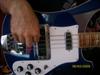
Pickup placement directly affects the freqency response of an electric stringed instrument. The harmonics (overtones) are accentuated or deaccentuated differently at each point along the length of the string. So by "listening" to the string in different places, different tone colors can be heard (or not heard). Jaco's Portrait of Tracy cannot be played properly on a 1" spaced Rick if the neck pickup is equal to or louder than the treble pickp. The second, third and fourth fret harmonics are nearly completely swallowed. But it can be played on a 1/2" spaced Rick with any combination of tones and volumes. One of the harmonics is played by fretting the A string at the second fret and hitting the resulting harmonic at the sixth fret. Even that harmonic is somewhat muted to my ear on a 1" space. In my experience, the colors of all notes fretted or open are affected by the placement of the pickups.
So Jaymi says that harmonics ring better on a 1"-spaced Ric, and Ted says that they ring louder on a ½" Ric, and Jeffrey agrees with that... I still don't understand it but you all say that you can hear the difference, so that must be enough to justify the change.
I assumed that the pickup was pulled back to improve the strength of the bass and resistance to warp and breakage, like Gibson did when they moved the front pickup on the EB0, EB3 and EB4 to the "new" position, sometime in the 70's. Those basses were still mud central even after the change, but, so I'm told, at least they don't fold in half when left in the trunk on a hot day.
I assumed that the pickup was pulled back to improve the strength of the bass and resistance to warp and breakage, like Gibson did when they moved the front pickup on the EB0, EB3 and EB4 to the "new" position, sometime in the 70's. Those basses were still mud central even after the change, but, so I'm told, at least they don't fold in half when left in the trunk on a hot day.
"A Noble Instrument Must Be Nobly Regarded"
And that is torture. I think I tried to learn the same one if that's the song with all the overtones and couldn't stretch enough for certain parts of it on a Ric. The treble pickup gets the harmonics the neck pickup doesn't get. The 2nd harmonic (1/4 of the string) node is right near the neck pickup. A node is a non-vibrating part where the string divides when it vibrates, they vibrate in whole, halfs, quarters, eights, etc. The direction in which the harmonics vibrate reverse at each node which is why there is a non-vibrating node, these are called overtones or harmonics and give an instrument it's timbre. If the 2nd harmonic node is at a pickup that one and anything higher will not be heard, anything lower and the fundamental will be heard. A Ric has rich overtones because the pickups are very clear (among many other reasons) and can pickup very high harmonics unlike a Gibson EB-0 which can't because the pickups are wound with a lot of coils of wire which makes them deeper, louder and limits their high frequency response. There was virtually no difference when they moved it on the Gibsons because of the pickups themselves.
I myself think the 1/2" spacing Ric basses are deeper.
The way you can hear which harmonics sound and which do not is by shutting off the bridge pickup and plucking harmonics and then doing the same thing with the neck pickup, you'll notice certain harmonics are much louder with certain pickups. Even the way you set your intonation has an effect.
The harmonics move as you fret notes so as you go up the neck different ones will sound.
I myself think the 1/2" spacing Ric basses are deeper.
The way you can hear which harmonics sound and which do not is by shutting off the bridge pickup and plucking harmonics and then doing the same thing with the neck pickup, you'll notice certain harmonics are much louder with certain pickups. Even the way you set your intonation has an effect.
The harmonics move as you fret notes so as you go up the neck different ones will sound.

Moving the pickup just moves the most resonant harmonics to a different set which may or may not be appropriate for a given song.
The pickup was moved at the suggestion of our Chief Engineer at that time, George Cole, one of the finest bass players you'll ever hear. It evened out the hot and cold notes that occur in every instrument due to all the little resonances that go on. That was the sole reason for the relocation.
This was prior to the time of affordable laser interferometry, so we used an electronic stroboscope instead to observe how the bass vibrated as each note was played. The way the pickup placement then interacted with that was observed on an oscilloscope.
We also added a number of small lead weights under the fingerboard to further tune the overall resonance but given the wide variation of wood density, the results weren't consistent enough to continue doing that.
Hmmm, this discussion just gave me a good idea . . .
The pickup was moved at the suggestion of our Chief Engineer at that time, George Cole, one of the finest bass players you'll ever hear. It evened out the hot and cold notes that occur in every instrument due to all the little resonances that go on. That was the sole reason for the relocation.
This was prior to the time of affordable laser interferometry, so we used an electronic stroboscope instead to observe how the bass vibrated as each note was played. The way the pickup placement then interacted with that was observed on an oscilloscope.
We also added a number of small lead weights under the fingerboard to further tune the overall resonance but given the wide variation of wood density, the results weren't consistent enough to continue doing that.
Hmmm, this discussion just gave me a good idea . . .