

Jeffrey,
What mods were done on the bridge of the 73 4001?
I have a 1976 4001, so I am somewhat curious.
Your Rickenbacker modifications?
Moderators: rickenbrother, ajish4



-
soundmasterg

- RRF Consultant
- Posts: 1923
- Joined: Tue Oct 01, 2002 1:06 pm
As I promised, here are some pics of my 4001/4003 copy I made. I used all RIC hardware except for the TRC I made myself, and I used a different truss rod setup and made the pickguard too. One of the pics is while I was spraying the lacquer on it and letting it hang to dry. The other pics are as it is now. I sourced all of the wood locally, and it is a 1 piece quarter-sawn hard rock maple neck with walnut wings, a walnut veneer on the headstock, and a lacquered bubinga fingerboard with pearl inlays. Hope you like it.


Hmmm...well, I like it but, putting a RIC truss rod cover copy on a RIC copy is a bridge too far. I've always felt that the companies and individuals that copied Ricks were missing the boat by not trying to take the design further or even improve on it's mechanicals somewhat. Features like 21 or 24 frets, a new bridge like the Hipshot, exotic woods, brass parts, an exagerrated cresting wave shape, etc.

The bridge mods are documented in an article on the main site about how to make the bridge easier to intonate with the strings up to pitch.
www.rickresource.com/rrp/4000seriesbridge.html
www.rickresource.com/rrp/4000seriesbridge.html
-
jingle_jangle

- RRF Moderator
- Posts: 22679
- Joined: Wed Dec 22, 2004 6:00 am
- Contact:
Thanks Jeffrey.
Greg that was quite obviously a lot of work. It looks like you did a nice job. How does it play and sound?
Greg that was quite obviously a lot of work. It looks like you did a nice job. How does it play and sound?
“We can't solve problems by using the same kind of thinking we used when we created them.” - Albert Einstein
"You do not really understand something unless you can explain it to your grandmother" - Albert Einstein
"You do not really understand something unless you can explain it to your grandmother" - Albert Einstein
-
captsandwich

- Intermediate Member
- Posts: 1312
- Joined: Tue Jan 31, 2006 6:13 am

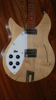



Due to uncooperative ants sneaking out the Ric-O-Sound jack the ant farm idea was abandoned and the guards were back-painted white with polished edges. A toaster neck pickup, an added high-gain converted with a toaster cover in the mid position and another converted high-gain at the bridge. About ready to ship out to M.A. for the 12-saddle bridge installation, new nut spacing and final set-up.

-
soundmasterg
- RRF Consultant
- Posts: 1923
- Joined: Tue Oct 01, 2002 1:06 pm
Dane, Kevin, and Brian, thanks for the comments. I just got back from California for the holiday weekend so sorry for the delay in my reply.
It WAS a lot of work....it took me about a year working on it here and there, but it plays VERY nice and sounds just like a RIC, of course it should sound like a RIC since I used their pickups. I made my neck a little less wide and a little deeper due to the different truss rod design that I used. With the 1/2" spacing it sounds a little different than a 4003 with the hi-gain in there, but I can use a toaster too and get authentic sounds. My favorite part of the construction process was shaping the neck.
Regarding the TRC, I can see your point Dane, and I'm sure Mr. Hall isn't too happy about it either. I've already told him that if I ever sell this bass which I highly doubt I will, the vintage RIC-style TRC that I made will come off and something else will go on like Fakenbacker or something along those lines. I also will not misrepresent it to someone and say it is a real RIC. Anyone who knows the specs and look that a RIC bass comes with could see this isn't a real one if they pulled the TRC and looked at the truss rod I used, which is one of Stew-Mac's vertical dual rods. I also made several mistakes on it that the good luthier could spot in a minute or two. At gigs, people will say it is a nice RIC, and I always correct them because I don't want someone to get the wrong impression.
At the time I made the bass I had a 1973 4001 that needed about $600 of repairs to really play right, and the neck had been broken and repaired before I bought it so it would never be exactly right. I decided I could copy it and make myself a couple for about the same money, and then sell the '73, which is what I did. I'm actually not done with the second one yet and probably won't be for awhile. It was strictly a financial thing, as I couldn't afford a new one at the time. I never had any intention of selling them or making copies to sell, and I never will either. If I ever build some more basses and decide to sell them, I'll be coming up with my own design in the future. Building the RIC copy helped me to learn how to build guitars/basses with a straight-thru neck too, so it was a useful exercise. I'll also say that I like the look of the vintage style TRC a lot better than the modern ones, and the way I made it with a vinyl label on the back of some clear acrylic would be easy and cheap to make, but still look good, and in a lot of ways look better than the vintage style ones if Rickenbacker ever wanted to reproduce the vintage style ones. It was scanned into a computer from the original one on my old '73, and then zoomed in and cleaned up before being printed. The old ones were silk-screened on the back of the clear acrylic I believe, and so as a result the edges of the lettering were kind of hazy looking. Cleaning it up on the computer allows a nice crisp and clean edge to the lettering. You can also use different colors easily too, and maybe I might change it to a different color scheme so people would know for sure on sight that it isn't a true RIC.
It WAS a lot of work....it took me about a year working on it here and there, but it plays VERY nice and sounds just like a RIC, of course it should sound like a RIC since I used their pickups. I made my neck a little less wide and a little deeper due to the different truss rod design that I used. With the 1/2" spacing it sounds a little different than a 4003 with the hi-gain in there, but I can use a toaster too and get authentic sounds. My favorite part of the construction process was shaping the neck.
Regarding the TRC, I can see your point Dane, and I'm sure Mr. Hall isn't too happy about it either. I've already told him that if I ever sell this bass which I highly doubt I will, the vintage RIC-style TRC that I made will come off and something else will go on like Fakenbacker or something along those lines. I also will not misrepresent it to someone and say it is a real RIC. Anyone who knows the specs and look that a RIC bass comes with could see this isn't a real one if they pulled the TRC and looked at the truss rod I used, which is one of Stew-Mac's vertical dual rods. I also made several mistakes on it that the good luthier could spot in a minute or two. At gigs, people will say it is a nice RIC, and I always correct them because I don't want someone to get the wrong impression.
At the time I made the bass I had a 1973 4001 that needed about $600 of repairs to really play right, and the neck had been broken and repaired before I bought it so it would never be exactly right. I decided I could copy it and make myself a couple for about the same money, and then sell the '73, which is what I did. I'm actually not done with the second one yet and probably won't be for awhile. It was strictly a financial thing, as I couldn't afford a new one at the time. I never had any intention of selling them or making copies to sell, and I never will either. If I ever build some more basses and decide to sell them, I'll be coming up with my own design in the future. Building the RIC copy helped me to learn how to build guitars/basses with a straight-thru neck too, so it was a useful exercise. I'll also say that I like the look of the vintage style TRC a lot better than the modern ones, and the way I made it with a vinyl label on the back of some clear acrylic would be easy and cheap to make, but still look good, and in a lot of ways look better than the vintage style ones if Rickenbacker ever wanted to reproduce the vintage style ones. It was scanned into a computer from the original one on my old '73, and then zoomed in and cleaned up before being printed. The old ones were silk-screened on the back of the clear acrylic I believe, and so as a result the edges of the lettering were kind of hazy looking. Cleaning it up on the computer allows a nice crisp and clean edge to the lettering. You can also use different colors easily too, and maybe I might change it to a different color scheme so people would know for sure on sight that it isn't a true RIC.