Page 3 of 5
Posted: Tue Nov 14, 2006 6:00 am
by jdogric12
I had one of those. Loved the guitar, except for its tone plugged in. I think it had different pickups. They were like humbuckers or something. It had two switches too. I could never get a good tone out of it, and sold it. It had the space control bridge. Cool concept, it keeps the Bigsby in check, but good luck if you need to adjust one or two strings during a setup.
Posted: Tue Nov 14, 2006 6:11 am
by admin
Please explain Jason. The point of the space control bridge is to be able to adjust the spacing is it not? Why is it a problem.
It sounds that you had the Filtertron Ceramic pickups. The TV Jones' alnico Filtertrons are the preferred humbuckers, at least this is the most common comments that I have heard.
Posted: Tue Nov 14, 2006 8:29 am
by lawton
Peter, I prefer the Gretsch bar bridge over the space control, but the space control can be really nice if 1) you're REALLY picky about intonation -- with the bar bridge only you intonate the high and low E only because those are the only "affect-able" strings for you -- the space control gives you the ability to make micro adjustments laterally until you have it just right, and 2) if you really want to adjust the string spacing to something different than what's "stock" on the guitar. For me the space control bridge is just too much control. You can figit and mess with it forever and it might not still be exactly like you want it... BUT, you have the control and capability to adjust it, so you may be tempted to do so. In other words, it is NOT the type of Gretsch bridge for someone with Obessive Compulsive Disorder (har har).
As I said above, IMO the bar bridge gives you a bit more sustain. It's heavier (like you need more weight on the bottom of a guitar with a Bigsby, though...), and I have the feeling that it allows better transfer of vibration to the body of the guitar, i.e., makes the guitar feel "livelier." I do plan to pull the space control off of my G6128T-57 in favor of a bar bridge.
Posted: Wed Nov 15, 2006 2:31 am
by admin
Thanks Lawton. I very much appreciate your comments. I tried a bar bridge but could not live with the intonation issues. I concur that the sustain was better with it though.
As a string-bender, the standard Gretsch spacing is problematic for me and as such the space control bridge may be the way to go.
Posted: Wed Nov 15, 2006 2:49 am
by jdogric12
What I meant was you can't move the saddles up or down, like on a tune-o-matic, or a RIC bridge. The side to side motion is really cool, though.
Posted: Wed Nov 15, 2006 2:55 am
by admin
So there is no height adjustment with the space control bridge at all, Jason? Do you mean you cannot adjust the saddles, forward and backward?
Posted: Wed Nov 15, 2006 3:04 am
by admin
In looking at a photo of this bridge on the Gretsch site it would seem that there is no adjustment for intonation beyond slanting the base of the bridge. Is this correct, space control experts?
Posted: Wed Nov 15, 2006 3:06 am
by admin
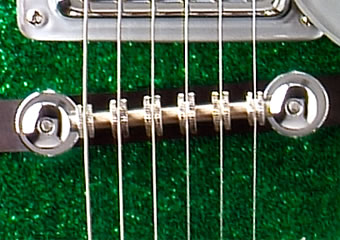
Here is the space control bridge photo.
Posted: Wed Nov 15, 2006 3:51 am
by lawton
Hey. The floating bridge allows for height adjustment via the wheels on either end. You can't adjust the height of the individual "saddles" though (to use the Fender/Gibson/Rick lingo).
Here is my process for setting it up:
1) set the string spacing the way I want it (understanding that I may end up moving a string to one side or the other slightly as I work through the process).
2) set the bridge height the way I want it (low - medium action).
3) Position the bridge for proper intonation of the low and high E strings. The bridge position/location, of course, is going to vary based on where I've put the high and low E saddles, and based on how high I've set the action, AND on how I've tuned the guitar.
4) Check the intonation on the other four strings, making slight lateral position adjustments to the roller saddles to get the intonation right.
Throughout this process you're constantly checking your tuning (obviously). I'm also assuming with this description that the neck doesn't need adjusting. Trussrod adjustments would need to have been completed and the neck would need to be stable before starting all this process.
Positions and settings for proper intonation are going to vary, of course (and as I said above) with different tunings, and with different string types and gauges. I find that my Duo Jet is alot more stable intonation -wise with flatwound 12s (I use the Thomastik-Infeld Jazz strings). If you've just got to use roundwound 10s (or, God help you, 9s!), I think you'll find this style bridge to be more complicated and frustrating.
Good luck with it!!
Posted: Wed Nov 15, 2006 4:05 am
by admin
Much appreciate Lawton. I have the tune-o-matic type bridge which has allowed me the luxury or great intonation regardless of string type. I will just live with the spacing. I am not Red Green but neither am I Adrian Monk.
Posted: Wed Nov 15, 2006 4:05 am
by admin
Much appreciate Lawton. I have the tune-o-matic type bridge which has allowed me the luxury or great intonation regardless of string type. I will just live with the spacing. I am not Red Green but neither am I Adrian Monk.
Posted: Wed Nov 15, 2006 5:06 am
by jingle_jangle
Whoa. Something got passed over here.
"...the space control can be really nice if 1) you're REALLY picky about intonation -- with the bar bridge only you intonate the high and low E only because those are the only "affect-able" strings for you -- the space control gives you the ability to make micro adjustments laterally until you have it just right..."
The Space Control bridge allow only the same intonation control as the Rocking Bar bridge, no more, no less.
It is a straight (vertically-arched to match the fretboard, though) piece of threaded rod stock onto which ferrules are strung, the grooves of which hold the strings in place laterally.
As I pointed out in one of my first posts (above) on this topic, the Space Control allows you to adjust string spacing within a rather narrow range, to better suit your playing style. But it gives no control over exact intonation. Just as with the Rocking Bar Bridge, you're stuck with a compromise intonation across all six strings.
You really need a bridge with six adjustable saddles. The Adjust-O-Matic is the trick here. It is available as a separate part without the base, for about $45.00. The wooden base is standard across these models. In some cases, the threaded height adjustment posts and thumbwheels need to be replaced, but these come with the bridge itself.
Posted: Wed Nov 15, 2006 5:12 am
by freshmattyp
This one from Stew Mac did the trick for me. I am not a fan of the space control bridge.
link
Posted: Wed Nov 15, 2006 6:05 am
by lawton
And for those who like to hit that Bigsby:
link

Posted: Wed Nov 15, 2006 7:31 am
by jingle_jangle
Gretsch makes OEM bridges very similar to both of these. The non-roller is virtually identical to the Gretsch item, right down to the relief slots in the wood piece.
Incidentally, these parts from S-M should be properly arched to match the geetar's top contour and bring the string height down to an acceptable level. They typically are about .125" too high.