Page 3 of 11
Re: Ready to start on the Wreckenbacker
Posted: Mon Feb 18, 2013 9:26 am
by Wiker
basshead wrote:Aside from sanding or using stripper, is there anything else that will remove the colour in all the cavities.[/attachment]
Maybe scraping the finish off with an X-Acto type hobby knife. Chisel blade to scrape in bottom of cavities. Little bit of sanding afterwards.
Re: Ready to start on the Wreckenbacker
Posted: Mon Feb 18, 2013 10:45 pm
by johnallg
What about gentle sandblasting?
Re: Ready to start on the Wreckenbacker
Posted: Tue Feb 19, 2013 6:40 am
by basshead
The clear comes off pretty easily with a sharp chisel. Dunno about the colour yet
Re: Ready to start on the Wreckenbacker
Posted: Tue Feb 26, 2013 3:48 pm
by basshead
Here's the result of the strap button screw hole repairs.
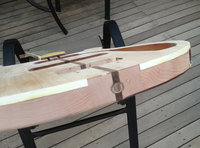
- The lighter ring around the plug is the filled indentation left by the strap button. If I can be bothered, I might remove the lighter fill and fill it with shedua to match the stripe, lol.
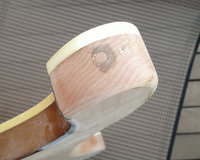
- The multiple holes on the horn...
Ready to start on the Wreckenbacker
Posted: Tue Feb 26, 2013 4:13 pm
by 8mileshigher
A very interesting project, Wayne ! I am enjoying your narrative and the detail pictures.

I admire your woodworking skills and that you are undertaking this project.
Re: Ready to start on the Wreckenbacker
Posted: Tue Feb 26, 2013 4:54 pm
by basshead
Thanks Rich. I'm going on vacation tomorrow week so nothing will get done for a couple of weeks but I want to get stuck into it when I get back.
Now, if someone has the dimensions to a 4001 bridge pocket, they'd come in might handy right about now

Re: Ready to start on the Wreckenbacker
Posted: Mon Apr 01, 2013 5:16 pm
by basshead
Hi gang, I'm back from vacation and ready to restart on the Wreck. I've read through the forum and would like to clarify som information.
• Apart from the fretboard, I have sanded the whole guitar to bare wood with 220 dry. Should I now rub it down with 320?
• To defret, I need to slice through the clear finish beside the frets then use a soldering iron and "nippers" to remove them. Anything else I should bear in mind?
• I assume I remove the neck binding before I remove the frets?
• The fretboard finish needs to be redone so should I rub it back with 220? If yes, then rub it also with 320? Once it's rubbed backs and levelled and the radius is good, do I spray sealer on it before putting the new frets in?
• Once the new frets are in, how do I file the ends back at the correct angle? Once the frets topped and levelled, (not crowned), do I just bevel of the edges slightly?
• I plan to paint the bass a solid colour so do I still need to seal it? If yes, is there a PPG sealer as that's about all I can get out here.
More questions to follow...
•
Re: Ready to start on the Wreckenbacker
Posted: Mon Apr 01, 2013 8:05 pm
by ken_j
To defret, I need to slice through the clear finish beside the frets then use a soldering iron and "nippers" to remove them. Anything else I should bear in mind?
You may want to adjust the neck to have a back-bow so thet the fret slots fan out. This will ease removal.
I assume I remove the neck binding before I remove the frets
Yes, if you follow the factory method. Though you can cut the fret tang and let the fret overhang the binding if you want to leave it in place. Then dress the frets to the edge of the binding. Stewmac sells a
fret tang nipper for doing this.
Re: Ready to start on the Wreckenbacker
Posted: Wed Apr 03, 2013 6:28 am
by Wiker
Pull the old frets slowly to avoid chipping the edge of the slots. Don’t know if it’s better to remove the binding before or after de-fretting. Logical thing would be to remove the binding first. On the other hand, if the binding is left in place maybe it will help prevent chipping at the edge of the board.
From the back of my head I think Paul W.’s procedure is to (1) fret; (2) apply grain filler on the board, also filling the base of the frets, and then sand; (3) spray sealer; (4) several coats of clear, sanding between each coat; (5) final two coats sprayed first with the bass upside-down for the clear to build up on one side of the frets, and the last coat with the bass right side up for the clear to build up on the other side of the frets.
Myself I don’t have much finishing experience. The only thing I’ve done so far is refinishing the fretboard.
I sanded the board with 320. I don’t know, but I guess 220 would probably be enough.
After de-fretting, adjusted truss rods to get the board as flat as possible. Sanded down to bare wood using a radius block, keeping the block straight at all times (don’t want to introduce any twist or deformation). With a long ruler (long enough to reach all the way from the nut to bottom of the body) I checked to see if the surface of the board ran parallel with the body. Adjusted truss rods so that the ruler was at least not descending down towards the bridge area. Then did the final sanding to get the board flat and even.
Myself I applied grain filler before re-fretting. Factory filler is light coloured I think (white or natural wood colour). I used darker, rosewood coloured filler myself, and think it added a bit of depth to the board.
Re-fretted.
I couldn’t get hold of any vinyl sealer. Paul W. wrote somewhere that the clear itself (thinned down a little bit extra) can be used as sealer, so that’s what I did.
While the first coat was still wet I went over the board and filled in spots with a toothpick where necessary. Also against fret bases to get them fully covered.
Several coats of clear with sanding in-between. Between each coat I sanded away any build-up against the frets, leaving the build-up to the final coat(s). For sanding I made a sett of sanding blocks, one block to fit between each par of frets. (I used wood but some kind hard styrofoam is easier.)
Spraying a nice coat on a flat surface is one thing. On a fret board any unevenness will be quite visible due to the frets. At first it was a bit of a challenge getting a uniform coat, especially build-up against the fret bases.
The first thing I did was to orient the fan of the spray gun across the neck, and cover the whole board in one movement down the neck. Against the frets it was obvious the gun spits out more finish in the middle of the fan pattern. So, what worked for me was to orient the fan pattern along the neck, and move the gun from side to side across the board while moving down the neck. This gave me a nice and even coverage.
I sprayed the board both with the bass standing up, and with it lying flat. I don’t have the expertise of Paul W., and struggled to get even build-up on both sides of the frets when spraying two final coats with the bass standing up and upside-down.
With it lying flat it was much easier to get even build-up on both sides. On the other hand, due to the curving of the board, the finish would flow a tiny little bit from the centre to the edge of the board – not obvious if sprayed thin. Also, won’t get as much build-up against the frets with the bass lying flat as when standing up.
I don’t know how many times I sprayed the board before I was satisfied, but I became a racer sanding off the finish and start over.
Next time, when refinishing the whole bass, I will try again spraying final coats on the fret board with the bass standing up.
Re: Ready to start on the Wreckenbacker
Posted: Thu Apr 04, 2013 4:17 pm
by basshead
Thanks for the info. Any idea of the correct type grain filler?
Re: Ready to start on the Wreckenbacker
Posted: Fri Apr 05, 2013 3:37 am
by Wiker
basshead wrote:Thanks for the info. Any idea of the correct type grain filler?
Don’t know what’s the "correct" grain filler, but.. I used Timbermate wood filler, mahogany.
http://www.woodcraft.com/category/20205 ... iller.aspx
The mahogany coloured matched the fret board wood quite well. Natural colour would probably be more authentic though.
I bought it from StewMac but they seem to have switched to another brand (or maybe it’s the just Timbermate rebranded).
http://www.stewmac.com/shop/Finishing_s ... iller.html
Re: Ready to start on the Wreckenbacker
Posted: Fri Apr 05, 2013 4:26 am
by basshead
Thanks for that mate. I think I'll go with the neutral colour for the "original" look.
Re: Ready to start on the Wreckenbacker
Posted: Fri Apr 05, 2013 2:52 pm
by ken_j
I have used both Bartley (from Wood Craft) and
H. Behlen Pore-O-Pac with good results. I believe some brands are able to accept stain (oil) prior to application to adjust the color to where you need it. Read the label. I also use H. Behlen Vinyl sealer.
Re: Ready to start on the Wreckenbacker
Posted: Mon Apr 29, 2013 1:10 pm
by basshead
Re: Ready to start on the Wreckenbacker
Posted: Wed May 01, 2013 2:50 am
by Wiker
Great

Interesting to see how the maple itself has "ambered" over the years. So it’s not only ambering of the clear coat, but also of the wood itself that contribute to the nice color of a vintage guitar.
Any plans/ideas for how to plug/cover screw holes to avoid filling them when finishing?
Hm.. That piece of pipe (or pipe of peace) in the last photo, with something wrapped around it - sanding paper? Should make the perfect tool for sand finish off walls in cavities.