Page 3 of 3
Posted: Tue Mar 16, 2004 9:14 am
by tblair
I think the flat back is just V1 of the toaster- actually it's V1 & V2:
V1= flatback/no chrome plating
V2= flatback/chrome plating
My '57 850 has the chrome plated version. I assume my '58 335 does too, but I don't know if I've ever looked. I will tonight.
Not sure at what point they started exposing the poles form the back- probably when they introduced the long-poles (which were in place by 1959).
Posted: Tue Mar 16, 2004 9:53 am
by larrywassgren
No problem John, although I do have a hard time facing vintage guitars with a screwdriver. I won't be doing that one again. All three pick-ups have the same flat-back. You can see there is writing on the one above(8o and something else I couldn't read). The other two had writing on them too, but there just isn't enough wire there to pull the pick-ups out far enough for a better photo. Notice to how those corner screws on the pick-up were longer screws but they look like they were cut off crudely to make them shorter. Also, those screws and the nut go into a hole drilled in the top of the guitar so they lay flatter on the surface. Glen or Peter, could you post that picture showing the holes? The rubber grommets cover the holes so they are not visible when the pick-up is screwed down.
Posted: Tue Mar 16, 2004 11:52 am
by leftybass
Larry, thanks for going the extra mile with your 325; you are providing an insight into the contstruction of one of the first 28 ever made by 'breaking it down' here and there for us to see. Fantastic. Glen, great research topic too.
Posted: Tue Mar 16, 2004 12:44 pm
by glen_l
Here's one that shows the clearance holes in the top of another early '58 Capri. There are even two clearance holes for the pickup terminal posts. None of these appear the go all the way thru, they are just deep enough to allow the pickup to drop into place.
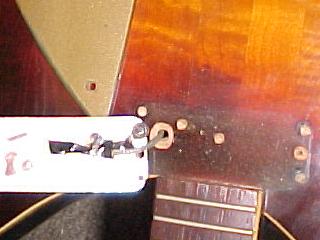
Interestingly this pickup also has the notation "80" as did Larry's.
Posted: Tue Mar 23, 2004 1:12 pm
by glen_l
After sorting thru all the photos of various models of late 50's Ric wiring I've managed to come up with a few conclusions. I'd like to thank Larry in particular for daring to open his '58 325 and take all those great internal photos. You did far more than I dared ask, and it's very much appreciated. Also to Tony Blair who did an excellent job photographing the wiring on his 57/58 combo Rics. There was some very eye opening material from all these guitars.
Thanks to reference from 3 different '58 325's, I have been able to establish the circuit. These 325's were wired in a way unique to that small group of guitars. No Rickenbacker guitars prior or subsequent were wired anything like them. More to follow in my article.
The wiring on the combo450 appears to be the most sophisticated loom on any vintage model. The sealed section is still a mystery, but I hope to get more information to unlock it's secrets later on.
The combo wiring on the first Capri's was similar, but not quite the same as earlier combos like the 850.
The two pot, single toggle wiring on other early two pickup Capri's was not that same as the 325's. It was yet another circuit.
thanks to all
Posted: Thu Apr 15, 2004 4:06 am
by leftybass
Larry, Glen, Tony: With a reference to the two wiring pics of the long-body 325 wiring and then Larry's 325, is the is the Mallory U-34 pot for tone or for volume?
Posted: Sat May 22, 2004 2:49 pm
by glen_l
Just realised that I never answered this question Leftybass. There was one volume pot, one tone pot, and one toggle switch on the original '58 325's. They were nothing whatsoever like the "Guitar & Bass, 2 Control, 2 Pickups, Mono" schematic on the Ric website. Many have assumed that you simply wire the neck and middle pickups together (like you usually do with 3 pickup Rics) and use that schematic. Having looked closely at the situation there is just no similarity there.
Posted: Mon Jan 09, 2006 7:09 pm
by seth_lorinczi
Hi Folks,
Obviously I'm coming to this late in the game, but I was just looking inside my Combo 400 and trying to figure out what the toggle switch is for.
As with the Combo 450 pictured earlier, the ground (shield) from the pickup runs through one pole of the switch, and the hot wire runs through the other pole. Currently, the switch is set up to short the signal, turning the guitar off, but the schematic off the RIC site suggests there was another use.
Anyone have any insight on this simple (1 pickup, 1 switch, 1 vol 1 tone) guitar?
Posted: Mon Jan 09, 2006 7:35 pm
by jingle_jangle
Seth, I have an Electro ES-16. 100% original, 1 pup, 1 switch, 1 volume, 1 tone.
Dare I suggest that this is the same wiring scheme?
If it is, it's shown on the Rick website:
http://www.rickenbacker.com/pdfs/19506.pdf
They do say it's for a Combo 400.
Posted: Tue Jan 10, 2006 7:54 am
by seth_lorinczi
That makes sense. Someone was kind enough to post that schematic earlier; I was just trying to do some detective work and try to figure out how much (if any) of my wiring is original. Thanks much Paul!
Posted: Tue Jan 10, 2006 8:49 am
by jingle_jangle
I was mistaken, however, when I stated that RIC says that this is for a Combo 400. They say 420, which is a "cresting wave" solidbody.
But this does fulfill the specs: single pickup, selector switch, volume and tone controls.
If anyone else has a different schematic, please help both of us out.
Posted: Tue Feb 21, 2006 9:48 am
by glen_l
Sorry about the late reply on this one.
There's no accurate schematic for the combo 450 (and probably 400) They were doing some interesting things with the combo wiring back then. Twin coax's to pickups, custom switches, sealed sections with capacitor networks inside. None of this has ever published online, and I've yet to get my hands on a combo400 or 450 to reverse engineer it properly.