
(We now join this RM 1999 restoration already in progress)
Moderators: rickenbrother, ajish4
Re: (We now join this RM 1999 restoration already in progres
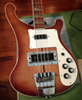
My neck pickup route is the same way 10 holes. Looks goofy. '77 4001.
'77 4001 AutumnGlo, '57 Nash P, '77 Gibson Grabber, Ibanez RB690, Epiphone Black Casady, Fender Rumble v3 500 210 combo /USA Ampeg 15

Re: (We now join this RM 1999 restoration already in progres
All 5 of my basses from '64 to '79 are the same way. It's a pretty commonly known part of the construction; I just never thought to ponder the "Why?"
-
Colonel Sanders
- Intermediate Member
- Posts: 842
- Joined: Wed Sep 07, 2011 10:39 am
Re: (We now join this RM 1999 restoration already in progres
My guess, but I could be absolutely wrong, is that it is easier to "free hand" a succession of Forstner bit holes than a router. Main assumption here being that they did not have a router jig for the channel for some reason.walker wrote:All 5 of my basses from '64 to '79 are the same way. It's a pretty commonly known part of the construction; I just never thought to ponder the "Why?"
1973 4001 Jetglo
2017 4003S Jetglo
2023 4003 Mapleglo
2022 4005XC Jetglo
1979 MusicMan Stingray
2021 Epiphone Thunderbird
2017 4003S Jetglo
2023 4003 Mapleglo
2022 4005XC Jetglo
1979 MusicMan Stingray
2021 Epiphone Thunderbird
-
ricnbacker
- Veteran RRF member
- Posts: 532
- Joined: Wed Aug 07, 2002 5:00 am
Re: (We now join this RM 1999 restoration already in progres
Well Thank you Mark. thanks for inviting me into your home and taking a look at my bass. it was a pleasure meeting you and chattingwalker wrote:Here's another brief sidebar until I finish up the RM:
So Chris Seibel dropped by yesterday to have me look at his bass regarding some buzz and string alignment issues, and while we were talking bass, he posed a very interesting question - one I've never heard anyone else mention before, or thought of myself in all my years of having Ricks-On-The-Brain. He was taking a look at the bare face of the RM and asked "Was this toaster pickup wire groove cut by a succession of drill holes?" I said yes, believing that to be true, then he asked: "Then how was this harness cavity cut?" "That was done with a router." I said. And now the $64,000 question posed by Chris: "Then why didn't they just cut the pickup wire groove with a router too?"
Good dang question. All the pickup, harness, and tailpiece cavities from about '64 on up are routed, yet RIC handled that wire path by hitting it with a drill about 10 times... which seems way more precarious to do at a suitable and accurate arc than it would be with a router. Seems like it would have been more time-consuming, too. I know that RIC has been using the CNC machines for all the cavity cutting on their guitars for the past few years, but the neck pickup wire trough cut out with a series of drill holes continued to be the RIC standard long after they started using a router to cut out the body cavities.
So there it is. Any theories? Or answers?
That bass is going to be great once its all back together it certainly felt good in its present state of progress. To the casual observer, they would not be able to tell one side is not original. I still cant believe how thin the necks are in comparison to mine.
I am still surprised at what truss rods look like too. now I understand how they function a little bit better.
-
ricnbacker
- Veteran RRF member
- Posts: 532
- Joined: Wed Aug 07, 2002 5:00 am
Re: (We now join this RM 1999 restoration already in progres
so, thinking about that other thing we discussed with the truss rods.apparently it was not an original thought
http://s127.photobucket.com/albums/p122 ... p/at34.jpg
http://cdn1.bigcommerce.com/server700/1 ... 0.1280.jpg
oh well....
http://s127.photobucket.com/albums/p122 ... p/at34.jpg
http://cdn1.bigcommerce.com/server700/1 ... 0.1280.jpg
oh well....

Re: (We now join this RM 1999 restoration already in progres
The holes are actually made with a Forstner bit, not a drill bit.
Re: (We now join this RM 1999 restoration already in progres
It was a pleasure, Chris. Interesting story on how you decided to play a Rick to begin with - you should post that on the "Why I play a Rick" thread. (I think there's one around here somewhere.) I know those '64 rods I showed you are pretty old technology - I wonder how the current 4003/4004 rods are made. Looks like a blue shrink-wrap on that 2nd photo.
Free-handing a router is actually pretty easy, especially if you're creating a slight arc and not trying to make a perfectly straight line, but the "no jig" theory still makes sense.
Free-handing a router is actually pretty easy, especially if you're creating a slight arc and not trying to make a perfectly straight line, but the "no jig" theory still makes sense.

Re: (We now join this RM 1999 restoration already in progres
Seems like it would have paid off many times over the years in time savings if they had made a jig to do the wiring arc.
Mark, the current rods are one round metal rod with threads at both ends. An acorn nut and washer on one end (body end) and the block and truss nut at the neck.
http://boutique.rickenbacker.com/TRUSS- ... p_547.html
The rods Chris showed are on Allparts:
http://www.allparts.com/truss-rods-and-nuts
Mark, the current rods are one round metal rod with threads at both ends. An acorn nut and washer on one end (body end) and the block and truss nut at the neck.
http://boutique.rickenbacker.com/TRUSS- ... p_547.html
The rods Chris showed are on Allparts:
http://www.allparts.com/truss-rods-and-nuts
-
Colonel Sanders
- Intermediate Member
- Posts: 842
- Joined: Wed Sep 07, 2011 10:39 am
Re: (We now join this RM 1999 restoration already in progres
The rods from Chris post are dual action. Meaning they can force the neck into a front bow or a back bow.johnallg wrote:Seems like it would have paid off many times over the years in time savings if they had made a jig to do the wiring arc.
Mark, the current rods are one round metal rod with threads at both ends. An acorn nut and washer on one end (body end) and the block and truss nut at the neck.
http://boutique.rickenbacker.com/TRUSS- ... p_547.html
The rods Chris showed are on Allparts:
http://www.allparts.com/truss-rods-and-nuts
1973 4001 Jetglo
2017 4003S Jetglo
2023 4003 Mapleglo
2022 4005XC Jetglo
1979 MusicMan Stingray
2021 Epiphone Thunderbird
2017 4003S Jetglo
2023 4003 Mapleglo
2022 4005XC Jetglo
1979 MusicMan Stingray
2021 Epiphone Thunderbird
Re: (We now join this RM 1999 restoration already in progres
A dual-action design would definitely work well with the '60s basses that sometimes develop a back-bow. That was the initial problem with the RM, and in dry weather my '68 has a tendency to bow back a little, too. It's rods are at full relief.
Re: (We now join this RM 1999 restoration already in progres
Yup.Colonel Sanders wrote:The rods from Chris post are dual action. Meaning they can force the neck into a front bow or a back bow.johnallg wrote:Seems like it would have paid off many times over the years in time savings if they had made a jig to do the wiring arc.
Mark, the current rods are one round metal rod with threads at both ends. An acorn nut and washer on one end (body end) and the block and truss nut at the neck.
http://boutique.rickenbacker.com/TRUSS- ... p_547.html
The rods Chris showed are on Allparts:
http://www.allparts.com/truss-rods-and-nuts


Re: (We now join this RM 1999 restoration already in progres
Those type of truss rods require a deeper channel, I don't think those would be a drop in for a modern (or older) Rick neck. However, those dual action rods are great; I have them in my two Martin Keith basses, my Rick Turner bass and there was one in my former G&L bass.Colonel Sanders wrote:The rods from Chris post are dual action. Meaning they can force the neck into a front bow or a back bow.
Re: (We now join this RM 1999 restoration already in progres
My Epi Thunderbird Pro IV is neck thru with a dual action rod. They do work pretty great.jps wrote:Those type of truss rods require a deeper channel, I don't think those would be a drop in for a modern (or older) Rick neck. However, those dual action rods are great; I have them in my two Martin Keith basses, my Rick Turner bass and there was one in my former G&L bass.Colonel Sanders wrote:The rods from Chris post are dual action. Meaning they can force the neck into a front bow or a back bow.
Re: (We now join this RM 1999 restoration already in progres
...there still is one in the G&L, actually.jps wrote:..there was one in my former G&L bass.
