Although most Rick truss rods fit properly into their cavities when new (and by "properly" I mean that the X-Cellite tool will go over the nut with no struggle..), because the necks are wood, which is organic and varies in hardness both while new and as it changes to match its environment, the occasional new guitar or bass, and many older instruments (especially 12s and basses...) will see the nuts too close to the floor of the truss rod adjustment pocket.
The most severe cases--and I've seen plenty of them--are '60s 12 strings and '70s and '80s 4001s. Since most players aren't techs, and most techs are not Rick techs, they will do exactly what John Hall is cautioning against--using a crescent wrench or socket wrench to apply torque to the rods. This kills the "feel" that a screwdriver-handled nutdriver like the X-Cellite gives you when adjusting your nuts (so to speak). Combine this with ignorance of the correct procedure for tightening that must be used with the old "hairpin" type truss rods, and it's a recipe for trouble of one of two types:
1. If the wood of the neck is soft or the fretboard to neck glue joint's strength is exceeded, the fretboard will begin to separate at or near the glue line. Many, many older Rick 12s and 4001s have this issue, and it's entirely due to ignorance of proper tools and procedures for neck adjustment.
For the record, before tightening the truss rod nuts to straighten the neck, the body of the instrument MUST be immobilized (padded clamp to padded flat surface) and the neck "persuaded" by hand to take its set, while tightening the nut with the proper tool using the other hand.
2. (And this is the issue with the OP's bass!) On some instruments you can develop so much torque on the rods by adjusting them too tight, that you can embed the spacer block into the neck wood, or, if the threads on the rods are weakened, you can snap the rod or cause it to bend into the floor of the adjustment pocket, which eliminates any space that might have been under the rod to allow the socket to slip under it to capture the nut. The threads are cut by hand on these older rods, not rolled, so they can be off-center and are often weakened by too much "persuading" with the wrong tools.
So, the OP's problem had less to do with Rickenbacker and everything to do with the ham-handed treatment that the instrument(s) had previously been subjected to. The X-Cellite tool is not sufficiently thin-walled to permit it to be used; this is neither the company's problem, nor the instrument's, nor the tool's. In cases like this, ingenuity is required, and if you don't have it, you're stuck.
In my tool chest I have 5 X-Cellite type tools of various wall thicknesses, ground down on a disc sander with some care. I have a lathe, but it's unnecessary to use that sort of time and precision. My favorite of these tools, has the outside diameter of the socket end ground to .355"
in diameter, with the tip ground to a slight bevel, too. I can tap this tool with a small hammer to seat it partway on the truss rod nut. The taper allows it to wedge itself between the nut and the floor of the cavity. I then place a strip of .060" steel across the truss rod adjustment cavity, and using the steel strip as a fulcrum and the tool as a lever, I gently urge the rod end straight again until I can fit the tool over the entire nut.
The tool I'm talking about is the second from the left in the photo, and it's not an X-Cellite, but a Valco S86 equivalent:

Below is an X-Cellite, ground to .335", seen from the end. It's the second smallest of the bunch. The smallest is already beginning to split at the vertices of the hex, but is paper-thin and still can be used in really stubborn cases:
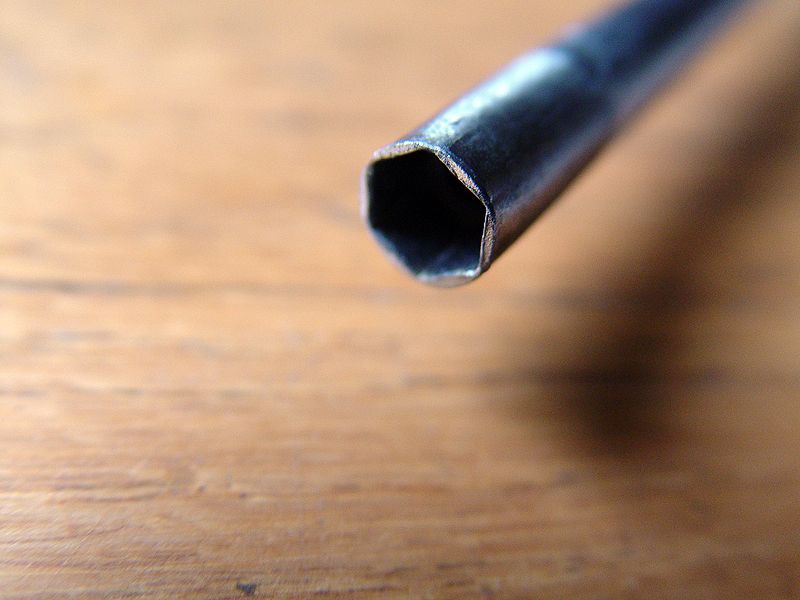
The modified tool allows me to undo decades of misadjustment. If I then remove the rods and find their threaded ends weakened or even twisted, I'll cut the threads off and shorten both tips of the headstock end--the lower tip must be about 5/8" longer than the upper tip, and it must be re-threaded. The upper tip needs to be ground to a slight bevel with the oblique angle of the bevel at the top, so it seats properly against the spacer block. Rods can be shortened like this once and sometimes twice without losing any of their effectiveness.


