Page 1 of 4
12 String Truss-rod Covers
Posted: Tue Apr 19, 2005 2:43 am
by admin
In looking through a number photos of 12 string headstocks, it is most interesting to see the different shapes of the Rickenbacker nameplate. Some are cut off very short just after the "r" in Rickenbacker. Some shave the topside of the nameplate just allowing the full "Ks" and "b" to show. This was noted more often in the 1960s models. Perhaps this was not a factory move but done by the artists themselves at some point.
Harrison's first 12 string had the same nameplate as was used on the 360/12V64, go figure.
Other nameplates as in McGuinn's early 370/12 had a truss-rod cover that did not seem to be shaped at all.
The purpose of shaving down the 12 string nameplate is to allow the strings to go to the tuners with as little obstruction as possible.
I am wondering if Rickenbacker ever considered making a thinner and slimmer nameplate for the 12 string truss-rod cover at any point to avoid the requirement of shaping. A retro, metal embossed nameplate might look cool and avoid getting in the way of strings, for example.
The shaved nameplate has certainly become part of the look of the 12 string headstock and I expect I would miss this if another one was substituted at this point. Just wondering. What do others think?
Posted: Tue Apr 19, 2005 2:53 am
by tony_carey
I know what you mean Peter. When you take a 12 string TRC in isolation, it just looks like a hacked about 6 string TRC, but when it's actualy on the guitar, it seems to transform into this glorious statement of intent.
You're right, there might be a 'better' way, but we've got so used to it, that there can surely never be another way!
Posted: Tue Apr 19, 2005 3:04 am
by leftybass
When the 12-strings were first made up through probably the middle of 1964, just about every one of them was shaped by hand. No two appear to be alike.
The biggest reason for this was that the slots routed into the headstocks were in a straight line, and of course the nameplate has a curve to it...so some shaving was required.
After a few months a particular shaping method seemed to take hold from what can be observed, and most TRC's that you see on the 12-strings from 1965 on have a uniform shape to them. The routs were also repositioned to allow for a better overall design of the peghead.
With the exception of the C63 12-string, the TRC's used today all look identical in their shape.
Posted: Tue Apr 19, 2005 4:01 am
by BobKat
Peter, a minor point of correction is that the Harrison 12's nameplate really wasn't very much like the 360/12V64 nameplate. It has a pronounced "hump" near the base of the headstock and is thinner as you go up. The 360/12C63 TRC is very faithful to the original Harrison 12.
Posted: Tue Apr 19, 2005 4:25 am
by admin
Thanks Bob. Not such a small point to those who worked on the model and in the world of Rickenbacker forensics. I appreciate your kindness. You are spot on as usual.
I have confused this TRC with his second model perhaps or I am losing the thin outer layer of my cerebral cortex, nothing serious. Here are images from the RIC site with regard to the 36012C63 and the 36012V64 to reinforce your point.
Notice that the shaving of the TRC on the 36012C63 is done mostly on the bottom edge while the shaving of the TRC on the 360/12V64 is done mostly on the top edge.


Posted: Tue Apr 19, 2005 5:15 am
by tony_carey
IMO, the c63 looks better. I had a 1975 450-12 with a 'top shaved' TRC & it never looked completely right. In fact, when I first got it, I wondered if it was a legit TRC!
Posted: Tue Apr 19, 2005 5:35 am
by admin
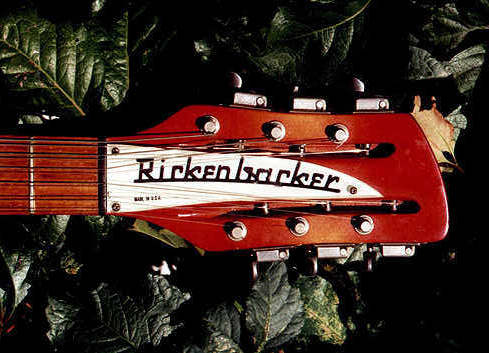
Your comments are interesting Tony. Here is an example of my 450/12 from 1966. Did the TRC look like this? Sorry about the English country garden backdrop.
Posted: Tue Apr 19, 2005 6:07 am
by tony_carey
Pretty similar Peter. The 'b' & 'k', like yours, were nearly off of the TRC, with loads of space below. I can see that to lower the logo would require a tilt in the screening, otherwise the last 'r' would be cut in half!
This could be why it was done this way?
The back drop....you're just trying to make me feel at home!
Posted: Tue Apr 19, 2005 6:17 am
by circles
It's been my impression that the shape of the TRC is almost secondary depending on where the Rickenbacker logo appears on the plate prior to shaping.
Anybody know what will happen if in a few years i need a replacement for my V64? Would i get an exact "v" series replacement, or would they only be able to provide a "c" series plate? Would the holes even line up or are they completely different? so many questions...
Posted: Tue Apr 19, 2005 6:42 am
by patrickkelly
My 1990 360/12 has the raised logo TRC and is not shaved at all. Anybody know when they stopped re-shaping them on the current (i.e., non-vintage) models? A couple of the strings really rub on the TRC. No biggie, really.
Posted: Tue Apr 19, 2005 6:52 am
by jingle_jangle
The difference in the shaping, year to year and model to model, is interesting. John Hall hasn't weighed in on this yet, but I do wonder if, even today, these are rough-shaped in batches and final-shaped to fit each instrument at the factory. The one on my 660-12 is just too close a fit.
Daniel, I believe that the holes would line up, but you might have to do some shaping yourself.
Posted: Tue Apr 19, 2005 7:26 am
by leftyguitars
If you want to see some really odd ones just check out left handed TRCs.
Posted: Tue Apr 19, 2005 7:43 am
by jingle_jangle
Like this?

Posted: Tue Apr 19, 2005 8:08 am
by leftybass
Wow that has to be the absolute best number one monumental ultimate headstock I've ever seen on a Rickenbacker bass.

Posted: Tue Apr 19, 2005 8:13 am
by jingle_jangle
Belongs to another Forum member. Not mine, sadly...