Page 1 of 2
Checkered Binding 4001
Posted: Mon Jan 29, 2007 8:31 pm
by aceonbass
So I drop by Pat Wilkins shop today to give him my 4008 to do a bit of touch up while it's apart and some parts are being replated, and he shows me what is probably a '72 4001 in for a re-fin while it's being worked on by another of my guitar techs. It's got walnut headstock wings, checkered binding and, even though the fingerboard's taped off, full width inlays. It's also got two sets of pickguard holes in it and enlarged tuner holes. All he's doing is a refin and nothing else, in the original finish which is fireglo. It's a shame that these tuner holes aren't being pegged and redrilled for the correct tuners along with one set of the pickguard holes. Alas it's not to be since he only has instructions to refinish it and nothing more. If one of you here owns this bass, please do the right thing and fix it before it goes under the spray gun.
Posted: Mon Jan 29, 2007 8:35 pm
by jose_pena
even better , DO NOT REFINISH THE DARN BASS !!!!!!!!!!
Posted: Mon Jan 29, 2007 9:32 pm
by aceonbass
The finish has already been sanded off. I was told that the body wings were separating and that they had to be re-attatched.
Posted: Tue Jan 30, 2007 4:40 am
by jingle_jangle
Got something against refins, Jose?
Posted: Tue Jan 30, 2007 5:13 am
by teeder
Here we go again!

Posted: Tue Jan 30, 2007 5:18 am
by heinpete
I like refins, they make old Rics affordable and even better playable if refretted!
Posted: Tue Jan 30, 2007 7:05 am
by shamustwin
Dane,
Wilkins is near me. Do you endorse them?
Thanks
Posted: Tue Jan 30, 2007 7:05 am
by elysrand
Mother Please, I'd rather do it myself!! I am all for refinishing, especially if it is something I can do myself, i.e. if it does not involve complex color application.
In early college I had summer jobs working in a startup guitar factory for Hartley Peavey, and I started off doing harness solder-ups. That was easy, I had soldered all my life as a young Ham Radio operator. After I showed them that I knew my way around a spindle sander and a bandsaw (from building furniture for the previous ten years with my Dad in his woodshop) they let me move to the woodshop. That was fun, and the second summer I started doing finish sanding and trim, and then spraying finish.
So believe me, I have NOTHING against a Good Refinish. And everything against even the chance of a Bad Refinish. I will never be a true artisan like Paul W or Dale, but I can do a simple refinish of a MG 4001 without much risk (provided I have a source for the right binding roll stock and fret marker sheet stock, of course)

Posted: Tue Jan 30, 2007 7:12 am
by wints
This is a bass you SHOULD refinish. It has no original finish left...
Now if was original...
Posted: Tue Jan 30, 2007 7:33 am
by jingle_jangle
...and possessing some visual charm (instead of merely looking like trash and muck), then by all means leave it alone...
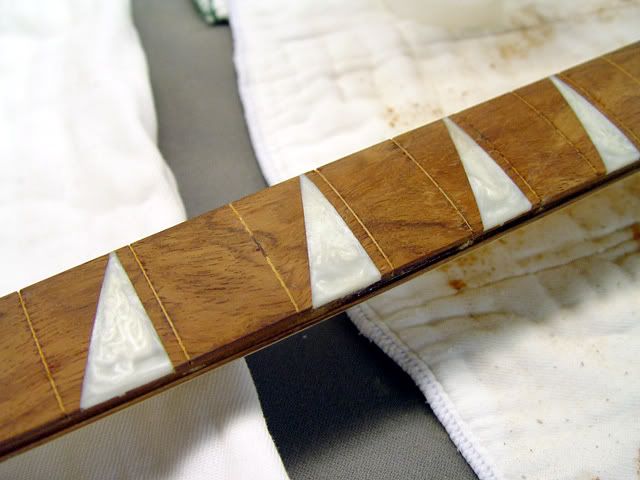
Elys, Rick fret markers are not cut from sheet stock. They are poured in place, after the pocket in the fretboard has been first handpainted light gray.This is done before the fretboard is radiused.
When I convert routed inlays to full-width, sawcut inlays, it is after the fretboard has been radiused (on an already-functioning instrument). In order to accomplish this successfully, due to the shrinkage of the polyester/pearl mixture and the necessity of getting it done in one pour, I build up the sides with sheet wax and masking tape before pouring the mix into the inlay slot. I also mask off the fret slots.
http://i63.photobucket.com/albums/h146/jangle_jingle/620%2012%20campbell/howitspoured.jpg
Here's a closeup after sanding and levelling:
http://i63.photobucket.com/albums/h146/jangle_jingle/620%2012%20campbell/insertclose.jpg
And a look at the finished board just before sealing and fretting:
http://i63.photobucket.com/albums/h146/jangle_jingle/620%2012%20campbell/inserts.jpg
Posted: Tue Jan 30, 2007 7:45 am
by aceonbass
Jerry, Pat has done all my basses(which I think you've seen) and I've been very happy with his work. He always seems to get the color I want just by my description of it and pics that are close. He actually has his own line of basses so he's pretty much a one stop shop for whatever you need done.
Posted: Tue Jan 30, 2007 7:54 am
by elysrand
Oops, didn't know, Paul! When Dale posted all the photos of his refinish of that late model JG conversion, where he made the horseshoe of two bent non-magnetic plates and retrofitted it with checkered binding, he specifically said he bought the full-width material in 12 inch by 12 inch sheets. I figured that this was all that was available these days.
So, you can still get the acrylic casting stuff, with the curing agent, and the flakes, and do it the original way? Awesome
Oh, what am I saying, if you are actually manufacturing the acoustics, the of course YOU can. I would have figured that "I" can't, because most folks can't get RIC-authorized materials? Or can anyone practice with materials available on the open market until they get the technique down well enough to do it too?
Please forgive me in advance, Paul, if I tread too closely to any secret lore. I truly do want to learn to do this, if you are willing to share knowledge.
Posted: Tue Jan 30, 2007 8:09 am
by jingle_jangle
The 12 X 12 inch sheets of the '60s "sparkly" crushed pearl--which is pretty close to the old Rick sparkle inlays in appearance--is available from
www.rescuepearl.com.
The "swirly" inlays--which pre- and post-date the sparkly stuff and are still used--are poured as I show. They are done (in my shop, at least) using crystal clear polyester casting resin, to which PPG dry pearl essence has been added.
The sheet wax is a patternmaker's material.
Posted: Tue Jan 30, 2007 9:35 am
by aceonbass
I've gotta admit that I actually like the poured swirly inlays better. Paul, would you mind shooting me an E-mail telling me what you charge to do that on a 4003?
Posted: Tue Jan 30, 2007 9:43 am
by elysrand
Paul, is the PPG dry pearl essence what produces the large "flakes" at various angles in the photos below (from the neck of an April 1971 4001, please pardon the focus issues), or was that a different material added to polyester casting resin in those years? The below is the precise finished cast product that I am after:
http://www.jingle-jangle.us/4001April1971-inlay-1.jpg
http://www.jingle-jangle.us/4001April1971-inlay-2.jpg
http://www.jingle-jangle.us/4001April1971-inlay-3.jpg