Page 1 of 2
Weird, weird Horseshoe problem
Posted: Tue Apr 03, 2007 7:44 am
by stevebasshead
I recently bought what turned out to be a Ric lap steel HS pickup for my 4003. The bobbin was too large anyway and didn't allow enough clearance for the strings so I installed my 4003's bridge bobbin instead (after removing the bar magnet, the HS's are magnetic).
At first I had the best sound ever right up until Friday nights gig when with no warning the output from the A and D strings dropped off hugely compared to the E and G.
On Saturday I checked everything out and found that only by getting the pickup height adjusted to move the A and D string's polepieces nearer the strings could I get decent volume from them, but of course by then the E and G polepieces were right up against the strings !
I concluded that the strength of the magnetic field was to blame so I took the HS's off the 4003 bobbin and put the bar magnet back on and reinstalled it (i.e back to being a regular 4003 pickup) and all was well again. So there's nothing apparently wrong with the 4003 bobbin because changing the source of the magnetism fixed the problem. Seemingly the E and G strings being deeper into the HS were fine so the strength of the field must have been higher there.
Am I needing to have the HS's remagnetized do you think ? I'm still puzzled about how they seemingly lost field strength in just a couple of weeks.
I'm desperate to get to the bottom of the problem, Sérgio's building me a new bobbin to put in them and I'd love to get it all sorted before it arrives.
Any and all ideas, theories etc. most welcome...
Steve.
Posted: Tue Apr 03, 2007 4:42 pm
by johnallg
Can you compare the strength of the two shoes while off the bass with a piece of metal? Subjective, but if there is an appreciable difference you should be able to tell.
Posted: Wed Apr 04, 2007 1:36 am
by stevebasshead
Good idea, I'll check tonight. I'll also see if there's any apparent lessening of the field at the ends of the HS compared to the inner curve.
Am I right in thinking the entire shoe is magnetic, not just, say, the bottom ? I remember when it first arrived I originally didn't think they were magnetic at all because nothing stuck to the top surface.
Posted: Wed Apr 04, 2007 8:09 am
by xsubs
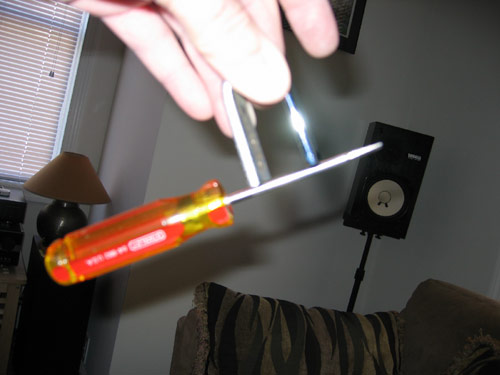
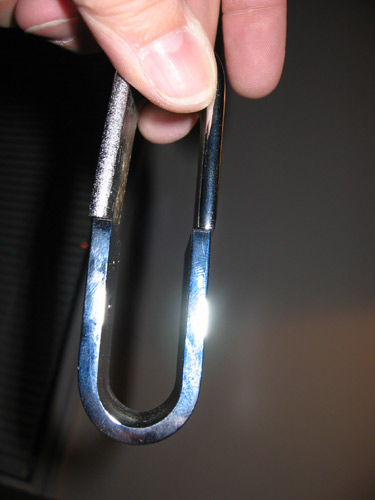
Sounds like you need a charge. An object made of ferrous metal should be strongly attracted to any part of the shoe. See this... a '67 HS magnet (NEVER re-charged, but in storage for 20 years) holding up a screwdriver, and a reissue HS. The reissue shoes are HEAVY...
Posted: Wed Apr 04, 2007 8:21 am
by stevebasshead
Wow. And wow again...
Thanks for this, and no way can my shoes do that ! They'll just about hold washer but not a screwdriver. And certainly not another HS. They're just about attracted to each other and one will pull the other along a smooth surface if I'm very gentle. And yet, they were quite capable of producing a seemingly strong signal (and the E and G strings still do).
Is there a recommended method of remagnetising them ? Any pitfalls to be aware of ?
Posted: Wed Apr 04, 2007 8:52 am
by elysrand
Any semi-magnetic material (able to be magnetized but not possessing perfectly stable ferro-crystalline structure) can be re-magnetized simply by stroking a far-stronger permanent magnet repeatedly in the same direction, like left-to-right, enough times. It realigns the magnetic poles in the ferro-magnetic crystalline material inside the shoes. To a certain degree, the more strokes in exactly the same direction with stronger and stronger magnets, the stronger the resulting magnetic field of the re-magnetized object.
It is also possible to re-magnetize (and far more commercially efficient) with a coil electromagnet driven by DC, not AC, current. This method is also faster if you use a large-enough unit, but the cost of such a unit is beyond the average person.
Posted: Wed Apr 04, 2007 9:09 am
by johnhall
There's no amount of stroking that will give you this kind of field (otherwise most of us would have magnetized body parts).
The commercial technique is with a device called a "magnetic separator"; ours is an 800 watt unit with 95V DC to the coils. Takes about 10 seconds to charge these.
However, the coil from almost any spot welder works nicely and after they tore down the power generating station next door to the factory in Los Angeles where all the original Frying Pan magnets were charged, that's exactly what they used instead, for years. Perhaps a local welder can help you out.
Posted: Wed Apr 04, 2007 9:28 am
by stevebasshead
Excellent, thanks John (and Elys, Sean and John A.) I know a couple of people with spot welders, I'll call them tonight.
Posted: Wed Apr 04, 2007 8:50 pm
by xsubs
You're welcome, Stephen.
If you can't find anyone... try Jason Lollar. He does it... here's a link (look halfway down)
http://www.lollarguitars.com/Winding.htm
Posted: Wed Apr 04, 2007 9:01 pm
by xsubs
Almost forgot... DON'T allow them to touch one another, and don't use them to REPEL objects. This weakens them.
In my example above, I'm attracting a NON-magnetic reissue shoe. Attraction of objects with no charge of their own is OK.
Hope this helps.
Cheers
Posted: Wed Apr 04, 2007 10:59 pm
by rickcrazy
"Don't allow them to touch one another"? Really? I mean, if by any chance you'd install them leaving no gap therebetween, would that have an adverse effect?
Posted: Thu Apr 05, 2007 6:49 am
by xsubs
Hiya Sergio!
Since the pickup wiring (ground) passes dead center through the gap, that won't be possible. Here's a pic to illustrate...
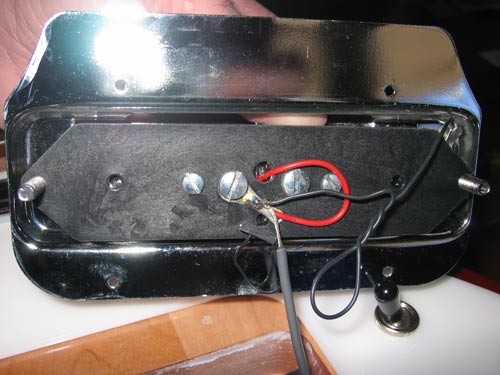
I had read the details on magnet properties, as I described, from one of the magnet mfgs websites... I just can't remember which! I'll see what I can find for you.
Cheers
Posted: Thu Apr 05, 2007 7:15 am
by stevebasshead
Hi Sean,
For a couple of weeks mine were touching at the base as I'd used my 4003's baseplate because I had no mounting screws to fit the thread on the baseplate the shoes came on. I got round the lack of gap for the wiring by mounting the bobbin on a couple of washers and taking the wire around the edge of the baseplate as a temporary measure.
This was fine at first, so if it turns out as you suggest maybe I've inflicted the problem on myself. Serves me right for not having the patience to wait for the new bobbin and baseplate from Sergio, haha!
I checked my shoes last night and they're seemingly of different strengths judging by the non-scientific test I did. One can just barely lift a 3/16 socket the other can only manage washers. Also, whereas the bottoms had seemed the most magnetic when I got them (if I remember correctly) now the top side seems the stronger.
I'm borrowing one of my mates arc welders at the weekend which I believe has the right kind of coil, so I'll try remagnetising the HS's. I'll test that it works on a non magnetic screwdriver first.
Does anyone know if I lie them in their sides next to the coil or stand them on their open ends ? Does it matter ?
Thanks,
Steve.
Posted: Thu Apr 05, 2007 10:18 am
by johnhall
I wish I could give you advice on the orientation of the horseshoes with respect to the arc welder but not only did I never personally observe how they did it, I suspect it would be different from welder to welder.
How about using something like a paper clip to determine where the strongest field is on the welder? My intuition is that you would then want to orient it with only one side of each shoe, i.e. the top, against that field. I do know you'll want to place the units, energize the welder, and then turn it off; you don't want to pull the units out of the field when the field is energized, as this is a well known way to demagnetize things.
What you should end up with is both top halves being the same polarity, while the bottom is opposite. Stated another way, in the position as normally mounted, the shoes should repel each other, while they should attract if one is flipped over.
There's a nice drawing of the north-south orientation in the original
patent.
Horseshoes being stored SHOULD be touching each other, but with one flipped over so they attract. That way they act as keepers and help each other stay charged.
Posted: Thu Apr 05, 2007 2:39 pm
by stevebasshead
Thanks John. Yes, I'll check with a paperclip as you suggest, and thinking about it I agree with your intuition. I guess if they were on their sides, or open ends face down, I'd be expecting the field from the coil to 'know' where to place the N and S fields on the shoes. Whereas with one face of the horseshoe nearest the coil getting the strongest effect from the field, the opposite pole has to be created at the weaker end. I'll experiment with some old bits of Meccano which I can bend into horseshoe shapes first.
I wasn't aware of the demagnetizing effect of pulling an object out of the field, but that would be useful since my horseshoes have different strengths. It may be as well for me to demagnetize them first so they both subsequently get an equal charge and end up with the same field strength in both halves. Otherwise Sergio's new bobbin could sound unbalanced across the strings.
Even with what little charge they still have I'd noticed they had to be flipped to attract each other. Along with what you say about storing them flipped and touching to retain their charge it does seem more and more likely my installation with the like-poled bottoms touching may have caused my problem.
I should be picking up the welder tomorrow or Saturday evenings, I'll post the results as soon as I've done it.
Thanks,
Steve.