Page 1 of 1
1967 - 360/12 Original neck toaster not working
Posted: Tue Jun 05, 2007 5:33 am
by mikestop
I have a 360/12 made in 1967 that is ALL original except for some new capacitors I put in a few years ago. The other day the the toaster pickup at the neck just stopped working/completely dead.
I checked the connections under it and cleaned them up and re-soldered, still nothing. Also looked under the pickguard and all wires and connections looked O.K. I've never worked on guitar electronics (I restore Antique Radios as a hobby so I'm fairly familiar with elctronics in general)Any ideas on what the possible causes might be. Thanks for any ideas!!
Posted: Tue Jun 05, 2007 6:04 am
by tennis_nick
This might just be a shot in the dark but... could it be possible that you'Ve been plugging into your Rick O sound jack instead of the mono jack?
Either that, or maybe something demagnetized the pickup... I dunno, shots in the dark
Posted: Tue Jun 05, 2007 6:40 am
by jingle_jangle
Check the mono jack first and the pickup switch next. It'll be one of those two, I'll betcha!
Posted: Tue Jun 05, 2007 8:21 am
by mikestop
Thanks Nicolas, but I always use the mono jack. Even tried plugging into Ric O jack but still nothing. Guitar has never been near anything that might de-magnetize it, but thanks again for you ideas!!
Paul I checked the continuity on the pickup toggle switch and it's good in all 3 positions. I'll check the mono jack. Is there a wire connected to it that would cause just this one pickup to fail?
Posted: Tue Jun 05, 2007 9:26 am
by soundmasterg
Unsolder the pickup from the guitar. Then get your DMM and check the resistance of the pickup. It should be around 7.4k ohms. If it isn't, then the pickup is somehow shorted. Sometimes the coil end wire is the culprit and you can unwind a little, find the break, and fix it. Other times it is the coil start wire, or somewhere in between that is bad. It can always be rewound too if it is in fact dead.
Posted: Tue Jun 05, 2007 10:08 am
by robbo63
I had the neck pickup in my 66 330 go bad with a break in the pickup winding. It didn't go completely dead, instead it would cut in and out, especially with harder strumming. Greg's suggestion is good, check the reading from the pickup with a meter.
Posted: Tue Jun 05, 2007 10:49 am
by rickcrazy
And sometimes the problem lies in the negative terminal, in which case only a rewind will "bring the pickup back". Hint, hint.
Posted: Tue Jun 05, 2007 11:38 am
by beatlefreak
Just to clarify - When you check with an ohmmeter, if you get a resistance reading way lower than 6k-8k, you've got a short somewhere in the winding. If the reading is way higher (20k up to no reading), you have an open in the coil.
Posted: Tue Jun 05, 2007 11:40 am
by teb
Once more with feeling..... Without disconnecting any wires or reaching for any meters, pull the mono jack out of it's hole in the body. This can be done by either removing the jack plate and pulling the jack out to the outside through it's hole in the wood, or unscrewing the lock nut holding the jack to the plate and pulling the jack into the control cavity. There is a switch built into the mono jack assembly and the hole in the body is usually just barely big enough for the jack to fit through. If the jack gets turned slightly in it's hole the switch part can get pressed up against the walls of the tunnel through the wood and it can prevent the switch from working properly. The result is that all of the sudden you have one dead pickup. Chances are that as soon as the jack is out and away from the wood, your dead pickup will come to life like new. Then it's a matter of either reinstalling the jack and twisting it slightly in it's hole until it's clear and working properly, or doing a little carving around the hole, inside the control cavity, to give the switch a bit more space and to prevent the problem from happening again.
While you have the jack free from the body, take a good look at it. You'll see the switch and you'll see how it works. It's a pretty clever gizmo, but being more complex than your average guitar jack it's to your benefit to understand what it's doing in case you ever need to trouble-shoot it again.
Finally, if this process doesn't bring your pickup back, then it is time to start unsoldering stuff, getting out the meter, etc.
Posted: Tue Jun 05, 2007 12:56 pm
by teb
Here is what I'm talking about. Whether or not it turns out to be the problem here, remember these photos because if you play (or mess with) stereo-wired Rickenbackers long enough you may well run into this scenario some day and it makes for a very frustrating afternoon where your assembly works great on the bench, but you stick it all back in the body and have a dead pickup.
The jacks: Mono jack on the left, with switch (the two metal blades on the far left side form the switch) and the stereo jack (Ric-O-Sound) is on the right.
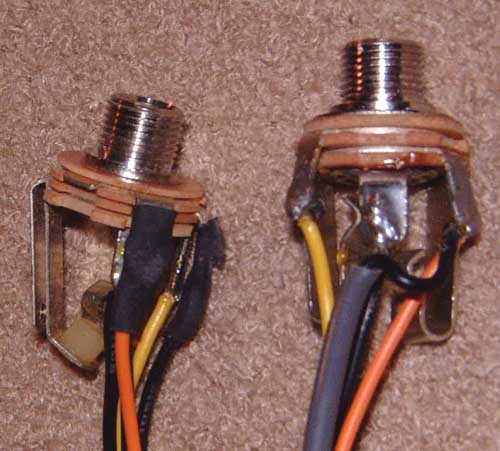
When you stick the plug into the mono jack, there is a small bump on the outer switch blade which contacts the blade next to it, which is being forced outward by the plug. Remove the plug and the inner blade moves inward again until the two no longer touch - unless the outer blade has become jammed up against the wood and is being forced up against the inner blade. That's when you have a dead pickup problem. If your jack gets loose over time and spins slightly as you plug and unplug the guitar this can happen, or if you for some reason disassemble the guitar and then reinstall the electronics but don't get the mono jack back in at an attitude where it has proper clearance.
This is the wood mod which helps prevent future problems. The body's sidewall is actually fairly thick in this area, so the jack hole really is more like a tunnel through the wood than just a hole. This guitar is wired dual-mono with different jacks, so ignore the jacks themselves, but you can still see the wood mod from back when it had the original jacks. The original mono jack was the one on the right in this photo from inside the control cavity. R.O.S. jack was the left one (the top of the guitar would be to the right).
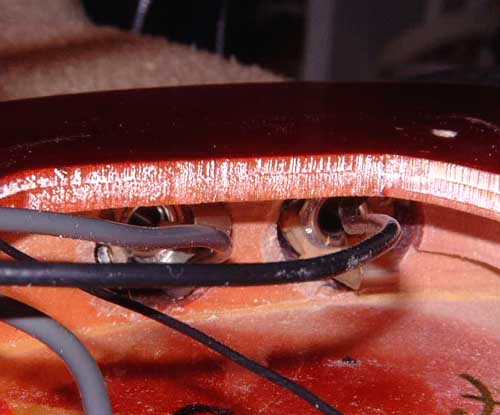
Essentially all that is needed is a bit of flaring at the tunnel entrance to provide enough clearance for the switch blades to stay clear of the wood. You can see the beveled carving on the left side of the original mono jack's hole. It's done from inside the control cavity, only on the entrance to the tunnel and doesn't usually take very much wood removal. You don't need to go deep enough to get anywhere near the jack plate or the varnished outer surface. You just want to give the switch on the mono jack a little more breathing room on the control cavity side of the tunnel. The alternative, of course, is simply to play around with the orientation of the switch in the hole until you find a position where it's clear of the wood and then to snug it down firmly on the jack plate to keep it from moving, but slightly opening the entrance to the tunnel may be a more dependable long-term solution.
Posted: Tue Jun 05, 2007 4:23 pm
by beatlefreak
Todd, the switch in the mono jack is what connects the two pickups on the same 'hot' line when it is engaged. the two pickups are connected separately to two different lugs on the stereo jack. When a plug is inserted in the mono jack, the switch engages, and the two pickups are connected together.
If this switch is jammed against the body wood (therefore always engaged), you'd get both pickups rather than a dead pickup. You'd also get the same sound on both channels of the stereo jack, because both pickups would be connected together on both lugs.
It could be possible that the mono jack might get jammed in such a way as to prevent the switch from engaging. That would cause a dead pickup. Perhaps that was what you've seen before.
Posted: Tue Jun 05, 2007 7:26 pm
by teb
Kris, that explanation of how the switch configuration works makes sense. I spent a couple of very confused hours repeatedly disassembling and reassembling the electronics and trying to figure out why they worked great on the bench, but not in the guitar. In any case, what saved me was digging up some old photos from Mark Arnquist that happened to show how to trim the wood back around the mono jack to create clearance for the switch and that fixed it. As I said, it may or may not be the problem that Mike is currently having, but the scenario it's worth filing somewhere in the back of one's brain because if it ever happens it will drive you nuts.
Posted: Thu Jun 07, 2007 12:35 am
by mikestop
Thanks everyone. I found the problem. The coil wire has a break right at the lug connection. I'll wind it back 1 turn and re-connect. Thanks again!!!
Mike.....
Posted: Thu Jun 07, 2007 1:25 am
by beatlefreak
Good news that it was right at the end! Many times they can break somewhere in the middle, necessitating a rewind.
Posted: Thu Jun 07, 2007 9:23 am
by soundmasterg
Yah, thats a lucky find! It won't change the sound at all either to lose 1 turn. Just be careful when resoldering the connection as magnet wire is very small and you don't need something very hot or it can melt the wire or cause something else to short further inside the pickup wind. A 25w soldering iron or smaller is just fine.