VINTAGE KEYBOARDS, ANYONE?
Posted: Wed Jul 02, 2008 5:30 pm
Is anyone else here smitten by them?
I started out as a keyboard player. Why? The old man (Alphonse, progenitor of our chromosomic potpourri) had this accordion...we were/are Polish, with a strong genetic propensity toward polka music. I never took a lesson--too poor--but did pull the case out from the closet and managed to learn a few basic chords going by ear. My friends put together a Beatles band in late '64, so there I was--there were already two guitarists and a bassist, so I (besides being disposable and painfully aware of it) became the keyboardist by default and inclination.
After two non-paying gigs, I was put on notice by the band-leader, once-best-friend Gus, whose parents had a bit more money, that unless I got a proper keyboard, I was going to be mustered out. So I took the only money I had--$55.00 that I'd received for my 16th birthday, supplemented by a loan from my grandmother for $25.00--and found a German mom-and-pop music store on Lincoln Ave. in Chicago which had a portable P-18 Farfisa in stock--for $80.00. It sort of met the appearance criteria--light gray two-tone Tolex--with a nice bling medallion on the top that said, "Portorgan Farfisa", which made me the butt of endless gags at the whim of the band leader/former best buddy, whose sarcasm knew no bounds.
It was a reed organ; essentially a chord organ version of an accordion with a motor and blower instead of a bellows. It had one sound, and once I mounted a crystal mic element inside and wired that to a pot, I could at least control the volume. Still, listeners complained about the shrillness.
Now I look back and am amused at how unlike any real combo organ it was--too small, too limited, and too square. As in not hip. As defined by sixteen-year-old sensibilities, anyway (did I just perpetrate an oxymoron?).
A couple of years back, I bought a nice P-18 for something like $45.00, identical to the $80.00 one from 1965. Here it is...pathetic, but my age has given me a sense of nostalgic, absurdist humor:

Well, in '04, I started collecting '60s combo organs, and I'm a bit abashed at the number that I have managed to accumulate, along with a 25-year-old lady organ tech who I keep in plane tickets to Amsterdam, apparently (at least, that's where she was last week). I've got the "usual", some in duplicate; along with some oddballs, too. About 10% work right out of the box. I've learned the ins and outs of shipping them to avoid damage, as most are large/heavy/delicate.
Yesterday the set shown below arrived, and every feature worked right out of the box. It's a '67 Baldwin, according to Barry Carson, who "wrote the book" on transistor combo organs and who is the former owner of this mint condition example, and is one of less than 100 ever made. As you can see, it was styled to match their line of "Supersound" solid state amplifiers. The organ/amp pair is a real rarity (have you ever seen another outside of a Baldwin line catalog?).
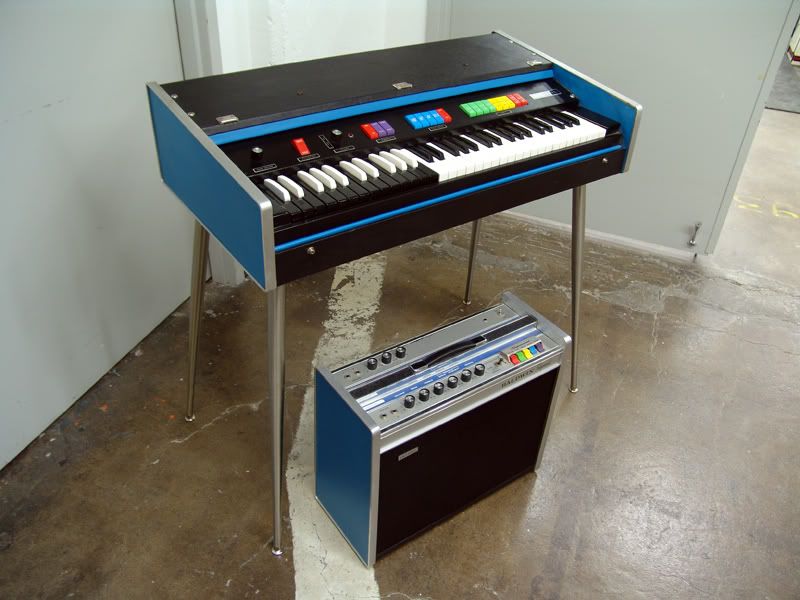
In setting up the Baldwin, I was struck at the similarity between its styling and that of the P-18 Farfisa. So I posed 'em together. It reminds me of a FIAT trying to pass a Peterbilt. The Farfisa (FIAT), made in Italy by the same company that made the Combo Compact, is just too precious, and petite in sound, too. The Baldwin, built in the USA, which is rare in the combo organ biz, is the Peterbilt. It's a tank.

If anyone else out there uses vintage combos, do join me in posting pics. Otherwise, get ready for an onslaught of Farfisas, Elkas, Gibsons, Lowreys, Teiscos, a WERSI, two or three Hammonds, and of course, my lovely VOXes. We're talking mostly '60s vintage stuff here--by 1971 or so it was all over as ICs took over and led to the Golden Age of analog synths.
Dare I mention that I'm looking for a replacement for my long-lost and lamented ARP Quadra?
I started out as a keyboard player. Why? The old man (Alphonse, progenitor of our chromosomic potpourri) had this accordion...we were/are Polish, with a strong genetic propensity toward polka music. I never took a lesson--too poor--but did pull the case out from the closet and managed to learn a few basic chords going by ear. My friends put together a Beatles band in late '64, so there I was--there were already two guitarists and a bassist, so I (besides being disposable and painfully aware of it) became the keyboardist by default and inclination.
After two non-paying gigs, I was put on notice by the band-leader, once-best-friend Gus, whose parents had a bit more money, that unless I got a proper keyboard, I was going to be mustered out. So I took the only money I had--$55.00 that I'd received for my 16th birthday, supplemented by a loan from my grandmother for $25.00--and found a German mom-and-pop music store on Lincoln Ave. in Chicago which had a portable P-18 Farfisa in stock--for $80.00. It sort of met the appearance criteria--light gray two-tone Tolex--with a nice bling medallion on the top that said, "Portorgan Farfisa", which made me the butt of endless gags at the whim of the band leader/former best buddy, whose sarcasm knew no bounds.
It was a reed organ; essentially a chord organ version of an accordion with a motor and blower instead of a bellows. It had one sound, and once I mounted a crystal mic element inside and wired that to a pot, I could at least control the volume. Still, listeners complained about the shrillness.
Now I look back and am amused at how unlike any real combo organ it was--too small, too limited, and too square. As in not hip. As defined by sixteen-year-old sensibilities, anyway (did I just perpetrate an oxymoron?).
A couple of years back, I bought a nice P-18 for something like $45.00, identical to the $80.00 one from 1965. Here it is...pathetic, but my age has given me a sense of nostalgic, absurdist humor:
Well, in '04, I started collecting '60s combo organs, and I'm a bit abashed at the number that I have managed to accumulate, along with a 25-year-old lady organ tech who I keep in plane tickets to Amsterdam, apparently (at least, that's where she was last week). I've got the "usual", some in duplicate; along with some oddballs, too. About 10% work right out of the box. I've learned the ins and outs of shipping them to avoid damage, as most are large/heavy/delicate.
Yesterday the set shown below arrived, and every feature worked right out of the box. It's a '67 Baldwin, according to Barry Carson, who "wrote the book" on transistor combo organs and who is the former owner of this mint condition example, and is one of less than 100 ever made. As you can see, it was styled to match their line of "Supersound" solid state amplifiers. The organ/amp pair is a real rarity (have you ever seen another outside of a Baldwin line catalog?).
In setting up the Baldwin, I was struck at the similarity between its styling and that of the P-18 Farfisa. So I posed 'em together. It reminds me of a FIAT trying to pass a Peterbilt. The Farfisa (FIAT), made in Italy by the same company that made the Combo Compact, is just too precious, and petite in sound, too. The Baldwin, built in the USA, which is rare in the combo organ biz, is the Peterbilt. It's a tank.
If anyone else out there uses vintage combos, do join me in posting pics. Otherwise, get ready for an onslaught of Farfisas, Elkas, Gibsons, Lowreys, Teiscos, a WERSI, two or three Hammonds, and of course, my lovely VOXes. We're talking mostly '60s vintage stuff here--by 1971 or so it was all over as ICs took over and led to the Golden Age of analog synths.
Dare I mention that I'm looking for a replacement for my long-lost and lamented ARP Quadra?


