Mark, you couldn't write this at a more timely moment.
I recently completed writing and producing a series of 5 online interactive classes for my University in the Industrial Design curriculum, specifically on the topics of beginning through advanced precision modelmaking and finishing for Industrial Design students. I write and filmed these in order, starting with the basic class (101) and moving through the most advanced class, which is a class in machine shop theory and practice.
Because students take these classes at home, on their own time, and an online modelmaking class had never before attempted anywhere, to my knowledge, it became our responsibility to map out parameters under which students could best learn the practical, hands-on skills that modelmaking classes which take place in a shop environment, teach.
We agreed that each student would be required to invest in a full set of table-top machines, ranging from a 12" disc sander, modelmaker's table saw, and 10" band saw (for the first class) through a small machine lathe and mini-mill (for the last).
I think you can see where I'm heading here...eighteen months ago, when I ordered the machinery with which to videotape the advanced class, I ordered this exact mini-mill upon which to base the class, as the mill and its companion mini-machine lathe were on offer as a package deal for about $1500.00 with all necessary attachments. I spent several weeks working with this machine under tight production deadlines. I got to know its strengths and shortcomings very well. It is currently bolted to a workbench in the machine shop right outside my office window.
If I was writing for a hobbyist forum, on the topic of building scale models of locomotives, automobiles, airplanes, live steam, or working multi-cylinder powerplants in scale, I would recommend this machine as a good beginner's milling machine. It is a scaled-down replica of the much-respected gear headed EMCO machines, which are built in Austria to a very high standard. These minis, however, are made in China and like most Chinese machine tools, there are trade-offs to accommodate the price points.
I would note that its shortcomings in hobby use are mostly convenience ones--it is difficult to fasten items to its table, its cutting capacity is very limited, and there are no provisions for digital readouts, though backlash in the X and Y feed screws is excessive, leading to a loss of accuracy that takes some ingenuity to eliminate.
The machine, as shipped, requires some assembly. But, more importantly, there is MUCH setup and "dialing in" to be done--the table gibs have to be set just so, the backlash adjusters need lots of fettling, and specific accessories must be ordered to complete the most basic projects; this can slow a schedule down and frustrate the user. If you're used to a larger, more precise and powerful machine, your frustration with this machine's limitations could be great. Its strengths lie in making nice little parts. Operative word here being
little.
For musical instrument use, this machine is virtually useless, mostly due to size. I have yet to see an ad showing it with a proper scale reference (like a person using it). Here's a picture (tiny screen grab) from the class itself showing me standing next to it.
Can you see it? No? Well, it's there, on the left. (Hint: it's red, mostly.)
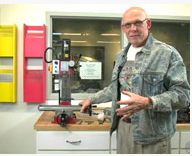
- mini-me.jpg (59.54 KiB) Viewed 1139 times
To use this machine to build anything the size of a guitar or banjo would not be possible...for parts a few inches in length, maximum, it's a possibility.
Now, the question arises: what could you use for a drum sander, power planer, and bench drill? Well, a decent-sized floor standing or bench-mount drill press can be used for all of those functions. You'll need one with at least a 10" throat depth. There is an inexpensive attachment for this machine available called a Wagner Power-plane (it's a cutterhead) that will plane wood, though it's kind of light capacity. There is a luthier's drum-sanding station which attaches to the drill press, also sold by Stew-Mac, which does thickness sanding and drum sanding. Of course, you can drill with it.
That leaves wood turning and pin routing. Nothing turns wood like a wood lathe, and these can be bought fairly inexpensively through craigslist ads and Ebay. Even a new light-duty one won't break the bank. The pin router is another story--commercial ones weigh a ton, use lots of power, and are dangerous as hell. There is a light duty one (fine for guitar work--I occasionally use one, on my light show conversions) available from Grizzly.
But, no matter how you cut it, unless you get lucky with used machinery, you're looking at around $2K+ for these three machines. But that's money better spent than the $550.00 on the mini-mill, at least for your purposes.


