Page 1 of 3
Horseshoe Pickups
Posted: Mon Mar 02, 2009 1:58 am
by rickfan60
It seems that once something is no longer available everybody wants it no matter how unimportant or ignorable it was while it was being made. Over the last 30 years I have learned that nowhere is this more true than in the guitar world. To guitar buffs of all stripes, old is ALWAYS considered to be better. This is the ruling opinion despite advancements in materials and methods. We always tend to think the old way is and will always be better. I could not disagree more. Valid arguments can be made about old growth woods versus younger farm raised wood. OK. I would even accept arguments about older woods having been aged and dried out just right or having a vibe because of regular use. Even so, plenty of bad guitars were produced by ALL makers. Not every '62 Jazz Bass was worth a damn but some people will take out a second mortgage to pay for one regardless of how good it really is. Old simply does not always equal good. There, I said it. Of course that makes me a heretic to some of you but so be it.
At some point we just have to accept the fact that the builders of the instruments did learn and somehow manage to improve the quality and playability of their products by making changes over time. Version 1 of pretty much everything is not as good as the following versions. Of course these improvements usually meant leaving something behind. Those things left behind are what WE focus, fixate, and fantasize on. That brings us to the much celebrated Rickenbacker horseshoe pickup.
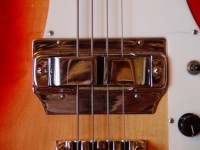
It is basically the same pickup used in Rickenbacker lap steels from 1952 on to about 1968 only with 4 poles pieces. Now, I think the vintage horseshoe is a fine pickup when played properly. It has a wonderfully complex tone that is more subtle than that of the modern pickups. Their low resistance windings probably account for that. The tone range is quite wide. With rounds I can coax a solid Squire tone out of it and with flats it can sound just like McCartney's bass. Despite the nice tone there are negatives to the design. The horseshoe is very intolerant of hard play and can be quite fragile. The magnets are quite brittle and will crack like glass if struck by a hard object or dropped. The bobbin material is thin and the mounting screws can tear it leaving the bobbin to float around loose. Mine is held in place with short drywall screws because the holes became so enlarged over time. Unfortunately one of the previous owners was not very nice to the old girl. Someday I will have to work out a better solution. The biggest problem with the horseshoe though is that the magnets are weak and rapidly degauss. Regular gaussing is required if you want them to sound good. Unfortunately the old bobbins just don't hold up to being pulled apart and put back together. Many horseshoe pickups were discarded in favor of anything else that would fit in the hole. In the long run the negatives outweighed the positives so Rickenbacker developed the simpler and far more reliable high gain.
People are still willing to pay lots of money for those old pickups, despite the shortcomings. There are alternatives to dropping a boat load of cash on a pickup you don't even know if you will like. You can build your own pickup using stock Rickenbacker parts you can gather through your favorite online buying/selling service. This is what you need.
1 50's to 60's vintage Rickenbacker steel guitar. (disclaimer to follow)
1 High Gain treble pickup (sorry about the ****** pic)
Re: Horseshoe Pickups
Posted: Mon Mar 02, 2009 2:21 am
by rickfan60
Building your own is not necessarily cheap but unless you get really lucky it will cost less than buying an original 60's pickup.
Disclaimer time: I do not advocate or condone the desecration of ANY musical instrument. Completing this project means you will be taking magnets from a vintage instrument. PLEASE do not harvest magnets from rare or unusual Rickenbacker steel guitars!!! The more common student instruments are better choices. Not that it is right to rob them either but if it is going to happen is should be confined to the common ones. I will tell you how to restore your donor instrument using the magnet removed from the high gain. Please be sure to do that.
Doing the Deed:
The first thing you want to do is take a look at your high gain and make note of which end is the E string end. The pole piece on the E end is closer to its end than the G pole is to its end. Newer high gains don't seem to have this distinction but the older ones do. Mark the E end with a piece of tape. This will be important later.
Disassemble the high gain carefully. You want to remove the bobbin assembly from the base plate first. Be careful not to break the lead wires. Once the plate is removed you must carefully remove the magnet. Don't rush it or you will tear the soft magnet and ruin it. Warm it up a bit and the glue will soften then get under it with a razor blade. Careful is the operative word here. Once the magnet is off the bobbin should look like this.
Re: Horseshoe Pickups
Posted: Mon Mar 02, 2009 2:33 am
by rickfan60
I should add that because of the way the magnet is made you will have to cut off the wire running to the center of the bobbin. Unlike what I show in the above pic, leave a little wire so you can resolder it later.
Still Doing the Deed:
Now you will want to cover the solder connection on the bottom of the bobbin with some electrical tape otherwise it may touch the horseshoe magnet and short the pickup. Punch a small hole in the tape and slip it over the end of the wire and snug it up around the solder.
Set the high gain aside for now and get your donor instrument. Carefully remove the pickup. It is just like taking the pickup out of your bass because the pickup in your donor guitar is the true origin of your bass pickup. Take the two inner screws out of the bottom of the pickup and slide the bobbin out. You should be left with something that looks like this.
Notice how one magnet has a wider opening than the other? That will be the EA magnet. The E end of the bobbin will go into this magnet.
Re: Horseshoe Pickups
Posted: Mon Mar 02, 2009 2:41 am
by rickfan60
Doing the Deed Part 3:
OK, you can now insert the taped high gain bobbin into the horseshoe magnets. run the wires through the slot cut in the aluminum base plate. Note that I used thin washers between the bobbin bottom and the magnets. They can be seen in this picture.
Install the bobbin screws and you are almost there.
Here is an important detail. You must wire the pickup leads in reverse for the bobbin to work properly with the horseshoe magnets. The ground and hot must be switched or the pickup will be out of phase with the neck pickup and sound REALLY bad doing it.
Install the assembly into your pickup surround and put the entire assembly into your guitar and wire it up. Be sure to reverse the hot and ground!
Re: Horseshoe Pickups
Posted: Mon Mar 02, 2009 2:51 am
by rickfan60
Finishing the Deed:
Getting the pickup height right is the most difficult part. If it is too high the strings will hit the poles, too low the magnets. You will have to experiment a bit to get it right.
If you want a more vintage sound, have the bobbin rewound to about 6K ohms. That is about where the originals are. You can do this by removing some of the existing windings or rewind it from scratch. If you do that, reverse the direction of the windings and you won't have to reverse the leads.
Cleaning Up:
Take that soft magnet from your high gain and apply it to the bottom of the bobbin in the steel guitar. While you are at it, give it that plastic base plate too. Reassemble the pickup and put it back in the steel guitar. It should work properly when you are done. If you really want to do it up, put one of your unused pickup covers on it so it will at least look like it still has a horseshoe pickup. It is cool how you can drop the modern parts right into the old guitar like that.
That should be enough to get the job done.
Re: Horseshoe Pickups
Posted: Mon Mar 02, 2009 2:51 am
by jaymi
That is awesome, Ted!!
Re: Horseshoe Pickups
Posted: Mon Mar 02, 2009 2:55 am
by antipodean
Thanks for this Ted! I want to get myself a student model steel and get to work right away!
I note that the gap in the shoes at the baseplate in step 3 is somewhat bigger than in step 2. Does this require any tinkering or is there some play in the shoes or baseplate?
Re: Horseshoe Pickups
Posted: Mon Mar 02, 2009 2:58 am
by rickfan60
No. The screws were not installed at the time so the shoes are not in their correct places. There is only one way to assemble the base plate and shoes.
Re: Horseshoe Pickups
Posted: Mon Mar 02, 2009 3:16 am
by antipodean
Got it - that makes perfect sense!
Now to find that elusive beaten-up steel.....
Re: Horseshoe Pickups
Posted: Mon Mar 02, 2009 3:24 am
by atomic_punk
Ted, your thoughtful description of every step along the way was a joy to read. Even though I have no plans or desire to do this myself, I enjoyed the detail and thoughts one would have to go thru in doing it. Kudos.
Re: Horseshoe Pickups
Posted: Mon Mar 02, 2009 7:25 am
by leftybass
Beauty of a post, Ted.
Re: Horseshoe Pickups
Posted: Mon Mar 02, 2009 12:44 pm
by rickaddict
rickfan60 wrote:It seems that once something is no longer available everybody wants it no matter how unimportant or ignorable it was while it was being made.
Yep! Nothing attracts a crowd, like a crowd!
Cool post, Ted!

Re: Horseshoe Pickups
Posted: Mon Mar 02, 2009 12:55 pm
by wints
leftybass wrote:Beauty of a post, Ted.
Absolutely!
Re: Horseshoe Pickups
Posted: Mon Mar 02, 2009 1:06 pm
by whojamfan
I agree with Ted on the "older is better" myth. I had the pleasure of playing and owning many "vintage" guitars in the mid 80s. At this time, nobody wanted these old pieces of junk because Floyd Rose metal was king. You could pick up cool guitars between 350 and 500 bucks that go for 3,000 and up today. Having said that, a lot of them I have tried were junk, real clunkers that would never stay in tune and weren't built perfectly, despite current mindset. I'm not saying they were all like that, but the stupid prices these old instruments are bringing these days just makes me laugh. I'd sure hate to drop a wad on one and get something like I tried out 20+ years ago.
I find quality control of most instruments superior today than those of yesterday. Whether or not you care for todays choices of new instruments, they are more consistantly playable than any of old. I was in a band in the mid 80s with a guy who had a 58 Les Paul Standard in cherry sunburst, and the thing was a dog. Played bad, sounded bad, wouldn't stay in tune. It's a joke how much this crummy guitar is worth now, especially since a 500 dollar Epiphone would smoke the shorts off of that old "treasure".
This, as always, is my highly subjective opinion based on experiences I have had, and am not knocking fine vintage instruments, I just don't buy in to the "hype". A good instrument is a good instrument no matter what year it was made, or who made it.
Having said that, what a great post on making the pickup, and sorry if I strayed off the main topic a little there

Re: Horseshoe Pickups
Posted: Mon Mar 02, 2009 1:10 pm
by beatlefreak
Quite an analysis, Ted. Thanks for that.