Page 1 of 2
Mmm....strippers
Posted: Mon May 18, 2009 7:40 pm
by collin
Paul, do you happen to know which brand/type paint strippers work the best with which paint variaties?
For example, does Jasco brand work better on CV, and Aircraft stripper on Laquer/enamel/polyeurethane?
I'm not well-versed in the chemical composition of each paint type, so often reading the labels is of little help.
This is for removing (? Laquer ?) paint off of a CV body, then eventually CV off the body back to bare wood.
Thanks!
-C
Re: Mmm....strippers
Posted: Mon May 18, 2009 9:43 pm
by jingle_jangle
The hot ticket is to use Kleen-Strip #343 Aircraft Stripper, which is roughly 1 1/2-2 times the price of ordinary Jasco, and not exactly easy to find, but works a treat on anything except polyester finishes. (It softens polyester but it's still a bear to remove polyester from a wooden body.)
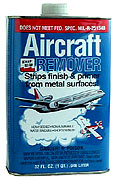
- KLEQAR343.JPG (10.55 KiB) Viewed 1894 times
This is the stuff. It's available at most auto body shop supply stores, for around $20/quart. It strips CV, lacquer, enamel, urethane.
If you've got lacquer
overCV, and want to leave the CV and whatever is under it intact, I'd remove the lacquer with lacquer thinner and clean rags. The thinner will soften the surface of the CV slightly and temporarily, but it will soon re-harden and can be cleaned and waxed again.
Re: Mmm....strippers
Posted: Mon May 18, 2009 10:25 pm
by collin
Perfect, thank you Senor.

I figured there was a good technique. Now I just need to figure out what type of paint I have on top (don't have the body in hand yet).
Re: Mmm....strippers
Posted: Tue May 19, 2009 11:54 am
by jdogric12
We used that stuff on a recent Squier and it was naaaasty. A real pain. Does it work better on Ricks?
Re: Mmm....strippers
Posted: Tue May 19, 2009 1:38 pm
by collin
jdogric12aolcom wrote:We used that stuff on a recent Squier and it was naaaasty. A real pain. Does it work better on Ricks?
Well, that makes sense. Squiers are covered in the nastiest, thickest plastic poly ever laid on a guitar. It's a total dog to get off the surface, and half the time you end up sanding the details.
Re: Mmm....strippers
Posted: Tue May 19, 2009 1:39 pm
by kennyhowes
Just scrape it.
Re: Mmm....strippers
Posted: Tue May 19, 2009 2:31 pm
by jingle_jangle
collin wrote:jdogric12aolcom wrote:We used that stuff on a recent Squier and it was naaaasty. A real pain. Does it work better on Ricks?
Well, that makes sense. Squiers are covered in the nastiest, thickest plastic poly ever laid on a guitar. It's a total dog to get off the surface, and half the time you end up sanding the details.
Collin's right, here...I have had little success in removing Fender polyester finishes using chemical means. Kira's '58 Duo Sonic--which body began life as a '90s Squier Duo--was done by power-sanding off the 1.5mm-thick polyester coating, down to bare wood, before doing the shape mods to bring it back to '58 specs. It was a bear--I've tried bagging these bodies to keep the stripper wet, and I've used every type of stripper I could find...the best I could get was a slight surface softening and swelling.
As for scraping, this works only with very thin shell nitro finishes, where the color is only a couple of thousandths thick. It is ineffectual on Ricks and anything finished in urethane or polyester.
Re: Mmm....strippers
Posted: Tue May 19, 2009 3:34 pm
by cjj
jingle_jangle wrote:collin wrote:jdogric12aolcom wrote:We used that stuff on a recent Squier and it was naaaasty. A real pain. Does it work better on Ricks?
Well, that makes sense. Squiers are covered in the nastiest, thickest plastic poly ever laid on a guitar. It's a total dog to get off the surface, and half the time you end up sanding the details.
Collin's right, here...I have had little success in removing Fender polyester finishes using chemical means...
Have you ever tried Acetone or Methylene Chloride on polyester? I know those solvents will swell and weaken some polyester resins, but I have no idea whether polyester guitar finishes are of those types.
Re: Mmm....strippers
Posted: Tue May 19, 2009 3:53 pm
by jingle_jangle
I work with both these solvents daily, and they're impractical for paint stripping duty. Methylene chloride is a major component of the paste-type strippers, anyway.
The main issue with these is that they're water-thin, evaporate too quickly to do any good, and if bagging the guitar with one of these didn't yield penetration of the wood (which can cause finish problems), they might soften the polyester a bit. I'd give methylene chloride or ethylene dichloride the better chance. Here, toxicity and waste disposal rears its ugly head--perhaps the reason that RIC strips its finishes primarily by scraping.
Re: Mmm....strippers
Posted: Tue May 19, 2009 4:32 pm
by 1965
jingle_jangle wrote:As for scraping, this works only with very thin shell nitro finishes, where the color is only a couple of thousandths thick. It is ineffectual on Ricks and anything finished in urethane or polyester.
I would think scraping would work fine on vintage Rics
Re: Mmm....strippers
Posted: Tue May 19, 2009 4:38 pm
by scotty
The fact that not one scantly clad pic has been posted indicates that we are now in a mutual understanding that posting such an item would be degrading and inappropriate behaviour.This is where ones imagination has to come into its own.

Re: Mmm....strippers
Posted: Tue May 19, 2009 5:07 pm
by collin
scotty wrote:The fact that not one scantly clad pic has been posted indicates that we are now in a mutual understanding that posting such an item would be degrading and inappropriate behaviour.This is where ones imagination has to come into its own.
haha, touche! Or we are seriously all guitar geeks in the highest order.....at least my title was tongue-in-cheek.
Re: Mmm....strippers
Posted: Tue May 19, 2009 5:10 pm
by jingle_jangle
1965 wrote:jingle_jangle wrote:As for scraping, this works only with very thin shell nitro finishes, where the color is only a couple of thousandths thick. It is ineffectual on Ricks and anything finished in urethane or polyester.
I would think scraping would work fine on vintage Rics
This is true, Wes. It's a good way to remove paint and CV on recently-painted Ricks (before the CV has hardened to its fullest) and older Ricks with lacquer or very thin CV finishes. The most commonly-refinished Ricks for me, however, are typically '80s models, and paint and varnish on these is the thickest and hardest. I use chemical stripper for the large surfaces, top and back, after taping off the binding with several layers of masking tape. Fretboards and details, as well as the unmasked binding areas are sanded, and finally surfaces are scraped where necessary to flatten and smooth surfaces.
That's my method. YMMV (Your Method May Vary).
Re: Mmm....strippers
Posted: Tue May 19, 2009 5:19 pm
by kennyhowes
scotty wrote:The fact that not one scantly clad pic has been posted indicates that we are now in a mutual understanding that posting such an item would be degrading and inappropriate behaviour.This is where ones imagination has to come into its own.
Aye, but it's tempting...
Re: Mmm....strippers
Posted: Tue May 19, 2009 5:26 pm
by kiramdear
I'm proud of you boys.

