Page 1 of 1

Top Thickness and bracing ..

Posted: Sun Feb 20, 2011 6:38 pm
by Ric_MEL
collin wrote: There are massive differences in the construction, tone, playability and sound between vintage (pre'70) Rics and later versions.
I know with acoustic guitars.. Martin and Gibson for example. in their many years of production history.. have futzed with top thickness and bracing.

For example some of the old Martins as they aged had troubles with their tops as they didn't hold up under years of tension.. alternatively..
I've read there was a period in Gibsons history where management didnt' want to deal with problems.. defects .. or returns.. so they ratcheted up the thickness of tops and bracing. .but Killed the guitar tone in the process...

So as I was interested in seeing 60's 360NS..

re: Collin commenting on construction and tone re: vintage vs modern .. and I believe one of the noted features of the Carl Wilson ( or maybe Roger McGuinn ? ) model is the thinner top

My question I guess is: If thinner top or bracing is so noteworthy in a better sounding instrument.. and with modern day CNC capability where routing etc. can be done - reliably and repeatedly: to within THOUSANDTHS of an inch.... why don't they ?

After building these guitars for 50 years.. there must be a reason RIC builds each guitar... exactly the way they do as they could do it any way they determine to be the correct way. with years of feedback available. and not a massive retooling required.

Re: Top Thickness and bracing ..

Posted: Sun Feb 20, 2011 7:22 pm
by admin
A fair question Mark.

While some models may have thinner tops with the aim of copying parameters of yesteryear in the case of reissues, for example, I suspect that the Factory has found a thickness that is optimal for tone and durability.

I hope that someone from RIC will be able to respond to your question.

Re: Top Thickness and bracing ..

Posted: Sun Feb 20, 2011 8:31 pm
by Ric_MEL
If there were any anomolies due to vintage construction that took time to become evident - .. that were remedied by changing construction specs..

this would be place with the body of knowledge to know.. ( both from an extensive user base. and access to Rickenbacker themselves.. )

similarly .. in that 1970 time frame.. there must have been some feedback or something: to change other aspects... re: 24 fret necks versus 21.. or hi-gain pickups. etc.

M

Re: Top Thickness and bracing ..

Posted: Mon Feb 21, 2011 12:45 am
by paologregorio
Brian Medway and I both have early 80s thicker-topped, X-braced models in the "pile"; the combo of the thicker top and X bracing makes for a really cool sustain-y top, along with some other sweet tonal characteristics.

The thin tops are beautifully resonant though; Collin's 1993 has a frighteningly thin top that's amazingly resonant. :lol:

The thinness of the top is clearly visible when viewing the "f" hole cutout; my jaw fell open when I saw how thin it was on Collin's guitar.

Re: Top Thickness and bracing ..

Posted: Mon Feb 21, 2011 2:49 am
by collin
There is always give-and-take when it comes to building guitars.Rickenbackers have always been somewhat "fragile" guitars, especially when you compare them to bolt-on planks like Fenders etc, but it's worth it for the unique tone.

People often give the vintage models a bad rap for their fragility, but it's this same delicate construction that made them sound as good as they did.
I know that, since the introduction of the "C" series and Carl Wilson models, Rickenbacker has brought back the X-bracing and thin tops,respectively, and apparently done it with better structural integrity than 40+ years ago, so I'll hand it to them -- but it might not have to do with CNC machines.

CNC machines can speed up the process and consistency, but at the end of the day -- these guitars aren't made of metal that can be perfected down to thousandths of an inch, it's wood and wood can expand/contract/shift over time, while appearing to be "normal" off the assembly line.

From what I understand, changing from the x-bracing was done in-part to avoid the necks shifting. This is interesting to me, as from my experience, the necks can shift on pre 70's Rickenbackers because they occasionally had a poor neck tenon fit into the body (with too much room on the sides of the tenon), and not related to the x-bracing or top at all. I just reset the neck on a '66 330, and that's exactly what happened.
Ric_MEL wrote: in that 1970 time frame.. there must have been some feedback or something: to change other aspects... re: 24 fret necks versus 21.. or hi-gain pickups. etc.
From what I gather, both 24-fret necks and Hi-Gains were simply changes due to ever-changing consumer preferences into the 1970s, but I doubt that many consumers would have given much thought to internal guitar construction back then, that would warrant the changes beyond just being structural changes.

In any case, I think Peter is right -- the tops on Rics (particularly the C-series guitars) are much closer to **most** vintage spec Rics, and they must have found the appropriate balance between tone and durability, as they sound good and seem to be holding up well.
paologregorio wrote:The thin tops are beautifully resonant though; Collin's 1993 has a frighteningly thin top that's amazingly resonant. :lol:
The thinness of the top is clearly visible when viewing the "f" hole cutout; my jaw fell open when I saw how thin it was on Collin's guitar.
:lol: Thanks. That guitar is kind of a "special case." It is more resonant and has a thinner top than most vintage Rics i've seen, and is about as fragile as a Rickenbacker gets. No wonder Townshend could easily snap 'em in half. :shock:

Re: Top Thickness and bracing ..

Posted: Mon Feb 21, 2011 3:02 am
by winston
paologregorio wrote:Brian Medway and I both have early 80s thicker-topped, X-braced models in the "pile"; the combo of the thicker top and X bracing makes for a really cool sustain-y top, along with some other sweet tonal characteristics.

The thin tops are beautifully resonant though; Collin's 1993 has a frighteningly thin top that's amazingly resonant. :lol:

The thinness of the top is clearly visible when viewing the "f" hole cutout; my jaw fell open when I saw how thin it was on Collin's guitar.
Paul is correct. My 330 has acoustical qualities that contribute to the sustain that I describe as "sustain that goes on into next year". It is easily my favourite Rickenbacker in my small collection, in part because of its construction...........vintage tuners, small headstock, vintage bridge and the thicker X braced top. The fact that FG finish on mine is absolutely beautiful helps pin this guitar firmly in the number one slot.

I should mention that my 330 is equipped with two "toasterised" HB-1 pickups. This guitar rocks.

Re: Top Thickness and bracing ..

Posted: Mon Feb 21, 2011 3:41 am
by kiramdear
The first time that I plugged in my Carl Wilson, I sat down, tuned up, and started digging the tone. Loud and clear. It took me several moments to realize that I hadn't turned on the amp. :shock: :lol:

Re: Top Thickness and bracing ..

Posted: Mon Feb 21, 2011 4:24 am
by winston
No need to plug the guitar in then Kira...............jangle on. 8)

Re: Top Thickness and bracing ..

Posted: Mon Feb 21, 2011 12:02 pm
by egosheep
collin wrote: I know that, since the introduction of the "C" series and Carl Wilson models, Rickenbacker has brought back the X-bracing and thin tops,respectively, and apparently done it with better structural integrity than 40+ years ago, so I'll hand it to them -- but it might not have to do with CNC machines.
Just to be clear, they haven't brought X-bracing to all the standard models, right? Just the c63 and c58 and carl wilson?

I recently got an '83 330 with the thicker top and X-brace. I just love it, the sound is totally awesome, and the neck is a lot slimmer than the 2009 330 I had.

Re: Top Thickness and bracing ..

Posted: Mon Feb 21, 2011 1:01 pm
by Ric_MEL
collin wrote: In any case, I think Peter is right -- the tops on Rics (particularly the C-series guitars) are much closer to **most** vintage spec Rics, and they must have found the appropriate balance between tone and durability, as they sound good and seem to be holding up well.
This was my assumption.. that RIC has balanced the desire for a particular tone.. .with a conservative approach to insure integrity - and come to a defacto decision. Initially was curious to see of the thinner tops ever presented a problem in long term durability.. etc.

.. especially since there is a solid segment of the RIC community.. that reveres the thin(ner) tops and X bracing..

I'd love to see. .if there are threads/links available - pictures or details of the internal structure. and compare the difference between modern construction and vintage.

so. ( I'm guessing here now.. so help me out. 8-)

Thinner tops in general, X bracing up until about 1970.

Then some pretty major changes: Thicker tops.. , 24 fret necks.. Hi-Gains.- ( yet still X bracing ? )

Then a change to some other kind of bracing ( non "X" bracing ) in the early 80's.. that remains to this day the internal structure of 330/360.. except c63 c58 & Carl Wilson ) .

I'd love to A/B RICs with these various feature sets... it's one thing to get it down on paper.. the details.. ( my anal approach to the hobby )..
and yet another to HEAR the differences. As with all things tone.. to each his own.. ( ie. many people prefer Hi-Gains.. or humbuckers.. over Toasters. . yet Toasters are are the quintessential look and vintage sound for Rics.. ) .. At the end of the day.. ya gotta like the way it sounds..

I'd sure love to compare:
a modern 330/12... modern construction.. Hi-Gains.. <thicker> top, modern bracing, ..

with the sound of a jaw dropping beautiful 360/12c63.. Thinner top, X bracing.. Toasters.. 21 fret neck.., 7 1/4" radius fretboard.. . all the things I yearn for ON PAPER.. because they are vintage.. without paying for collector rarity.. or dealing with problems, restorations or high prices.. I don't even know which SOUND I'd prefer...

it's a journey...8-)

Re: Top Thickness and bracing ..

Posted: Mon Feb 21, 2011 3:43 pm
by JakeK
paologregorio wrote:The thin tops are beautifully resonant though; Collin's 1993 has a frighteningly thin top that's amazingly resonant. :lol:
He does have one of the best Rics on this forum! He can verify I've said this to him before, I've told him a number of times over the phone!

Re: Top Thickness and bracing ..

Posted: Mon Feb 21, 2011 3:52 pm
by godber
Ric_MEL wrote:...I'd love to see. .if there are threads/links available - pictures or details of the internal structure. and compare the difference between modern construction and vintage...
1981 370/360SPC X-bracing.
Image

Re: Top Thickness and bracing ..

Posted: Wed Feb 23, 2011 4:11 pm
by Ric_MEL
Thanks Mark.. as I see that X cross right about the bridge pup

below.. The the only other pic I've found < google > re: an inside look at a <330> route but doesn't show me the bracing.. .


by the way.. if you haven't seen this series of pictures .. pretty cool (couple years ago I guess.. )
http://www.notcot.com/archives/2009/09/ ... ker-gu.php

rickenbackerfac18.jpg

Re: Top Thickness and bracing ..

Posted: Wed Feb 23, 2011 4:24 pm
by godber
No need for Google! There's lots of info right here on the forum - this one's got a nice clear pic Mark.
viewtopic.php?f=13&t=8245&p=9000&hilit=bracing#p9000

Re: Top Thickness and bracing ..

Posted: Wed Feb 23, 2011 4:51 pm
by Ric_MEL
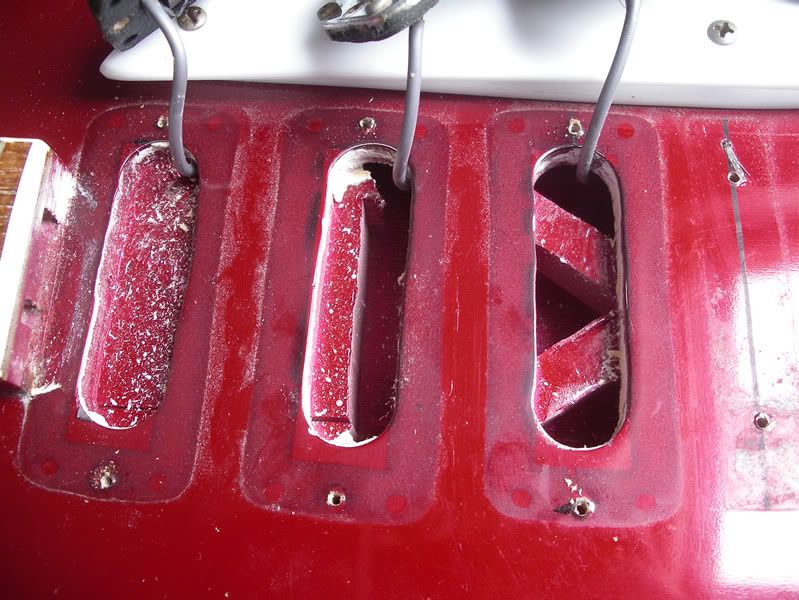
Thanks. So that's the Xbrace.. and I'll assume they were glued on..

does my photo then represent a finished modern 330? NO bracing. and that very long neck pocket ? . or the neck comes down a ways into that route.. and then the balance is space under the pickups..

this is quite a difference! especially with top thickness variable added in.. more of an acoustic build..

compared to:
xbrace.jpg