The voltage rating of the cap doesn't matter since the voltages involved in a guitar circuit are so small. The only thing a higher voltage rating will get you is a larger physical size.
OK, now for some info on where the cap goes and why. Sorry, this does get a bit technical...
<Nerd Mode>
What is a capacitor anyway? Well in it's simplest sense, it's a couple of metal plates separated by something that can store a charge. But we won't go into all of that, we'll just get into how it behaves in a circuit. A capacitor acts like a frequency dependent resistor. A resistor is something that inhibits the flow of electric current at all frequencies, even DC. The capacitor, since it's 2 plates not touching will not let DC through at all. So, what's this frequency dependent part?
The "resistance" of a capacitor is is given by the following equation (Oh no! MATH!):
Xc = 1/(2*PI*F*C)
Where "PI" is the constant 3.14159265..., F is the frequency in Hz, and C is he capacitance in Farads.
But that's more than we need. All we care about with that equation is that both C & F are on the bottom of the fraction. So if either gets bigger, the resistance (We call it Xc because it's not pure resistance) gets smaller. So, for a given C, the higher the frequency, the lower the resistance and the more signal gets through.
So, a capacitor will "do the same thing" regardless of where it is in the circuit.
BUT, we're talking about a "circuit" and all of the different components act together to do something so you can't just ignore them and stick the capacitor wherever you want and have the
circuit do the same thing!
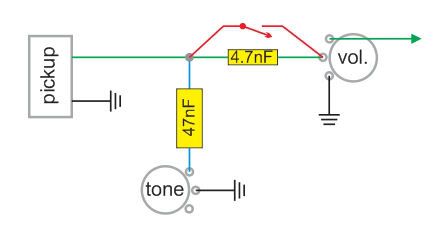
Now, the 0.0047uF "vintage" tone cap is placed in the circuit to act as a "high pass filter" meaning it will pass higher frequencies and block lower ones. A simple high pass filter consists of a capacitor in series with the signal and a resistor to ground:
210px-High_pass_filter.svg.png
This is the same as what's in the Rick circuit, but they use the volume pot (which is just a variable resistor) as the resistor. So, what does this filter do? Well, we said it passes high frequencies and blocks low ones. But how low?
Well, the frequency where output has dropped to half of the input is given by:
Fc = 1/(2*PI*R*C)
Which is called the "cut off" frequency. Here, R is the resistance in ohms, C, F, and PI as as above. So what? Well, as we can see, the resistor factors into the equation, so you can't ignore it. It's basically bleeding off some of the signal that manages to get through the cap, which is what makes the filter "cut off" as the signal gets lower. If you put it before the cap, it just lowers ALL of the signal and things won't behave the same way.
Now, in reality, it's a whole lot more complicated than that. The whole circuit works together and affects everything. The tone control affects the frequencies getting to the in-line cap as well as affecting how the "high pass" filter part works. Even the "input impedance" of the amplifier affects how this all works (the amp input impedance is the "resistance" to ground of the amplifier input).
But in simple terms, you can, for the most part, think of things happening in sequence as the signal encounters the different parts.
So, if you put the cap
after the volume control, it will still act like a high pass filter, but the "R" part of the equation becomes the amp input impedance and the way it will sound then becomes very dependent on the amplifier.
</Nerd Mode>
Well, that's probably enough for now, hope it was at least a bit helpful...


 ) on the soundcard than a guitar/bass amp.
