Stereo Wiring v. Mono Wiring
Posted: Sun Jan 04, 2004 9:12 pm
Hey all!
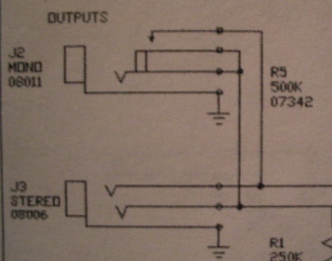
I was plucking my '97 4003 MG (w/ 7.4K toaster, horseshoe w/ .0047 mfd cap, and v63 guard) the other day and was relishing the diverse sounds that come from these great machines. Having read all past postings about the horseshoe and the volume drop that occurs when both pickups are on, I decided to take out my other Rick, a '98 4001v63 FG w/ .0047 mfd cap to size the two up. As I was comparing them, I noticed that the horseshoe in the 4003 dropped in volume when both pickups were on and returned to full volume when selected solo. The 4001v63 does not exhibit the same anomaly, that is, the horseshoe volume does not decrease when both pickups are selected. (I tested this by using the “pick-click method”: place a pick between the gap in the horseshoe, and tap on the top of the pickup while moving the pickup selector switch.) Having said that, both basses sound neck-pickup dominate with both pickups on. I understand this to be quite normal, correct? The 4003 is understandably more neck-pickup dominate than the 4001v63 simply by virtue of the horseshoe volume drop in the 4003. Anyhow, this led me to study the schematics that are posted on the RIC website. The diagram for the 4003 and other stereo basses shows how the 4003’s wiring is completely "stereo" and that the mono output is really just a 2nd output off of the stereo output. Also notice the "R5" resistor. Unless I completely missed something, my '97 4003 does not have a "R5" (I scoured that control cavity). Mark Arnquist answered this in a previous post by saying that this is the "5th knob" for a 4005 or something. There is, however, a separate diagram for the 4005, 360, and all others that feature stereo wiring and the mixer knob, which is a 250K pot, not a 500k pot as shown in the 4003 diagram. Here is the 4003 schematic. Take special notice of how the outputs are wired...
http://www.rickenbacker.com/us/19507.htm
and the 4001v63...
http://www.rickenbacker.com/us/19501.htm
So could the volume drop in the horseshoe we all notice be due simply to the stereo wiring? If we all look at the wiring of our stereo basses, we notice how much wiring there actually is. The 4001v63, c64, and all other and older non-stereo 4001’s are not as complex (like this post!). Now, I really am not sure, this is just a theory, but unless there is an obstruction (like a resistor on the horseshoe) that becomes active when the mono jack is used, where is it? It's not in the actual wiring and it is only labeled on the diagram, not represented. If it is something else, perhaps the only way to find out, without an electronics expert, is to rewire the bass. What could possibly account for the large volume decrease in the horseshoe in a Stereo bass and no horseshoe volume decrease in a Mono bass? What really scares me is that something is wrong with either, if not both, of my babies... I mean, basses.
I was plucking my '97 4003 MG (w/ 7.4K toaster, horseshoe w/ .0047 mfd cap, and v63 guard) the other day and was relishing the diverse sounds that come from these great machines. Having read all past postings about the horseshoe and the volume drop that occurs when both pickups are on, I decided to take out my other Rick, a '98 4001v63 FG w/ .0047 mfd cap to size the two up. As I was comparing them, I noticed that the horseshoe in the 4003 dropped in volume when both pickups were on and returned to full volume when selected solo. The 4001v63 does not exhibit the same anomaly, that is, the horseshoe volume does not decrease when both pickups are selected. (I tested this by using the “pick-click method”: place a pick between the gap in the horseshoe, and tap on the top of the pickup while moving the pickup selector switch.) Having said that, both basses sound neck-pickup dominate with both pickups on. I understand this to be quite normal, correct? The 4003 is understandably more neck-pickup dominate than the 4001v63 simply by virtue of the horseshoe volume drop in the 4003. Anyhow, this led me to study the schematics that are posted on the RIC website. The diagram for the 4003 and other stereo basses shows how the 4003’s wiring is completely "stereo" and that the mono output is really just a 2nd output off of the stereo output. Also notice the "R5" resistor. Unless I completely missed something, my '97 4003 does not have a "R5" (I scoured that control cavity). Mark Arnquist answered this in a previous post by saying that this is the "5th knob" for a 4005 or something. There is, however, a separate diagram for the 4005, 360, and all others that feature stereo wiring and the mixer knob, which is a 250K pot, not a 500k pot as shown in the 4003 diagram. Here is the 4003 schematic. Take special notice of how the outputs are wired...
http://www.rickenbacker.com/us/19507.htm
and the 4001v63...
http://www.rickenbacker.com/us/19501.htm
So could the volume drop in the horseshoe we all notice be due simply to the stereo wiring? If we all look at the wiring of our stereo basses, we notice how much wiring there actually is. The 4001v63, c64, and all other and older non-stereo 4001’s are not as complex (like this post!). Now, I really am not sure, this is just a theory, but unless there is an obstruction (like a resistor on the horseshoe) that becomes active when the mono jack is used, where is it? It's not in the actual wiring and it is only labeled on the diagram, not represented. If it is something else, perhaps the only way to find out, without an electronics expert, is to rewire the bass. What could possibly account for the large volume decrease in the horseshoe in a Stereo bass and no horseshoe volume decrease in a Mono bass? What really scares me is that something is wrong with either, if not both, of my babies... I mean, basses.