Page 1 of 2
What parts are nickel?
Posted: Thu Aug 30, 2012 10:09 am
by basshead
Hi everyone, I'm trying to find out what parts would have been nickel plated and what parts would have been chromed on a '77 4001. If you know, please chime in.
I've had a search here but didn't find anything. Is there a good source of that sort of information?
Re: What parts are nickel?
Posted: Thu Aug 30, 2012 4:32 pm
by basshead
Success. I found some info on a page somewhere on the forum, lol. According to
http://www.rickresource.com/rrp/axtbassarticle2.html , in 1973,
Schaller BMC chrome open back machine heads replaced Grover sealed back machine heads
so I'm assuming an original set of machine heads for a '77 would have been these? Did they have the word "Rickenbacker" stamped on them then?
Re: What parts are nickel?
Posted: Fri Aug 31, 2012 3:24 pm
by badeggs
basshead wrote:...I'm assuming an original set of machine heads for a '77 would have been these? Did they have the word "Rickenbacker" stamped on them then?
Pretty sure nothing on a '77 was nickel-plated. The 60s open-back keys were (never certain if these were also Schallers or if they were made by Kluson, I've seen both names used when talking 60s keys), but the 70s Schallers were chromed. And yes, chromed Schallers would have been original to the bass, likely with black plastic spacers between the plate and the headstock.
They didn't start stamping "Rickenbacker" on them until 1984 (I think).
That article's timeline is a little dubious - more-accurate dates for changes have been pinned down since it was written. Rick mixed and matched Schallers and Grovers through 73 and 74...and of course Grovers came back for a brief time in 80-81.
Re: What parts are nickel?
Posted: Fri Aug 31, 2012 4:14 pm
by basshead
Thanks very much. I was confused with some eBay ads of "'70's nickel plated tuners" etc.
What about bridges? Are there any differences between a (77) 4001 & a 4003 bridge?
Re: What parts are nickel?
Posted: Sat Sep 01, 2012 2:19 pm
by badeggs
basshead wrote:What about bridges? Are there any differences between a (77) 4001 & a 4003 bridge?
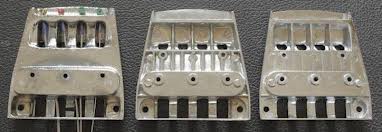
The bridge (really the whole bridge/tailpiece assembly) has been made of chrome-plated zinc (the saddles are unplated) since mid-73, when they stopped making the old-style cast-aluminum tails. The aluminum ones are distinguished mainly by the gap in the center tooth, a result of the casting process. They also had aluminum saddles on the bridge, and didn't have those two additional screws, just the three under where the bridge sits. Rick made the aluminum ones themselves, I'm pretty sure the zinc ones are contracted out. Here's the best photos of just the tailpieces to illustrate, from forum member Jeffrey Scott:
The pre-73 aluminum, 80's zinc, and current zinc
The one in the middle is basically how a '77 would look. They've changed the underside of the mold over the years, to add more zinc underneath, as the 70s ones are a bit thin and can bend (the often talked-about "tail lift"). The early 4003 tailpieces had seven screws (two more towards the bottom) to help combat the lift, but people complained about the look, so they switched back. You can see how the one on the right is a bit beefier, though neither has the mass of the aluminum one.
- Bottoms.jpg (10.43 KiB) Viewed 1254 times
Same order as above
I don't know why one pic pops and the other doesn't...
Re: What parts are nickel?
Posted: Sat Sep 01, 2012 2:30 pm
by jps
badeggs wrote:I don't know why one pic pops and the other doesn't...
Here ya' go!

Re: What parts are nickel?
Posted: Sat Sep 01, 2012 2:47 pm
by basshead
Great info, thanks very much. Apart from looking at the underside of the tailpiece, are the middle and late styles distinguishable when fitted to the bass?
Re: What parts are nickel?
Posted: Sat Sep 01, 2012 3:50 pm
by cjj
I made 'em into a single picture:
Re: What parts are nickel?
Posted: Sat Sep 01, 2012 8:25 pm
by jps
Excellent, thanks!
Re: What parts are nickel?
Posted: Sun Sep 02, 2012 4:13 am
by Wiker
basshead wrote:Success. I found some info on a page somewhere on the forum, lol. According to
http://www.rickresource.com/rrp/axtbassarticle2.html , in 1973,
Schaller BMC chrome open back machine heads replaced Grover sealed back machine heads
so I'm assuming an original set of machine heads for a '77 would have been these? Did they have the word "Rickenbacker" stamped on them then?
Late '70s, I thought that would be the nickel plated tuners with black plastic bushings.
Have a look through the register.
Pickguard screws where probably nickel plated.
Re: What parts are nickel?
Posted: Wed Sep 12, 2012 2:08 pm
by sys700
There were nickel-plated tuners on my 77 330/12.
Re: What parts are nickel?
Posted: Wed Sep 12, 2012 3:11 pm
by basshead
Wiker wrote:...nickel plated tuners with black plastic bushings...
Are replacement plastic bushings available anywhere? If not, who sells the most similar chrome bushing? I could just powder coat some chrome bushings so they looked the part.
I do have the four plastic bushings but one has a chip out of it.
Re: What parts are nickel?
Posted: Wed Sep 12, 2012 5:45 pm
by johnhall
badeggs wrote:Rick made the aluminum ones themselves, I'm pretty sure the zinc ones are contracted out.
No we didn't. We've never had in-house casting capabilities.
Re: What parts are nickel?
Posted: Thu Sep 13, 2012 8:48 pm
by iiipopes
The only nickel parts on my 1981 320 and 360-12WB are the nickel plating on the original Chicago Kluson tuners.
Re: What parts are nickel?
Posted: Fri Sep 14, 2012 10:29 am
by cassius987
See where the ball end is hanging out and the string leaves on the other side to travel to the saddle? I think that's where most of the tension gets put on the tailpiece by the string as it is the only other major point of contact (besides the saddle). Thicken that part up a bit on the new tailpiece by widening the mass of metal perpendicular to the strings and bringing the edge of it closer to the saddles and you'd probably have a lot greater resistance to bending. In addition the break angle should increase a little bit. I'm sure RIC has there reasons for not trying this yet, if they haven't, perhaps tonal effects of the break angle change or something.