Page 1 of 2
How are the truss rod channels made?
Posted: Fri Jul 26, 2013 7:58 pm
by Hotzenplotz
Today I found at wikipedia.com this picture:
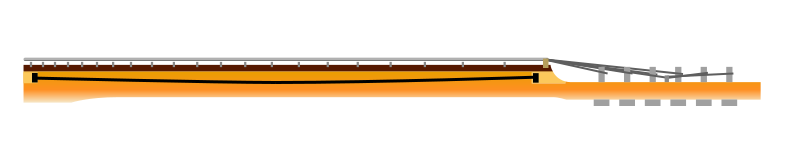
- 795px-Guitar_neck.svg.png (7.43 KiB) Viewed 1318 times
Now my question is: Is RIC using a similar channel with a slight bow ("away" from the middle of the fretboard) inside? I never read about something like that.
Re: How are the truss rod channels made?
Posted: Fri Jul 26, 2013 8:08 pm
by cassius987
I wonder if it's possible that the channels could be made parallel with the surface of the neck (the part that glues to the fingerboard) which would cause them to flex in parallel with the neck itself, and maybe decrease the severity of the rod action on the fingerboard as near-straightness is achieved. (Just a thought. I have no idea the answer to your question but look very much forward to it.)
The guitar neck pictured goes totally around the truss rods instead of leaving a space open between the rods and the fingerboard, that is certainly not how a Ric is made.
Re: How are the truss rod channels made?
Posted: Fri Jul 26, 2013 9:53 pm
by jps
cassius987 wrote:The guitar neck pictured goes totally around the truss rods instead of leaving a space open between the rods and the fingerboard, that is certainly not how a Ric is made.
There are pieces of wood that attach to the underside of Rick fingerboards that create the upper part of the curved channel on instruments with the modern truss rods, IIRC.
Re: How are the truss rod channels made?
Posted: Fri Jul 26, 2013 9:56 pm
by jps
cassius987 wrote:I wonder if it's possible that the channels could be made parallel with the surface of the neck (the part that glues to the fingerboard) which would cause them to flex in parallel with the neck itself
That would not work as then the force could not be directed where desired. One of the beauties of a double
action truss rod system (as used by Martin Keith, G&L, Rick Turner, for examples) is that it works you like described, with a channel parallel to the fingerboard as it does not depend on curvature of the channel to direct the force.
Re: How are the truss rod channels made?
Posted: Fri Jul 26, 2013 10:11 pm
by Colonel Sanders
Hotzenplotz wrote:
Now my question is: Is RIC using a similar channel with a slight bow ("away" from the middle of the fretboard) inside? I never read about something like that.
You need to have a slight bow for a single action truss rod to work. The way you create that curved channel will differ from one manufacturer to the other.
Re: How are the truss rod channels made?
Posted: Sat Jul 27, 2013 9:20 am
by Hotzenplotz
So if I am right the difference between the old and the new system is that the old one has got this metal stripe between the rod and the fretboard and the new system uses a curved inlay of wood between the fretboard and the rod, right?
Re: How are the truss rod channels made?
Posted: Sat Jul 27, 2013 11:08 am
by jps
The metal stripe I think you are referring to is actually the upper half of the truss rods. Consider the old style rod as a 48" long piece of flat stock steel rod folded in half with the folded end down near the heel of the neck and the two ends of the rod protruding out from under the nut at the headstock, one of which is longer and threaded to accept the truss rod nut.
Re: How are the truss rod channels made?
Posted: Sat Jul 27, 2013 11:15 am
by Hotzenplotz
Yes, that good old fret board catapult...
In the end it is the grandfather of the actual two way rods (wich of course are working quite different), isn't it?
Re: How are the truss rod channels made?
Posted: Sat Jul 27, 2013 11:17 am
by cassius987
jps wrote:cassius987 wrote:I wonder if it's possible that the channels could be made parallel with the surface of the neck (the part that glues to the fingerboard) which would cause them to flex in parallel with the neck itself
That would not work as then the force could not be directed where desired. One of the beauties of a double
action truss rod system (as used by Martin Keith, G&L, Rick Turner, for examples) is that it works you like described, with a channel parallel to the fingerboard as it does not depend on curvature of the channel to direct the force.
I see, thanks Jeff.

Re: How are the truss rod channels made?
Posted: Sat Jul 27, 2013 11:26 am
by Hotzenplotz
cassius987 wrote:jps wrote:cassius987 wrote:I wonder if it's possible that the channels could be made parallel with the surface of the neck (the part that glues to the fingerboard) which would cause them to flex in parallel with the neck itself
That would not work as then the force could not be directed where desired. One of the beauties of a double
action truss rod system (as used by Martin Keith, G&L, Rick Turner, for examples) is that it works you like described, with a channel parallel to the fingerboard as it does not depend on curvature of the channel to direct the force.
I see, thanks Jeff.
So the double action rods as a pair would mean a totally adjustable neck for both sides?
Or are there any disadvantages of these "new" rods?
Re: How are the truss rod channels made?
Posted: Sat Jul 27, 2013 12:30 pm
by jps
The only disadvantage to double action rods is they are a bit bulkier which may require a thicker neck to have two of them inside of it, side by side.
http://www.stewmac.com/shop/Truss_rods/ ... s_Rod.html
Re: How are the truss rod channels made?
Posted: Sat Jul 27, 2013 12:37 pm
by Hotzenplotz
Well, with two rods the weight is maybe an issue...

Re: How are the truss rod channels made?
Posted: Sat Jul 27, 2013 9:27 pm
by jps
Nah, a heavier body will take care of any balance/neck dive issues.


Re: How are the truss rod channels made?
Posted: Sun Jul 28, 2013 7:31 am
by Hotzenplotz
Ouch, my back!
Re: How are the truss rod channels made?
Posted: Mon Jul 29, 2013 11:51 am
by johnhall
Hotzenplotz wrote:Today I found at wikipedia.com this picture:
795px-Guitar_neck.svg.png
Now my question is: Is RIC using a similar channel with a slight bow ("away" from the middle of the fretboard) inside? I never read about something like that.
This is exactly how the truss rod runs in our neck- two of them, side-by-side, of course.
The slot is initially routed to the arc that you see, then a filler strip is added into the slot, which is also cut to match that arc and leave room for the rod to be inserted. The filler strips actually extend up into the fingerboard area at this point, so the CNC mills down the entire fingerboard attachment area a little bit before gluing. The grain of the filler strips is oriented to oppose the neck grain for additional strength.
Double acting rods are great in theory except I personally have never encountered on of our instruments that needed the backwards action adjustment. The downside is all of the extra metal inside the neck instead of wood and these simply isn't enough real estate for them in a neck of our size. The plus for manufacturers is that double acting rods are commonly and cheaply obtainable from China and Korea from many sources.