How hard would it be to convert a 330/12 into a 340/12?
That's what I did, and it's really not terribly difficult. I wanted a spare twelve-string, so I waited until I found a used 330/12 with really nice wood and bought it. It was Mapleglow with black trim (which I'm not fond of, but that can be fixed easily enough).
Step one is the hardest, as you have to unmount all the hardware and attack the top of a perfectly good Rickenbacker with power tools in order to create the rout for the middle pickup. You're going to be cutting a trench in the top for the back side (magnets) of the new pickup to fit down into. The hole is actually a pretty small rectangle and not very deep, however most normal, hand-held routers won't do the job because their bases would run into the end of the neck before you could get the bit to the spot where it needs to cut. Most people (myself included) don't have access to a pin router which is a big bench machine that has it's bit on an overhanging arm, so that the bit can drop down from above with no base plate needed. So, I went old-school-vintage-Rickenbacker-style and instead of using a router, I used a drill to cut the trench. You use a fairly good-sized forstner bit (makes very clean, flat-bottomed holes and has a small pilot spike that keeps it from skidding) and you drill a series of overlapping holes, making the trench. The factory used to do this on solid body guitars to make paths for pickup wiring that would later be covered by the pick guards. The trench then gets connected to the control cavity area with a small, diagonal/horizontal hole made with a regular bit for the pickup's wire to run through and the raw wood in the trench gets sealed with a couple coats of varnish.
The other nice thing about this method is that you aren't dragging the base plate of a power tool over the nice varnish on your guitar's top and potentially scratching it. The Forstner bit is the only thing that touches the surface, and only where it is going to cut. You then drill the two small holes at the ends of the trench for the screws that will hold the pickup in place and adjust its height. Now you can install the pickup using the foam pad or rubber grommets, feed the wire through to the control cavity and wire it in using the factory wiring diagrams (or whatever wiring style you choose).
Optionally, I chose to cut the buttons off of my hi-gain pickup magnets and fit them with toaster covers, moved the original bridge pickup to the middle, and added a real toaster at the bridge position, but you can do whatever you find you like best for placement and wiring. I tried various combinations and that was the one I liked best. As mentioned, I also opted to run my middle pickup on its own circuit for more tone possibilities and this is how it was done:
The middle pickup was grounded to the loop with everything else and a sixth knob was installed as a volume control for it. It has no tone control and is essentially full at all times (I almost never touch the tone controls on either of my twelves). The mono output jack was switched to a stereo jack. The regular neck/bridge circuit goes to one part of that jack, the middle pickup to the other. If I plug a regular, mono guitar cord into the guitar I have the factory-original 330, 5-knob wiring using the neck and bridge pickups. Plugging a stereo cord into the jack also brings the middle pickup to life, and using a stereo Y-cord, I can send that signal to another amp, channel or track. The sixth knob allows me to feather in as much of the additional signal as I want to add.
Finally, the top edges of the pick guards will need to be cut level, or a notch cut out for the new pickup. I was making new back-painted white guards anyway, so I just made them to fit. In addition, to finish my conversion I switched to a white TRC, chrome tailpiece and bridge baseplate, chrome tuners and made a new graphite/epoxy nut with the widest string-spread and narrowest pairs possible for my big, blunt bass player fingertips. One thing to be sure of before you add a third pickup though, is that you are comfortable doing your picking in the fairly small spaces between pickups. It is a different feel from a 330 or 360 where there is a big, open center gap, and it does take some time to get used to.
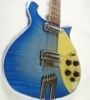
Here are photos of the 330 as purchased, the Forstner bit trench, and the finished guitar. I'm sure that this all makes the purists want to pull their hair out screaming, but I'm not a purist - I'm a guitar player and I will do whatever it takes to make my instruments play and sound the way I want them to. Plus, I always make money selling used Rickenbackers and I'll put the sound and playability of my Ricks up against the sound of any ever built. They would sell in a heartbeat.
These tunes are what I'm talking about with regard to tonal possibilities. They're my 360/370/12, but it's wired the same as the 330/340/12 with two circuits. On this tune the first guitar you hear is the twelve-string (one track) and it is played by tapping on the strings with my thumb and plucking with bare fingers, kind of like banjo technique. It uses only the neck pickup and runs throughout the tune. The cowboy licks that start on verse three are my Yamaha Silent Guitar, I think the bass was my Hofner. The second track of twelve-string in verse #4 is set more conventionally with all three pickups running and flat-picked with a more typical Rickenbacker tone.
http://webpages.charter.net/tbradshaw/M ... an%20w.mp3
This clip has the twelve-string (two tracks) flat-picked with all three pickups and the tone set in "all-out-attack, bee-in-a-beer-can" mode.
http://webpages.charter.net/tbradshaw/M ... Lomomd.mp3