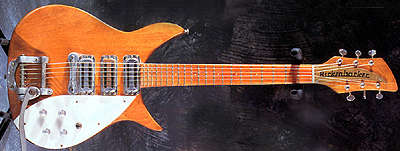
Peter,
Many thanks for your compliments, and for your technical assistance with this board -- to say nothing of all the many excellent scans and webphotos of John Lennon's 1958 Rickenbacker 325 Capri that you have made available to all on your award-winning websites, and now this forum.
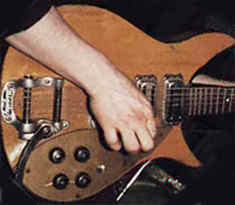
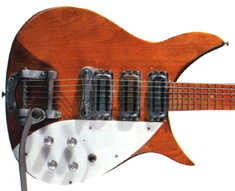
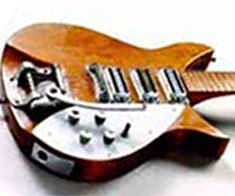
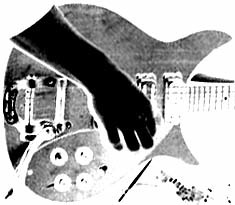
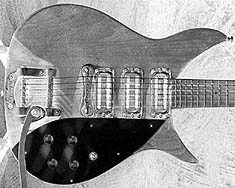
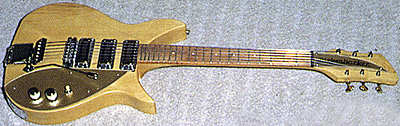
But with all due respect, how can simply sanding the guitar completely erase the single most identifying feature of the guitar, the thick dark woodgrain tiger stripes running parallel to the neck/strings near the edge of the guitar body, and turn them into weak curvy loops running diagonal to the neck/strings up to 20 degrees or more?
If it can be established that the original thick dark woodgrain tiger stripes running parallel to the neck/strings near the edge of the guitar body (especially the most visible stripe) are not simply surface artifact, but are so thoroughly and deeply embedded in the guitar body wood that they extend all the way through the thickness of the body straight to the back of the guitar along the sides of the body, then we may draw some pretty strong conclusions:
1) The dark woodgrain tiger stripes could not be erased by any amount of sanding. Even if the front of the guitar body were to be sanded/planed/ground completely off the guitar, exposing the inner guitar body cavity (such as a light show body without its lenses), those dark woodgrain tiger stripes would still be embedded and remain very visible in the sides of the guitar body wood.
2) The direction of the woodgrain would remain constant, regardless of how much wood were to be removed off the front of the guitar body.
3) The sanding theory would then be invalidated and belong to the realm of wishful thinking.
But is there any photographic evidence which shows that the dark woodgrain tiger stripes (especially the most visible stripe) are indeed so thoroughly and indelibly embedded in the guitar body wood that they spill over the edges of the guitar body straight to the back of the guitar along the sides of the guitar body?
I believe
there is.