

I was talking to John who just ran into some troubles with repair guys who are not familiar with Ric stereo wiring. I am not an expert on things Rickenbacker but I am trying to learn....We have some ric-o-sound questions....
The regular jack gives you a straight mono signal out. Each pickup should do what the knobs say .... That's easy.
If I plug the jack all the way in the input labeled ric-o -sound I just get the bridge pickup. However with the jack not quite all the way in I can get both pickups.....Is this right?
Do you need a special stereo jack to use the ric-o-sound feature? Is this true ric-o-sound when I plug the jack partially in and get both pickups ? Do you use both jacks and plug each one into separate amps? And how does the mysterious grey ric-o-sound box actually work? What does it do?
These truly are unique instruments and it seems that there are some repair guys out there who don't realize that.
Ric-o -sound questions
Moderators: rickenbrother, ajish4
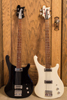
Yes, and the Ric-o-sound box splits the signal, it has two mono outputs for two mono cords which each go to their own amp or channel. And putting the mono cable all the way in to the ric-o-sound jack will only give you the treble pickup. that's normal. You use the ric-o-sound cord with a stereo jack on it with the ric-o-sound box on the other end and then run the two mono cords to their respective amps or channels. You don't use the mono out when you run stereo. It's either or.
You can see exactly what Ric-O-Sound does from the wiring diagram on the Rickenbacker website. The mono jack has the signals from both pickups wired to the "tip" connector. The stereo jack has the signal from each pickup separated. One is wired to the "tip" and one is wired to the "ring" connector. (Look at a 1/4" stereo plug to see what is meant by tip and ring.)
(If you put a mono PLUG into a stereo jack, you only pick up the "tip" signal since the "ring" signal is shorted to ground by the mono plug.)
Part of the confusion somes from the word "stereo". There is nothing stereo about this system in the sense of "left" and "right". It simply uses what is commonly called a stereo jack to separate the pickup signals. You can use a Ric-O-Sound box OR a splitter cable (http://www.procablesnsound.com/) which basically uses a "stereo" plug on the bass end and puts the individual pickup signals out on two mono plugs. The mono plugs are used to energize separate amplifiers. The net result is that you have separate control over the amplification of EACH pickup.
I made my own splitter using a "stereo" jack and two mono jacks in a shielded box. I have experimented with it a little by running the "bass" pickup into my main cab and the "treble" pickup into my smaller practice amp. You can get some interesting effects.
(If you put a mono PLUG into a stereo jack, you only pick up the "tip" signal since the "ring" signal is shorted to ground by the mono plug.)
Part of the confusion somes from the word "stereo". There is nothing stereo about this system in the sense of "left" and "right". It simply uses what is commonly called a stereo jack to separate the pickup signals. You can use a Ric-O-Sound box OR a splitter cable (http://www.procablesnsound.com/) which basically uses a "stereo" plug on the bass end and puts the individual pickup signals out on two mono plugs. The mono plugs are used to energize separate amplifiers. The net result is that you have separate control over the amplification of EACH pickup.
I made my own splitter using a "stereo" jack and two mono jacks in a shielded box. I have experimented with it a little by running the "bass" pickup into my main cab and the "treble" pickup into my smaller practice amp. You can get some interesting effects.
-
atomic_punk

- Senior Member
- Posts: 5093
- Joined: Wed Sep 17, 2003 5:00 am
- Contact:


Well, not truly 'stereo', but more like 'crossed over', as the highs and lows are what're being separated...back in my rocker days, I ran a stereo cord into a Morley stereo volume pedal; I used to run the treble signal through effects (Cry Baby, Roland distortion, MXR Phaser,etc.) and into a 150W GMT guitar head, then to two Sunn cabs, a 4x10 and a 2x12; the bass signal went through a Seamoon envelope follower (one octave down)...this and my Taurus pedals went into a 100W Marshall bass head and then into a Sunn 2x15 cab. I was bigger than Jesus then! (I didn't say greater, or better...just bigger}.
I didn't get where I am today by being on time...
Here is a quote from an online dictionary:
"Stereophonic means having two channels of audio. This is almost always taken to mean one for each ear, left and right, but could also be interpreted as any two-channel audio system."
I guess I wouldn't call Ric-O-Sound stereo, but by the above definition, it could be interpreted as such.
"Stereophonic means having two channels of audio. This is almost always taken to mean one for each ear, left and right, but could also be interpreted as any two-channel audio system."
I guess I wouldn't call Ric-O-Sound stereo, but by the above definition, it could be interpreted as such.
I agree that both pickups are full range, but obviously it's their placement along the string length that produces the 'high' and 'low' effect...of course this isn't the same as electronically 'crossing over', but the result is similar to me...you wouldn't want all the highs from your 'stereo' coming from one corner of the living room and all the lows coming from the other...to be fair though, if you ran the 'mono' signal from a single pick-up instrument through a crossover and then to two amp/speaker setups, the result would be different than R-O-S, as the Rick system undoubtedly produces some frequency overlapping...opinions?
I didn't get where I am today by being on time...
They are wound a little differently also, the neck has more windings. What you are describing Dane is the way a two way speaker is wired, a woofer and a tweeter with a crossover but has the same signal source, that is mono, with one pickup split no matter how different they sound that is still mono as it only has one signal source. The old fake stereo records had two ways to fake it, one way was to take the mono channel split it and make one channel bassy and the other trebly. The other method was to take the mono channel split it and make one channel out of phase with the other (which really sounded krappy even worse than the EQ'ing method.)
I went to an online dictionary the other day before I wrote my first post and there were about 7 or 8 different definitions, ric-o-sound agreed with at least 6 of them. ric-o-sound is not stereo in the modern sense of being able to pan sounds from left to right like modern stereo mixes, (or is that what the mysterious 5th knob does on 360's? If not I think that would make an excellent idea for 4003's and guitars) it is two distinct channels, more like the old stereo records, but is still true stereo as it has two distinct signal sources.
I went to an online dictionary the other day before I wrote my first post and there were about 7 or 8 different definitions, ric-o-sound agreed with at least 6 of them. ric-o-sound is not stereo in the modern sense of being able to pan sounds from left to right like modern stereo mixes, (or is that what the mysterious 5th knob does on 360's? If not I think that would make an excellent idea for 4003's and guitars) it is two distinct channels, more like the old stereo records, but is still true stereo as it has two distinct signal sources.