
Checkered Binding
Moderators: rickenbrother, ajish4

Checkered Binding
I understand that the beautiful checkered binding that we have come to love is a time consuming and expensive feature to create. I wonder if someone from the factory or with personal experience can comment on the steps involved in the process. One of the most gorgeous Rickenbackers I have seen has been the purpleburst of Mike Parks that has the stunning checkeredd binding on the headstock. A checkered bound headstock is something that dreams are made of.
Life, as with music, often requires one to let go of the melody and listen to the rhythm
Please join the Official RickResource Forum Facebook Page https://www.facebook.com/groups/379271585440277
Please join the Official RickResource Forum Facebook Page https://www.facebook.com/groups/379271585440277
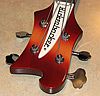


I've seen a few examples of Rickenbacker guitars with checkerboard bound headstocks. It would be interesting to hear from John Hall about when this option was available.
I agree - Mike Park's purpleburst guitar is outstanding. Supposedly RIC made a purpleburst 4005 for Mark Hudson at the same time. I'd love to see that one!
I agree - Mike Park's purpleburst guitar is outstanding. Supposedly RIC made a purpleburst 4005 for Mark Hudson at the same time. I'd love to see that one!
I don't recall having noticed a bound headstock on a Rickenbacker bass.
Life, as with music, often requires one to let go of the melody and listen to the rhythm
Please join the Official RickResource Forum Facebook Page https://www.facebook.com/groups/379271585440277
Please join the Official RickResource Forum Facebook Page https://www.facebook.com/groups/379271585440277
-
patrickkelly
- Junior Member
- Posts: 124
- Joined: Thu Mar 11, 2004 4:22 am

11 out of 10, Keith.
Life, as with music, often requires one to let go of the melody and listen to the rhythm
Please join the Official RickResource Forum Facebook Page https://www.facebook.com/groups/379271585440277
Please join the Official RickResource Forum Facebook Page https://www.facebook.com/groups/379271585440277

-
jingle_jangle
- RRF Moderator
- Posts: 22679
- Joined: Wed Dec 22, 2004 6:00 am
- Contact:
Fantastic, Keith.
Here is my contribution to the Checkered binding lore:
The checkered binding is made by laminating alternating 1 meter-square sheets of black and white celluloid until there are enough layers to comprise a 1 meter cube. The cube is then cut across the laminations with lasers to make striped sheets, and the striped sheets are cut once again across the stripes to make the so-called "checkered" strips.
This is not done at Rickenbacker, but by an outside supplier. John Hall has told me that the 1 meter cube provides enough binding for over a years' worth of production, and costs about $250,000.
It is also expensive to apply, being done entirely by hand, using brushes and a solvent which bonds the celluloid to the rabbetted edge of the guitar. It is held in place by large rubber bands until the solvent has dried--this is one of the "finishing bottlenecks", I'm sure--and then scraped by hand flush with the surfaces and edges of the instrument prior to painting operations. Getting this stuff to go around curves is especially tricky.
This is one of the most charming and anachronistic features of the deluxe instruments. Long may it live!
And, Keith, that is one of the most beautiful headstocks that I've ever laid eyes on!
Here is my contribution to the Checkered binding lore:
The checkered binding is made by laminating alternating 1 meter-square sheets of black and white celluloid until there are enough layers to comprise a 1 meter cube. The cube is then cut across the laminations with lasers to make striped sheets, and the striped sheets are cut once again across the stripes to make the so-called "checkered" strips.
This is not done at Rickenbacker, but by an outside supplier. John Hall has told me that the 1 meter cube provides enough binding for over a years' worth of production, and costs about $250,000.
It is also expensive to apply, being done entirely by hand, using brushes and a solvent which bonds the celluloid to the rabbetted edge of the guitar. It is held in place by large rubber bands until the solvent has dried--this is one of the "finishing bottlenecks", I'm sure--and then scraped by hand flush with the surfaces and edges of the instrument prior to painting operations. Getting this stuff to go around curves is especially tricky.
This is one of the most charming and anachronistic features of the deluxe instruments. Long may it live!
And, Keith, that is one of the most beautiful headstocks that I've ever laid eyes on!
“I say in speeches that a plausible mission of artists is to make people appreciate being alive at least a little bit. I am then asked if I know of any artists who pulled that off. I reply, 'The Beatles did.”
― Kurt Vonnegut
― Kurt Vonnegut
Paul: Thanks for these details. The difficulty getting it to go around curves may explain why it hasn't been tried on the bass headstock too often, if at all.
John: I guess your comment about this guitar's checkered past was bound to come up sooner or later.
John: I guess your comment about this guitar's checkered past was bound to come up sooner or later.
Life, as with music, often requires one to let go of the melody and listen to the rhythm
Please join the Official RickResource Forum Facebook Page https://www.facebook.com/groups/379271585440277
Please join the Official RickResource Forum Facebook Page https://www.facebook.com/groups/379271585440277