

There have been some great posts here in this thread. I just want to echo Bob's comments on how good bass players really understand and love their role - they are the glue that holds the whole jam together. You have to connect 100% with your drummer rhythmically, and still know how the chords are progressing and support that both melodically and dynamically.
If that sounds like fun, bass playing is for you. Love it and do it well, and you will always be in one band and in demand for others.
Also...the "Girls may be looking at the star..." quote.... I wish I could take credit for that one, but it's in a song I heard at a fellow musician's house a couple of years ago.... wish I knew the artist to credit....
Advice on switching from Guitar to Bass
Moderators: rickenbrother, ajish4

-
ken_swearingen
- Advanced Member
- Posts: 2298
- Joined: Wed Mar 31, 2004 6:00 pm
speaking of drummers and bassists,being a good bassist not only refers to talent but a lot of tolerance from drummers and guitarists,i played with one drummer who could play like Neil peart,but he would speed up and slow down leaving me to hold it together.learning to lay back and keep time with the drummer is your main job trying to keep things as tight as possible makes for a good rhythm section.singing and playing can be allot harder takes allot of practice unless naturally gifted.On bass you are hitting individual notes usually in sequence, rolling into another sequence of notes and trying to sing is like doing two opposite things at one time,playing rhythm guitar and singing is kind of like doing the same thing at the same time much easier IMO does that make any sense?
-
jwr2
Ken - that makes a lot of sense to me. In most cases, singing over rhythm guitar is easier. Bass is more of a challenge, especially when the bass rhythm is counter to the syncopation of the lyrics/vocals.
In some very rare cases, singing on bass can actually be easier than just playing bass... the most immediate example I can think of is "Still Rock N Roll To Me" by Billy Joel - I sing lead on that cover and play bass all the time. Once, we had a guest vocalist get up and sing lead on it, and evey though all I had to do was play bass, I messed it up, because I was used to singing lead and playing simultaneously.
Most songs are tougher singing over bass as opposed to rhythm guitar. Although....heck, if I had Geddy's or Sting's talents, it might not be an issue.
In some very rare cases, singing on bass can actually be easier than just playing bass... the most immediate example I can think of is "Still Rock N Roll To Me" by Billy Joel - I sing lead on that cover and play bass all the time. Once, we had a guest vocalist get up and sing lead on it, and evey though all I had to do was play bass, I messed it up, because I was used to singing lead and playing simultaneously.
Most songs are tougher singing over bass as opposed to rhythm guitar. Although....heck, if I had Geddy's or Sting's talents, it might not be an issue.
-
ken_swearingen
- Advanced Member
- Posts: 2298
- Joined: Wed Mar 31, 2004 6:00 pm
Most of the Rush stuff is easy to sing and play for me. The only time I don't sing is when I don't know the words or can't hit the notes correctly. Now "Turn The Page", that is another story. Bass and vocals are completely opposite. Geddy himself had problems doing that song. He had to make the bass less complex for it. "Anthem" is another example of that.
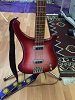
1976 Rickenbacker 4001
2011/05 Fender Standard Fretless Jazz Bass
2005/11 Fender Standard Jazz Bass
2011/05 Fender Standard Fretless Jazz Bass
2005/11 Fender Standard Jazz Bass
Ken - yes, the biggest challenge with "Still Rock N Roll To Me" is singing over a triplets-feel on the bass. Once you get that, it's second nature.
The first song I learned like that where I had to sing lead over a triplets giddy-up was "One Headlight" by the Wallflowers. Once I mastered that one, other songs in that vein became easier.
The first song I learned like that where I had to sing lead over a triplets giddy-up was "One Headlight" by the Wallflowers. Once I mastered that one, other songs in that vein became easier.
One Headlight's rhythm, IIRC, is not triplets but an eight note followed by 2 sixteenths...it's still a "giddy up", as the 2 16ths and the following 8th make three notes played in rapid succession.
Still Rock n Roll To Me is a swing rhythm written in standard notation to look like straight eigths. It's really played as a quater note/eight note pattern as would be felt in 6/8 or 12/8 time. Again, thinking back to charts A LONG time ago, SRRTM was written in 4/4 with the symbol at the top of the chart telling you to treat consecutive quarters as being swung...
Some songs like that I can handle - I've played/sung One Headlight playing bass (back in my 100% fretless days), but it wasn't an easy trick for me. Messing around a guitar trying to play a bass line, SRRTM "seems" like I can do it...
But then again, I've been playing bass almost 100% since last July or August, so I *should* be getting used to playing the bass part.
Jeff Rath, as he usually does, touched on a real important point in ANY ensemble part. No one lives in a vacuum in a small band, and it's easy to step on others toes and not mean it. Listening to vocal phrases and placing your hot riffs and licks AFTER the vocal phrase ends goes a long way to polishing a performance as "pro" versus "just a jam".
I find most rock songs have only a few key points, be it a riff, important extended chord or two, special rhythm, and if you get these few key points and sing the words, most people will be satisfied.
Still Rock n Roll To Me is a swing rhythm written in standard notation to look like straight eigths. It's really played as a quater note/eight note pattern as would be felt in 6/8 or 12/8 time. Again, thinking back to charts A LONG time ago, SRRTM was written in 4/4 with the symbol at the top of the chart telling you to treat consecutive quarters as being swung...
Some songs like that I can handle - I've played/sung One Headlight playing bass (back in my 100% fretless days), but it wasn't an easy trick for me. Messing around a guitar trying to play a bass line, SRRTM "seems" like I can do it...
But then again, I've been playing bass almost 100% since last July or August, so I *should* be getting used to playing the bass part.
Jeff Rath, as he usually does, touched on a real important point in ANY ensemble part. No one lives in a vacuum in a small band, and it's easy to step on others toes and not mean it. Listening to vocal phrases and placing your hot riffs and licks AFTER the vocal phrase ends goes a long way to polishing a performance as "pro" versus "just a jam".
I find most rock songs have only a few key points, be it a riff, important extended chord or two, special rhythm, and if you get these few key points and sing the words, most people will be satisfied.
Above e-mail is inactive. try ed_ardzinski@**** where **** is Hotmail.com or Yahoo.com. I tend to see things inthe hotmail box quicker...
The line quoted earlier is from "Joe's Blues" by Todd Snider. It's on his Songs For The Daily Planet album and every bass player should get a copy for that song alone. It's a great track.
One of the other lines is "You can learn to sing lead if you wanna be a star but the only way to groove is on a bass guitar!"
One of the other lines is "You can learn to sing lead if you wanna be a star but the only way to groove is on a bass guitar!"
A bass can't groove unless you have a good drummer and actually the whole band should groove and be a unit with everyone knowing their place and staying within it which takes mucho discipline. The best example of this to me is James Brown's stuff especially the original non-single version of Cold Sweat, those guys all played as a unit, take any one part by itself and it will sound incomplete, or drop anyone out it will sound incomplete especially either the drummer or the bass player. Those guys were masters. Another good example is Booker T and the MG's who played on almost all the 60's Stax stuff. I think it takes some of us (including me) a long time to stop overplaying. We call it playing everything you've ever learned in a one minute solo, or in one song. Some bands like Cream and Rush just to name a few made a career out of it but those bands (and gigs) are far and few between.
I learned how to play simple and groove by playing old style country in a band about 20 years ago, 1-5 1-5 etc.
I hated it at first and then got into it as I realized I was really learning how to lock in with the drummer, with simple music like that it is much harder than with fast rock n roll, it's even harder with blues, it sounds so easy and is so hard to really learn how to play, anyone that says blues is easy to play doesn't know how to play it.
I'm grateful that I have played a lot of different styles during my career especially roots music, it has all taught me something, even the lousy gigs, even the three-people-in-the-audience shows have taught me things, like how to play your best in any situation, I try to pretend there is somebody important out there (and you never know).
I learned how to play simple and groove by playing old style country in a band about 20 years ago, 1-5 1-5 etc.
I hated it at first and then got into it as I realized I was really learning how to lock in with the drummer, with simple music like that it is much harder than with fast rock n roll, it's even harder with blues, it sounds so easy and is so hard to really learn how to play, anyone that says blues is easy to play doesn't know how to play it.
I'm grateful that I have played a lot of different styles during my career especially roots music, it has all taught me something, even the lousy gigs, even the three-people-in-the-audience shows have taught me things, like how to play your best in any situation, I try to pretend there is somebody important out there (and you never know).
-
bassman_bob
- New member
- Posts: 80
- Joined: Tue Jun 17, 2003 7:04 am
I think your choice of instrument depends a lot on what you want the bass to be. If you're a former lead guitarist, then a 4003 is the best choice; you WILL stand out because you already "hear" lead parts you can do on the RIC. If you want a traditional role of rhythm instrument, use a Fender. Either get a maple neck '70s P bass off Ebay or a modern active J bass. As to amp, I recommend seperate head/cabs, not a combo. IMHO, the sound is better and your back will thank you. Ampegs are good heads. For cabs, listen to 4 10's or 1 15's, BUT I'll tell ya, if you can find some 2 12's, GET 'EM. They're my choice. And I prefer ported cabs. Keep us posted !
"I wouldn't be quite prepared for that eventuality"
-
ken_swearingen
- Advanced Member
- Posts: 2298
- Joined: Wed Mar 31, 2004 6:00 pm
I find that the better the drummer its harder for them to lay back,the not so talented drummers are easier to work with and get tight with,PM felt the same way about Pete best verses Ringo star,Pete was a better drummer,Ringo was more consistent not as talented but on time PM could work around him.That bass drum should be keeping time with every note you hit-try to teach this to a free style drummer.