
I want to make a number of comments about the luthier information posted on this forum.
1- I have had little contact with Rickenbacker since Brian Carman left the factory.
2- I do not pretend to be the official nor unofficial answer man for RIC.
3- I am NOT their customer service at all, nor do I pretend to be. It is of course, recommended that you contact RIC directly should you have questions pertaining to their instruments.
4-I do not know what materials RIC uses to spray their instruments, nor have I seen this process in the last 7 years.
5- Some of the technical inforomation is unknown to me as far as measurements and tooling , and how instruments are currently made.
6- As far as how their CNC tooling works and what updates RIC have made in tooling, I really do not know. I do remember what was used in the early 1970's. That tooling continued until the Brian Carman era ...and most certainly has been improved upon since then. However ...this is conjecture.I don't really know. I assume, however, that this is the case.
7-I was placed in the position of answering questions by a couple of friends a few years ago. I have carried out this task of answering your questions in good faith and will continue to 'help' as long as I am asked to do so and I have the time.
I hope that there comes a day when the Rickenbacker Co. will in fact have their own answer man. Till that time, I hope I give you answers that are comforting and knowledgeable so that you can get the most enjoyment out of your instruments.
By the way, this goes for any brand of instrument that you own.I am not partial to any one brand of guitar nor do I hold a grudge against any maker. So go play yer guitars/basses and have fun.
Rickenbacker information
Moderators: rickenbrother, ajish4
Rickenbacker information
So you too want yours "ALAPWOB"?!?!
-
corey
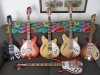

Mark, I treat my aging, delicate, falling apart Rick 335 with more care than you can imagine (actually, you probably could!). The exception comes when I'm in a full out jam! Anyway, if you told me that in order for it to sound better I should run over it with my new Toyota mega SUV several times so that only the jack plug remained, I would. And I mean it!
Mark
I certainly appreciate the expertise you share on this board. I think all here are fully aware that you voluntarily give advice to make our guitars better. I hope your schedule permits you to continue to advise this board.
My 360/12v64 plays pretty good. I installed a 12 saddle bridge, replaced the truss rods, & cut a bone nut. Couldn't have done it without ya.
Then..... had you set up shop near Boston, I would have hired you to do these things. Thanks for all your help.
I certainly appreciate the expertise you share on this board. I think all here are fully aware that you voluntarily give advice to make our guitars better. I hope your schedule permits you to continue to advise this board.
My 360/12v64 plays pretty good. I installed a 12 saddle bridge, replaced the truss rods, & cut a bone nut. Couldn't have done it without ya.
Then..... had you set up shop near Boston, I would have hired you to do these things. Thanks for all your help.
-
ralph
i really enjoy marks comments & expertise, he hit
the mark on my 360/12v64 & sending my ric from
ill. to washington was well worth the expense.
the 1st thing i do when i get hame in the evening
is log on to this forum. i feel mark is doing a valuable service to ric owners in helping them
keep their guitars in prime playing condition.
thanks for the insight. one ? if i may ??
in your opinion how much work would a stock
carl wilson 360/12 need to make it playable?
i'm thinking of adding to my collection
thanks again
the mark on my 360/12v64 & sending my ric from
ill. to washington was well worth the expense.
the 1st thing i do when i get hame in the evening
is log on to this forum. i feel mark is doing a valuable service to ric owners in helping them
keep their guitars in prime playing condition.
thanks for the insight. one ? if i may ??
in your opinion how much work would a stock
carl wilson 360/12 need to make it playable?
i'm thinking of adding to my collection
thanks again
Ralph , I assume that you are asking this of me .
I had a gentleman (Greg Simmons of Edmonton Alberta Canada) , drive down to the Seattle /Everett area last year with his new CW 12 string .He was down to do some business and while here , he dropped of his guitar .
What all did I do to it ?
1- reshaped the nameplate to vintage shape to allow the bass strings (the ones in the slots) to better clear that plate and not drag across the edge.
2- plug and redrill some of the side mounted tuner holes , as they wobbled and tightening the screws did nothing.
3-moved the bridge plate to center on the neck as this guitar came with a six string bridge and it is not mounted on center exactly .This is not deemed necessary as the slotting of the saddles , aligns the bridge.However , on the 12 saddle replacement bridge , the strings spacing is governed by the edge of the pairs of saddles .Meaning , the center of each set , is where the alignment must be off of and in setting the new bridge on the plate , it is obviously off center .
He also wanted to use a variety of brands of strings .So to allow this .......
4- I moved the bridge away from the neck so that the center point of the bridge,was "the nut to the 12th fret doubled ,plus 5/32" .
This gives the same compensation as is used by Fender,Gibson, Ibanez,Martin,Guild,Paul Reed Smith,Tom Anderson,Jackson/Charvel,and many other.This moved the bridge away from the neck and does not require removing any springs nor setting the saddles all the way to the back edge of the chassis (as Roger McGuinn suggests to do at his website)This basiclly sets the saddles ,when adjust for intonation, in the center of the whole chassis.
5-I cut the notches in the saddles so that the TOP of the strings followed the 10" radius of the fretboard.This gives a cleaner picking motion as they lie in an even arch.As opposed to the bottom of the strings following that radius/arch .Doing it that way the octave strings are 'below' you picking motion slightly.
6-I am not looking at the 'bill/receipt' for this guitar so I may be overlooking something.
I also restrung it , and pointed out the method used to do this to the owner .It makes a big differance .
7- I also cut a new nut with the widest amount of spacing .The original nut did NOT go all the way to the edge of the fretboard .So I replaced it with a new one that did meet the edges and had wider string spacing between the pairs.This made fingering much easier .
I have photos of doing this to many Rick 12 strings ....something that I also did to your(Ralph Davis) 360-12V64
8-Set up ,adjust the truss rods for minimum relief , set the bridge height, intonate for the new Rickenbacker strings .
9- readjust the pickup height.
Did this all seem necessary to do? Many people will make modifications to their instruments based on their particular needs. It is not possible to please all players with a stock instrument. What suits one person may be unsuitable for another. Hence the emergence of signature models.
I had a gentleman (Greg Simmons of Edmonton Alberta Canada) , drive down to the Seattle /Everett area last year with his new CW 12 string .He was down to do some business and while here , he dropped of his guitar .
What all did I do to it ?
1- reshaped the nameplate to vintage shape to allow the bass strings (the ones in the slots) to better clear that plate and not drag across the edge.
2- plug and redrill some of the side mounted tuner holes , as they wobbled and tightening the screws did nothing.
3-moved the bridge plate to center on the neck as this guitar came with a six string bridge and it is not mounted on center exactly .This is not deemed necessary as the slotting of the saddles , aligns the bridge.However , on the 12 saddle replacement bridge , the strings spacing is governed by the edge of the pairs of saddles .Meaning , the center of each set , is where the alignment must be off of and in setting the new bridge on the plate , it is obviously off center .
He also wanted to use a variety of brands of strings .So to allow this .......
4- I moved the bridge away from the neck so that the center point of the bridge,was "the nut to the 12th fret doubled ,plus 5/32" .
This gives the same compensation as is used by Fender,Gibson, Ibanez,Martin,Guild,Paul Reed Smith,Tom Anderson,Jackson/Charvel,and many other.This moved the bridge away from the neck and does not require removing any springs nor setting the saddles all the way to the back edge of the chassis (as Roger McGuinn suggests to do at his website)This basiclly sets the saddles ,when adjust for intonation, in the center of the whole chassis.
5-I cut the notches in the saddles so that the TOP of the strings followed the 10" radius of the fretboard.This gives a cleaner picking motion as they lie in an even arch.As opposed to the bottom of the strings following that radius/arch .Doing it that way the octave strings are 'below' you picking motion slightly.
6-I am not looking at the 'bill/receipt' for this guitar so I may be overlooking something.
I also restrung it , and pointed out the method used to do this to the owner .It makes a big differance .
7- I also cut a new nut with the widest amount of spacing .The original nut did NOT go all the way to the edge of the fretboard .So I replaced it with a new one that did meet the edges and had wider string spacing between the pairs.This made fingering much easier .
I have photos of doing this to many Rick 12 strings ....something that I also did to your(Ralph Davis) 360-12V64
8-Set up ,adjust the truss rods for minimum relief , set the bridge height, intonate for the new Rickenbacker strings .
9- readjust the pickup height.
Did this all seem necessary to do? Many people will make modifications to their instruments based on their particular needs. It is not possible to please all players with a stock instrument. What suits one person may be unsuitable for another. Hence the emergence of signature models.
So you too want yours "ALAPWOB"?!?!
-
ralph