
I will answer this as the answer to many of the finishing questions that I have been asked .
This may NOT be the way it is done at this moment , but it is the way we did it all those years ago .
After the instruments came over from the Woodshop, they were all inspected and the preperation for the spray booth began.
The guitars/basses were sanded with 150 grit sandpaper , then 220 grit sandpaper .
Any defects or imperfections in the wood were fixed at this time .
The fretboards and the skunk stripes were then 'filled'.This is filling the pores of the wood to give a level surface .
What was used to do this?
A paste wood filler ! You can purchase this at any paint store . We used an oil based product .As it ages , you can see the silica in it as that appears as the whitish lines in the fretboard.
After this 'filling' is performed twice (under the bridges of the basses in the 1970's, you will see this ;
Maria 2 . She was the person that did this job )
The guitar is ready then for sealing .
Prior to sealing the wood , the binding is masked off leaving only the wood exposed.
The sealer is sprayed on ...two coats .
Then the color is applied.
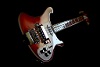
For fireglo , this is done in several passes with a spray gun (NO air brush is used to do this job nor any Burst at any guitar shop/factory).
The first pass around the border/edge is a quick pass just to build the 'look' .
The second pass defines the final Fireglo .
This is where you make or break the classic look .
Because this is hand done ...it is left to the hands of each sprayer .
That is why ,era to era , each time a new painter comes into the plant , a new look appears .
To recreate an older version , one has to see that version in either an instrument , or an excellent photograph.
After all th ecolor is applied , then it is allowed to dry .
After that the guitars leave the booth for a specialized job and one that I have the deepest respect for.
That is the removal of the tape and the 'scraping of the binding.
Great scrapers are awesome to watch .They can clean up this binding in a matter of moments.
I do it very infrequently and because of this , it takes me a long time to do one guitar .They do one in under 5 minutes easily.
Once the binding is scraped , the clear coats can then be applied .
How much clear coating is needed?
Lots ! There are three coats of clear per day .
This goes on till there are no more coats needed and there is a proper look .
At Rickenbacker this process took about ten days of spraying as I recall.
Maple is one of the easiest woods to spray as the pores are next to non existant .
Woods like mahogany and limba are very porous and require more work .
This is a condensed version , but should help anyone to understand the process better .
Inbetween each days worth of clear coating , the last coat is sanded to remove imperfections ....this continues until the final sanding when it is buffed and polished.
At that point it is ready to be assembled .
How is the Fireglo finish applied ?
Moderator: jingle_jangle
How is the Fireglo finish applied ?
So you too want yours "ALAPWOB"?!?!
-
d_funkie
Yes , clear is sprayed on the fretboard at the same time the rest of the guitar gets it's clear coats.
The skunk stripe is the contrasting color on the back of the neck ....similar to the North American mammal ...the Skunk.
See Waner Brothers Pepe LePew for more information.
The masking product used to mask off the binding is made by 3M Tape ...it is called ...............
Masking tape!
The skunk stripe is the contrasting color on the back of the neck ....similar to the North American mammal ...the Skunk.
See Waner Brothers Pepe LePew for more information.
The masking product used to mask off the binding is made by 3M Tape ...it is called ...............
Masking tape!
So you too want yours "ALAPWOB"?!?!
-
krishna
may seem stupid and redundant .. but so was ALL the binding masked off for the color coat .. I have heard of people (and have done it myself and it was a pain) simply sprayin all the binding with color .. then scraping everything clean .. then .. clear coating the body and binding without scraping.
By the way .. there is cool skinny masking tape available at places like Pearl Art and Charette's Drafting and Art supplies ...
krishna jain
By the way .. there is cool skinny masking tape available at places like Pearl Art and Charette's Drafting and Art supplies ...
krishna jain
No , the binding is masked off using 1/4" wide tape then trimmed ...only the edge gets cleaned up .It is amazing to watch some one good do it .
Laura Clark would smoke ciggies and talk and do this for hours ...she could do a 4001 in a couple of minutes ...perfect .
Laura Clark would smoke ciggies and talk and do this for hours ...she could do a 4001 in a couple of minutes ...perfect .
So you too want yours "ALAPWOB"?!?!
Guitars and basses , acoustic or electric , flattop , archtop ....
I work on it all and have my hands in everything .
I am NOT a guy at a bench with a set of screw drivers , and my Dad's plumbing tools .
The idea of a guy at a bench ,just unbolting and installing a direct replacement part is to me NOT a "Luthier" (and that is a word that I do not care for ...it has NO authority)
I work on it all and have my hands in everything .
I am NOT a guy at a bench with a set of screw drivers , and my Dad's plumbing tools .
The idea of a guy at a bench ,just unbolting and installing a direct replacement part is to me NOT a "Luthier" (and that is a word that I do not care for ...it has NO authority)
So you too want yours "ALAPWOB"?!?!
-
squirebass
- Veteran RRF member
- Posts: 1579
- Joined: Fri Oct 13, 2000 11:05 pm