
Q for John Hall or anyone else who knows this;
Depending on how extensive and detailed factory records on Rick guitars are, how much info could the factory provide,based on the serial #?
If, say[arbitrary # picked here] I gave them HJ1573[actually the # from my 1st ever Rick, a mapleglo 360-12], would any info the factory has indicate the fact it was a mapleglo when it was made?Or does the # simply refer to the Model it is?And are files kept as to whether a Rick was ever sent back for mods[hdwe.changes, additions, refinishing, etc.?]
Rick serial#s, etc.
Moderators: rickenbrother, ajish4
-
tony_carey

- Advanced Member
- Posts: 2055
- Joined: Thu Oct 28, 2004 6:00 am
- Contact:
Don, it is my understanding that only the first two digits mean anything (the month & year) & any other numbers are solely to offer a unique no. to a particular instrument. You cannot tell from the serial no. the colour, or even model.
If you go to the serial number decoder on the Ric site, you can type in the first two digits & ANY other four no's & the result will be the same.
If you go to the serial number decoder on the Ric site, you can type in the first two digits & ANY other four no's & the result will be the same.
'Rickenbacker'...what a name! After all these years, it still thrills me.
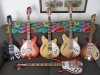
From what I've seen that has been reproduced, docs on both sides (manufacturing and sales) have a fair amount of info on them, meaning sn#, model designation, finish type (color) and sometimes special notations like 'verbal order' or 'left-handed'(i.e. McCartney's bass)....It sounds as though the search may start with a log book and then to the file cabinets for more detailed info. As you say Don, YMMV....
-
dale_fortune
- Intermediate Member
- Posts: 1241
- Joined: Sat Oct 30, 2004 6:00 am
Don The letters indicate the year and month example: A=1961 B=February Then the numbers are the production totals. We made about 25 to 30 Basses a day in the early 70's. Lift the pick guard and you will see various hand written names and numbers. These indicate the color, person who did various steps, and the model. Hope this helps.
So, you mean to say that the number on the S/N is whatever number unit made that year? (Or is it month?) I always thought it was a random picked number, that of course was not used again for that month and year, so no two instruments shared the same number. If the number is the actual production total, is that still how the numbering process done now?
Dale; I already knew that.My Q was more relating to a Rick that was possibly not original finish, and would the factory records show that a particular guitar came with a given color.I used my old guitar and # with that in mind. I sold it 30 years ago, and, assuming it's still out there somewhere, what if it has been refinned, and a current, or next prospective buyer wanted to do "forensics" on it via serial #s and communication with Rick.As we frequently see here on the Forum, some of us seemingly stop at nothing to determine this or that regarding their Ricks.This is the intent of the Q.

When I e-mailed the serial number of my 370/12v64 to RIC a number of years ago, they were able to tell me that it left the factory as a 370/12v64, thereby confirming its originality. Based on that experience, I would say that that model and finish data are available based on the serial number. (If RIC were in Finland, then it would be Finnish data ...)
It is better, of course, to know useless things than to know nothing. - Seneca
-
atomic_punk

- Senior Member
- Posts: 5093
- Joined: Wed Sep 17, 2003 5:00 am
- Contact:

-
dale_fortune
- Intermediate Member
- Posts: 1241
- Joined: Sat Oct 30, 2004 6:00 am

The data for maybe the last 100,000 or so instruments is online. Prior to that, it's all paper, in various sets of logs. With a bit of digging, it's usually possible to come up with all the instrument info if there's some special instrument or circumstance worthy of the time spent.
In the past the numbers beyond the date code were sequential only in relatively short periods of time and could roll over in as short a span as one month. Sometimes they just rolled over at 1000- there was no set procedure other than making sure the number was entirely unique. Now they are entirely random but still guaranteed to keep the serial unique.
In the past the numbers beyond the date code were sequential only in relatively short periods of time and could roll over in as short a span as one month. Sometimes they just rolled over at 1000- there was no set procedure other than making sure the number was entirely unique. Now they are entirely random but still guaranteed to keep the serial unique.
-
incubus2432

- Senior Member
- Posts: 4174
- Joined: Sat Jul 17, 2004 11:26 am