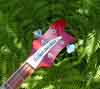
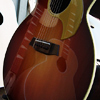
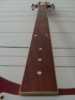
I have had so much success with changing my '97 330 to a 345, that I have decided to do the same to my 1980 330. When I was stripping it, ready to take it to the luthier for routing, I came across a whole row of writing in the control cavity. Can anyone recognise anything?
The caps all have taiwan written on them, so surely they're not original are they?
'Rickenbacker'...what a name! After all these years, it still thrills me.
Well, the routes done. It has a very thick top, so we didn't touch the x bracing. The dark patches are staining from the rubber pads.
Look at the bridge pick up route...factory original. Whoever did it must have just come back from a lunchtime pub session. The neck route isn't much better! Doesn't make any difference though I suppose....
'Rickenbacker'...what a name! After all these years, it still thrills me.
The neck routing on David Coyle's '68 335 was not even routing--it was a series of 1/2" diameter Forstner bit holes, joined. They were not in a straight line, either.
I assume this is because in '68, there was no jig constructed to allow the router to be used, whether a portable or overhead. Looks like there was some sort of jig used on yours' Tony.
Quality has gone way up in the last 20 years, since most of these operations are now done on the Rickenbacher CNC machine.
“I say in speeches that a plausible mission of artists is to make people appreciate being alive at least a little bit. I am then asked if I know of any artists who pulled that off. I reply, 'The Beatles did.”
― Kurt Vonnegut
Steve, the munched-on look is a result of the tight fit of the control cluster into the cavity on these guitars.
The guitars are routed on the line and they aren't joined up with their pickguards, which are assembled and checked on another bench, until the final assembly step, after they've been painted, color-sanded, and buffed out.
Occasionally the pickguards won't drop into place and align properly until additional steps are taken to enlarge the opening in the guitar top slightly. This is done (apparently) on a drill press with a drum sander mounted.
I think tolerances have tightened up since the CNC machine has come into use.
“I say in speeches that a plausible mission of artists is to make people appreciate being alive at least a little bit. I am then asked if I know of any artists who pulled that off. I reply, 'The Beatles did.”
― Kurt Vonnegut
The old 60's Rickenbackers have a whole slew of different features due to the guys at the plant that day. I have a 64 bass that has no truss rod cavities at the end of the neck.
The G string saddle on my 67 is so far notched off to the right that the string sits basically on the edge of the fretboard. The milled gap between the bridge is so sharp and irregular you could easily end up a bloody mess.
There are so many anomalies with the old guitars and basses and that's what makes them so interesting.