
Sanding a 4001
Moderators: rickenbrother, ajish4
-
ken_swearingen
- Advanced Member
- Posts: 2298
- Joined: Wed Mar 31, 2004 6:00 pm
Sanding a 4001
how do i take the clear coat off my 4001 fretboard and all???
-
david_schwab
- Member
- Posts: 392
- Joined: Fri Jul 15, 2005 3:44 am
- Contact:
Personally I wouldn't do that. Most of the wood used on Ricks will stain it left uncoated. This is the same reason maple fingerboards are finished. Rosewood is very oily and never needs to be finished, but Ricks don't have rosewood fingerboards.
I have refinished 4001's, and I used paint remover, but you will melt the binding and the fretboard markers if you are not careful, and actually the binding would need to be removed to go this route.
You can't just sand it, unless you remove all the frets.
I would advise against it myself unless you are accustomed to doing this kind of thing. It's a LOT of work.
I have refinished 4001's, and I used paint remover, but you will melt the binding and the fretboard markers if you are not careful, and actually the binding would need to be removed to go this route.
You can't just sand it, unless you remove all the frets.
I would advise against it myself unless you are accustomed to doing this kind of thing. It's a LOT of work.
-
ken_swearingen
- Advanced Member
- Posts: 2298
- Joined: Wed Mar 31, 2004 6:00 pm

-
jwr2
the new 4004L and 4004CII basses have bubinga ... the 4001 and 4003 basses have had rosewood since the 60's ... and there were a few maple fretboard basses made ... as far as I know Ric has never made a 4003 with bubinga ... Ric does something to the rosewood to make it look different or they get a different variety of rosewood that is lighter ...

-
david_schwab
- Member
- Posts: 392
- Joined: Fri Jul 15, 2005 3:44 am
- Contact:
Jeff, that's not exactly accurate. It's easy to say they used rosewood fingerboards since the 60's, but what kind of rosewood? Most guitars have traditionally used Brazilian Rosewood (Dalbergia nigra) for fingerboards, until it was banned from being exported, and older supplies were hard to get, so most guitar makers now use East Indian Rosewood (Dalbergia Latifolia), which has a more purple color. These are the fingerboard woods found on Fenders and Gibsons.
I've never seen any Ricks with either of these rosewoods.
They don't do anything to make the wood lighter, or look different, they are just using different wood!
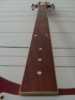
Here's an example.. this is my '73 4001's fretboard:
(the binding is removed and the fretboard was being converted to a lined fretless, and you are seeing it with no finish)

So what kind of wood is this? Is it rosewood? it sure doesn't look like rosewood. This is Tulipwood (Dalbergia variabilis) from Tropical South America, especially Northeast Brazil. As you can see by the scientific name, dalbergia, it is indeed a rosewood. But I wouldn't leave this unfinished as it's not as oily like Brazilian or Indian Rosewood. This would get dirty and stained fast (as parts of it already have sitting unfinished for a few years...) I suppose you could use an oil finish, but that's still a finish.
There are many other rosewoods as well, such as Central American Rosewood (Dalbergia stevensonii) Which is brown to purple with alternating dark and light zones forming a very attractive figure, Honduras Rosewood (Dalbergia tucerencis) which is orange brown with irregular black markings, Kingwood, also known as Violetwood, (Dalbergia cearensis), Cocobolo (Dalbergia retusa), and a popular one for instruments lately, "Bolivian Rosewood" or "Santos Rosewood," which is actually Morado, or Pau Ferro, (Machaerium scleroxylon), and not a true rosewood at all.
This is why Rick fingerboards don't look anything like Rosewood. They are not the Rosewood normally associated with guitar fingerboards.
I've never seen any Ricks with either of these rosewoods.
They don't do anything to make the wood lighter, or look different, they are just using different wood!
Here's an example.. this is my '73 4001's fretboard:
(the binding is removed and the fretboard was being converted to a lined fretless, and you are seeing it with no finish)
So what kind of wood is this? Is it rosewood? it sure doesn't look like rosewood. This is Tulipwood (Dalbergia variabilis) from Tropical South America, especially Northeast Brazil. As you can see by the scientific name, dalbergia, it is indeed a rosewood. But I wouldn't leave this unfinished as it's not as oily like Brazilian or Indian Rosewood. This would get dirty and stained fast (as parts of it already have sitting unfinished for a few years...) I suppose you could use an oil finish, but that's still a finish.
There are many other rosewoods as well, such as Central American Rosewood (Dalbergia stevensonii) Which is brown to purple with alternating dark and light zones forming a very attractive figure, Honduras Rosewood (Dalbergia tucerencis) which is orange brown with irregular black markings, Kingwood, also known as Violetwood, (Dalbergia cearensis), Cocobolo (Dalbergia retusa), and a popular one for instruments lately, "Bolivian Rosewood" or "Santos Rosewood," which is actually Morado, or Pau Ferro, (Machaerium scleroxylon), and not a true rosewood at all.
This is why Rick fingerboards don't look anything like Rosewood. They are not the Rosewood normally associated with guitar fingerboards.
-
ken_swearingen
- Advanced Member
- Posts: 2298
- Joined: Wed Mar 31, 2004 6:00 pm
Quoting john hall on fingerboard wood used in the 70s - today "We're currently using Bubinga and have for quite a few years now. Back then it was Hong Kong Rosewood, which I guess was a misnomer because I've been told it didn't come from Asia at all. The problem is that there's no standards for the trade or common names of wood, and it's not uncommon to have the same name for three or four different woods.
The botanical name is the only meaningful, consistent identification that means anything. Unfortunately, I can never remember those without referring to documentation. I do remember that the Hong Kong Rosewood was Dalbergia family while the Bubinga is Guibourtia".
The botanical name is the only meaningful, consistent identification that means anything. Unfortunately, I can never remember those without referring to documentation. I do remember that the Hong Kong Rosewood was Dalbergia family while the Bubinga is Guibourtia".
I have a 79 in which the neck had to have been refretted before I bought it and was never refinished. It sounds and plays great and I actually like it as much if not more than the finished necks. They look very dark with the finish off usually at least after some years. I have no idea what kind of wood it is although someone once mentioned Australian Kangaroo wood as a likely candidate.
-
jwr2
ok ... bubinga is sometimes refered to as rosewood ...
http://www.colonialtonewoods.com/pages/bubinga.htm
but then if a 4003 fingerboard is bubinga why do they refer to a 4004 fingerboard as bubinga and not rosewood?
http://www.colonialtonewoods.com/pages/bubinga.htm
but then if a 4003 fingerboard is bubinga why do they refer to a 4004 fingerboard as bubinga and not rosewood?
-
ken_swearingen
- Advanced Member
- Posts: 2298
- Joined: Wed Mar 31, 2004 6:00 pm