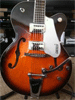
Jeff, Bubinga (Guibourtia tessmannii) is not Rosewood at all, and is from Cameroon and Gabon, West Africa. Most Rosewood is from Central and South America, except for the couple of species from Asia. All Rosewoods are in the Dalbergia family.
Bubinga is very pretty wood.
This is my other '73 4001. I have no idea what kind of wood this is! Probably in the rosewood family. Almost looks like Bubinga. I guess the point is that many of these woods look similar.
Years ago I had the clear stripped off the fingerboard of my '75 when I had it refretted. Now that I'm rethinking that move, I'm wondering if it's possible to have it reapplied (properly/correctly) *without* removing the frets again?
You should put some oil in it or wax it although I doubt you would be able to re-apply a clear coat if you did that, the wood would look a lot darker than that. One of mine is also bare wood but looks really good, I think it's the wax I use.
Christopher, I believe that at the factory, they spray right over the frets before they are leveled. You can see this because there is some lacquer on the fret wire.. everywhere but the crown. Sometimes it turns a little green on the edges. Same thing on maple fingerboards on various instruments.
You should be able to have it re-sprayed, and then just have the finish removed from the tops of the frets.
so Ben ... why does a 4001/4003 fretboard look so light? rosewood is usually dark ... is it a trade sercret? is it a special wood from an exotic place? also finishing the fingerboard changes the sound ... I oil finished all of my p-bass and jazz bass necks and they all have a tighter and more defined sound ... also if you spay over the frets a few days of playing up and down the neck and bending the strings will wear the finish off of the frets ...
Jeff, this is the traditional way we've done it for more than 40 years. There's a number of advantages, including giving the feel of a lower fret and the ease in which pulls can be done. As you say, the finish can wear but I've seen plenty of 20 or 30 year old instruments with no wear whatsoever and in any case, redoing the neck is simple and inexpensive. Besides, if the finish is that worn, the frets are worn too and will be needing attention.
The wood is no secret- it's been in the catalogs and website for years. In the past we used African Rosewood and for at least 12 years, it's been Bubinga.
You can remove the finish but it won't make the bass sound "tighter and more defined"- it's be just slightly warmer and that's not a trademark Rickenbacker sound.
I was trying to say that the finished fingerboard makes for a tighter and more defined sound in the previous post ... maybe I didn't make that clear ... oil finish is sort of half way between no finish and a gloss finish ... so when I oil finished my unfinished necks it changed the tone for the better ...
also last time I looked at your web site it said that the fingerboard on the 4003 was rosewood and not Bubinga ...
"why does a 4001/4003 fretboard look so light? rosewood is usually dark"
I guess you didn't like my answer? Rosewood does not have to be dark... the kind associated with most guitars, such as Fenders. That's a very dark rosewood, usually Brazilian for the older instruments, and Indian for newer ones. That's the rosewood you are thinking of... a dark brown with black steaks, or Indian which is a more purple color.
The name "rosewood" can refer to many different woods, and they are not all dark brown. As I showed you, one of my 4001's has what looks like Tulipwood, which is a true rosewood, but is not dark at all. True Rosewoods are in the Dalbergia family. Wood such as Bubinga, which looks like Rosewood is not. Most likely the other African Rosewoods are also not true Rosewood, just as African Mahogany is not true Mahogany. Incidentally the name "rosewood" refers to the smell of the wood when you cut it.
So the answer is, the 4001/4003 fretboards look lighter than that on a rosewood fingerboard Fender bass, because it is not the same rosewood. There's no right or wrong wood to use either.
Now as far as oil finishes. There are different kinds of oil finishes. Most of them have varnish in them, and are catalyzing oil finishes. They are a bit harder than just oil. The reason you might hear a difference is not so much the hardness of the finish, since unless it's a fretless bass, the strings do not touch the finish, but more because the oil seeps into the wood, thus causing a certain amount of damping. This is why darker oily woods sound "darker" than lighter non oily woods such as maple, which tend to have a brighter/tighter sound. Ebony, on the other hand, is not very oily, but is very hard and heavy.
I had always heard the rosewood was used because ebony was scarce and expensive. I have never heard it was chosen for tone. Of course, I haven't heard EVERYTHING!
as per the rosewood ... it is confusing ... they used rosewood that didn't look like rosewood and now they use bubinga that looks like the old rosewood that didn't look like rosewood but their web site still says they use rosewood even though they use bubinga ...